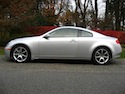
Why a Supercharger or a Twin Turbo is needed in a G-35

A general discussion forum for G35 and G37 owners and a great place to introduce yourself to the NICOclub G-Series Forums!
User avatar
C-Kwik
Moderator
Posts: 8070
Joined: Thu Aug 01, 2002 9:28 pm
Car: 2013 Chevy Volt, 1991 Honda CRX DX

Post

lucidd wrote:I've had friends that turbocharged their cars - and they definitely get more power - but lose top end -... in trade of strong torque.
In theory, if you add boost at any rpm, it will add power at that rpm proportionately to boost. Essentially, if you could add exactly twice the volume of air at all RPM's, the torque curve of the vehicle would double but follow the same basic shape. Turbos usually aren't broad enough in operation to follow it exactly. A smallish turbo will not only spool sooner, but have it's most efficient areas of operation occuring at lower RPM's, while at the upper ranges, it will likely be less efficienct and perhaps unable to flow enough air. So you basically end up with the torque curve rapidly dropping off at the upper end. A larger turbo will spool slower but be able to flow much more efficiently at the top end (perhaps even beyond redline depending on the turbo).

In any case, your friends' experiences are likely due to the choice of turbo. It's not a trait that is inherent to turbos. My turbo 240sx had a T04B and had plenty of steam through redline at 7 psi.


Jacko3
Posts: 2622
Joined: Wed Jan 09, 2008 6:55 am

Post

C-Kwik:

Well said, as you noted, "A smallish turbo will not only spool sooner, but have it's most efficient areas of operation occuring at lower RPM's, while at the upper ranges, it will likely be less efficienct and perhaps unable to flow enough air. So you basically end up with the torque curve rapidly dropping off at the upper end. A larger turbo will spool slower but be able to flow much more efficiently at the top end (perhaps even beyond redline depending on the turbo."

This is theoretically sound. The ratio of the gears that drive the turbo impeller in a small turbo and in a large turbo, makes this so. Every rotating object or a body being acted upon by acceleration due to gravity, will reach a terminal velocity beyond where, no further rotation or velocity could be achieved from that body due to friction with other bodies or acceleration due to gravity. The terminal velocity of the gears that drive the impeller will be reached more quickly in a small turbo than with a large impeller in a large turbo. Thus explaining the phenomenon, you noted above. Well said!


User avatar
phnx19
Posts: 40
Joined: Sat Aug 26, 2006 1:40 pm
Car: 2004 Silver G35 Coupe 5AT w/JWT TT, intercooler,HKS BOV, Stillen Full Exhaust, etc.

Post

People, you guys love to get off topic the original question is why didnt Infiniti or Nissan put more power in their G35 or 350Z? The answer is the Skyline GTR. the only problem is that they didnt sell it in the US, until now. Infiniti/Nissan response to guys wanting more power.

Personally I like to looks and confort of the G compared to the 350Z (not much room inside, and stiffer ride). However If I had an extra $100k laying around I would get the new GTR in a heart beat. I dont so for $10-15K I can add a TT and 100-200 more HP to my car and have everything I wanted. I love my TT and plan on increasing my HP more, just wish I bought the MT instead of an AT. Transmission is starting to slip, but once im done upgrading that, I will be able to handle over 600WHP. ONLY IN AMERICA.

User avatar
Dag35ttman04
Posts: 14
Joined: Mon Feb 18, 2008 7:16 am
Car: 04 Infiniti G35

Post

phnx19 wrote:People, you guys love to get off topic the original question is why didnt Infiniti or Nissan put more power in their G35 or 350Z? The answer is the Skyline GTR. the only problem is that they didnt sell it in the US, until now. Infiniti/Nissan response to guys wanting more power.

Personally I like to looks and confort of the G compared to the 350Z (not much room inside, and stiffer ride). However If I had an extra $100k laying around I would get the new GTR in a heart beat. I dont so for $10-15K I can add a TT and 100-200 more HP to my car and have everything I wanted. I love my TT and plan on increasing my HP more, just wish I bought the MT instead of an AT. Transmission is starting to slip, but once im done upgrading that, I will be able to handle over 600WHP. ONLY IN AMERICA.
I love my built TT G35 to very confortable with the power that I want. And +1 about the GTR

User avatar
Sentientbydesign
Posts: 5993
Joined: Wed Feb 02, 2005 8:21 am
Car: 03 Evo VIII - 330 AWHP
05 Subaru Legacy GT Stg 2 - Sold
05 G35 6MT Coupe - 278 WHP - Sold
04 WW Evo VIII - 302 AWHP - Ex's
96 I30 - Sold
Contact:

Post

I'm questioning why Nissan/Infiniti isn't turboing any of their lesser vehicles.

It's possible that they don't think reliability will be a great as it is now, but it seems like a better option than continously looking to larger displacements.

Also, I think our Gs are powerful enough, they are just heavy as all hell.

I wish I could take the power in my G and the weight of my wife's Celica (just around 2400lbs). Now, the torque would make the celica do perpetual doughnuts, but damn would it be fast.

User avatar
BigWill
Posts: 557
Joined: Sun May 07, 2006 9:21 pm
Car: Gone, but not forgotten-2004 G35 Coupe-5AT-Graphite Now-2008 Black Saphire IS 250

Post

leeG35 wrote:Supercharger Jacko? You need an after-buring turbojet if your life depends on beating everything that happens to be next to you.

http://www.snotr.com/video/568
Excellent video lee... I saw that one when it aired and was blown away. I think it is quite a statement that they had to use a fighter jet to make a comparison with the Veyron!

User avatar
C-Kwik
Moderator
Posts: 8070
Joined: Thu Aug 01, 2002 9:28 pm
Car: 2013 Chevy Volt, 1991 Honda CRX DX

Post

Jacko3 wrote:This is theoretically sound. The ratio of the gears that drive the turbo impeller in a small turbo and in a large turbo, makes this so. Every rotating object or a body being acted upon by acceleration due to gravity, will reach a terminal velocity beyond where, no further rotation or velocity could be achieved from that body due to friction with other bodies or acceleration due to gravity. The terminal velocity of the gears that drive the impeller will be reached more quickly in a small turbo than with a large impeller in a large turbo. Thus explaining the phenomenon, you noted above. Well said!
Gears? What gears? Turbos don't have any gears. The turbine and compressor wheels are connected directly by a shaft.

As for terminal velocity, it doesn't exactly apply here. At least not the way you state it. The effect of gravity does little to a turbo since it is not falling. In fact the net force on it is zero as the bearings in the turbo will provide a normal force exactly opposite gravity's force. In theory, a turbo can certainly reach an internal rotational terminal velocity, if engine exhaust gas were limited and constant. The output certainly is not constant and it's limit is well beyond the needs of any turbo that would operate reasonably on a given motor.

If anything, a max speed would be considered to be when the tips of the blades hit supersonic speeds. At which point, it would explode from the ensuing sonic boom. Of course, I doubt any gasoline powered motor would be running long enough to see that happen.

Jacko3
Posts: 2622
Joined: Wed Jan 09, 2008 6:55 am

Post

By gears, I meant internal moving parts (shafts, bearings, or whatever else is moving inside) of the turbo. All bodies will experience the effect of acceleration due to gravity--whether moving or static, even if the effect is smaller on some bodies than others. And yes, a moving body will have enough force to eliminate the impact of acceleration due to gravity. Thus, making the effects of gravity, negligible.

Yes, when the parts reach their terminal velocity, impellers are likely to send out shock waves, which tend to lead to sonic boom. Well, the term cavitation, is how that process is described in impellers. So long as the turbo is able to compress enough air, cavitation should be rare. But with a dirty air filter, it could potentially occur.

Any thoughts on this?


User avatar
BigWill
Posts: 557
Joined: Sun May 07, 2006 9:21 pm
Car: Gone, but not forgotten-2004 G35 Coupe-5AT-Graphite Now-2008 Black Saphire IS 250

Post

Maybe it's just simple semantics, or linguistic confusion here, but:

"Terminal Velocity1. Physics.a. the velocity at which a falling body moves through a medium, as air, when the force of resistance of the medium is equal in magnitude and opposite in direction to the force of gravity.b. the maximum velocity of a body falling through a viscous fluid."

I don't think that there is much falling going on in a turbo.

Any thoughts?

User avatar
rn79870
Posts: 4807
Joined: Sat Nov 24, 2007 8:54 am
Car: 2008 G35 & 2005 Vette C6 vert.

Post

Yeah Big Will, I think Jacko was referring to friction and inertia, not gravity. It's been a long time since I had physics and all I remember is how cute the blonde I sat next to was. We could have made such cute kids too, but she found love in other places.

User avatar
Sentientbydesign
Posts: 5993
Joined: Wed Feb 02, 2005 8:21 am
Car: 03 Evo VIII - 330 AWHP
05 Subaru Legacy GT Stg 2 - Sold
05 G35 6MT Coupe - 278 WHP - Sold
04 WW Evo VIII - 302 AWHP - Ex's
96 I30 - Sold
Contact:

Post

RN,

I want to meet you. You sound like a teenager in a 30-40 y/o body

The only effect gravity has on the turbo is the indirect effect of friction.

Analyzing the gravitational effects on the turbo is asinine. Especially if the turbo is mounted with the turbine perpendicular to the gravitational force... Let's not go there.

I do have a question though, and it's been bothering me for months now. If you have a small turbo and it reaches maximum boost at say 4k RPMs, what happens when you go above 4k RPMs. How does it handle the increased exhaust velocity and flow?

Does the excess get diverted?

Jacko3
Posts: 2622
Joined: Wed Jan 09, 2008 6:55 am

Post

Bigwill:

Every body falls and thus subject to the effect of gravity. Fall in physics does not imply physical falling all the time. Everybody can overcome the fall effect of gravity by doing more work greater than the force of gravity.

Jacko3
Posts: 2622
Joined: Wed Jan 09, 2008 6:55 am

Post

sentientbydesign:

Yes, analyzing the effects of gravity on a turbo is asinine. . However, it is fun to go through these foreces of nature and the impact they have on the most common of items around us.

No, the turbo or any moving body is subject to the force of gravity and the effect of kinetic friction.


User avatar
C-Kwik
Moderator
Posts: 8070
Joined: Thu Aug 01, 2002 9:28 pm
Car: 2013 Chevy Volt, 1991 Honda CRX DX

Post

Jacko3 wrote:Bigwill:

Every body falls and thus subject to the effect of gravity. Fall in physics does not imply physical falling all the time. Everybody can overcome the fall effect of gravity by doing more work greater than the force of gravity.
Objects fall when there is no normal force to counteract gravity. As I sit here on my chair, the chair provides a normal force that prevents me from falling. The ground provides a normal force that prevents it from falling. Gravity is a constant force as long as you are in it's proximity. But it is largely irrelevant in a turbo. This is seriously basic physics.
Jacko3 wrote:By gears, I meant internal moving parts (shafts, bearings, or whatever else is moving inside) of the turbo. All bodies will experience the effect of acceleration due to gravity--whether moving or static, even if the effect is smaller on some bodies than others. And yes, a moving body will have enough force to eliminate the impact of acceleration due to gravity. Thus, making the effects of gravity, negligible.

Yes, when the parts reach their terminal velocity, impellers are likely to send out shock waves, which tend to lead to sonic boom. Well, the term cavitation, is how that process is described in impellers. So long as the turbo is able to compress enough air, cavitation should be rare. But with a dirty air filter, it could potentially occur.

Any thoughts on this?
Sorry, but I have a hard time believing your intent was to refer to all the internal moving parts as gears. You mentioned ratios. There is no ratio in a compressor/turbine wheel assembly that moves as a single unit.

A moving body does not negate the effects of gravity. You can throw an obect off of a plane moving at mach 3 or drop it off a helicopter from the same height and both will reach the ground at the same time and same vertical speed.

The effects of gravity in a turbo are negligible, not because it is moving, but because it is suspended using oil and bearings to reduce friction to very low levels.

Again, terminal velocity has nothing to do with this. Seriously. Terminal velocity on a falling object occurs because the net force between the force of gravity becomes equal to the force that wind resistance provides. When the net force on any object is zero, it's speed and direction will remain unchanged. Again, it's very basic physics. As an engine's exhaust contains a lot of energy in the form of heat, pressure and sonic energy, even if only half of it is reclaimable , that's essentially half of the engine's horsepower output. There is a lot of energy available there which should be more than enough so that other issues (engine's capabilities being the major one) will be of concern well before the turbo might actually reach a point where the usable exhaust energy can be matched by the aerodynamic resistance in the compressor...

Unless you're pumping water or other liquid through your turbos, cavitation won't exist. Even then, as liquids are largely uncompressible, the turbo would meet a lot of resistance as its designed to try and compress the fluid travelling through it. Thus, it likely wouldn't be able to wouldn't be spinning that fast either.

A dirty air filter would simply be a restriction. The result would be that the inlet would experience lower pressure. This would create a slight increase in the required pressure ratio (turbos aren't measured in PSI, but by how much it increases the pressure of the air) through the compressor to reach the same absolute pressure. The increased pressure ratio required would likely require a bit more exhaust energy to be recovered by diverting less air through the wastegate, resulting in slightly higher backpressure which results in slightly less power.

User avatar
etschell
Posts: 934
Joined: Sat May 26, 2007 3:57 am
Car: 2007 f17

Post

sorry to burst your bubble but an srt-4 neon will spank a g37, let alone a g35. but at least you're not driving a 335i and getting spanked by a neon

User avatar
C-Kwik
Moderator
Posts: 8070
Joined: Thu Aug 01, 2002 9:28 pm
Car: 2013 Chevy Volt, 1991 Honda CRX DX

Post

etschell wrote:sorry to burst your bubble but an srt-4 neon will spank a g37, let alone a g35. but at least you're not driving a 335i and getting spanked by a neon
But with any G or even the 335i, at least you wouldn't be driving a Neon...

User avatar
rn79870
Posts: 4807
Joined: Sat Nov 24, 2007 8:54 am
Car: 2008 G35 & 2005 Vette C6 vert.

Post

etschell wrote:sorry to burst your bubble but an srt-4 neon will spank a g37, let alone a g35. but at least you're not driving a 335i and getting spanked by a neon
Automobile Magazine tested it...quoting from their article...But not before the SRT-4 blitzes the quarter-mile in 14 seconds flat at 102 mph by our measurements.What did they do with the G35 test wise? Correct me if I'm wrong, but I think it was 13.9 at 103. And the front of the G doesn't look like a dog that just had it's bell rung.

Hardly spanking a G35.

User avatar
Beezer
Posts: 156
Joined: Tue Nov 20, 2007 4:23 pm
Car: 2007 G35X

Post

This gravity debate is all my fault as I mentioned it in the other debate concerning -you know what -. I must have had some sort or premonition or something.

If I am right, then if I say - fusion - it just might show up in a future debate

User avatar
C-Kwik
Moderator
Posts: 8070
Joined: Thu Aug 01, 2002 9:28 pm
Car: 2013 Chevy Volt, 1991 Honda CRX DX

Post

Not as long as we don't try to build a time machine out of our G's...

User avatar
rn79870
Posts: 4807
Joined: Sat Nov 24, 2007 8:54 am
Car: 2008 G35 & 2005 Vette C6 vert.

Post

C-Kwik wrote:Not as long as we don't try to build a time machine out of our G's...
Actually, I was thinking about starting a thread about getting more heat out of my heater on 87 octane gas. But the time machine thread sounds like more fun.

User avatar
phnx19
Posts: 40
Joined: Sat Aug 26, 2006 1:40 pm
Car: 2004 Silver G35 Coupe 5AT w/JWT TT, intercooler,HKS BOV, Stillen Full Exhaust, etc.

Post

Sentientbydesign wrote:RN,

I want to meet you. You sound like a teenager in a 30-40 y/o body

The only effect gravity has on the turbo is the indirect effect of friction.

Analyzing the gravitational effects on the turbo is asinine. Especially if the turbo is mounted with the turbine perpendicular to the gravitational force... Let's not go there.

I do have a question though, and it's been bothering me for months now. If you have a small turbo and it reaches maximum boost at say 4k RPMs, what happens when you go above 4k RPMs. How does it handle the increased exhaust velocity and flow?

Does the excess get diverted?
Hi Sentienbydesign,You ask what happens when a turbo goes past max boost. That is where the wastegate come into play. A wastegate is set to a given PSI once it hits this predetermined PSI any excess is diverted out the tailpipe. So basically when a turbo goes past its max boost it looses power, unless the wastegate is turned up. That is where Boost controller come to play. By increasing your boost controller you are increasing the PSI to the wastegate, hence increasing your max boost. Hope that answers your question.

Jacko3
Posts: 2622
Joined: Wed Jan 09, 2008 6:55 am

Post

C-Kwik:

The term "fall" used in physics is not an actual fall. It is conceptual. I know this sounds strange. When a physicist tells you an object is falling, you will rarely see any physical object falling. Both horizantal and vertically placed objects experience fall due to gravity. You need not see movement to experience fall. I can't explain this concept any further. By the way, fall due to gravity is not basic physics. There is a lot more to it than we are discussing.

You said, "A moving body does not negate the effects of gravity: I guess I wasn't clear when I said, "And yes, a moving body will have enough force to eliminate the impact of acceleration due to gravity. Thus, making the effects of gravity, negligible." Well, the fact is that gravity is a weak force. it is weak enough so that humans can produce enough force to overcome its ability to pin us to one spot. So, movement in a horizontal way is actually a counter effect to the horizontal effects of gravity. And. if you can move fast enough horizontally, the effects of gravity declines considerably and not totally. This is partly the reason why light is not subject to the effects of gravity, and thus has a constant speed in a vacuum.

Terminal velocity does not necessarily have anything to do with wind resistance. Any moving object will experience terminal velocity. lets not mix terminal velocity with maximum velocity--these are two entirely diffferent but similar concepts. When Physicists calculate velocity, they tend to calculate the minimum velocity, the terminal velocity, and the maximaum velocity. Each is used in different ways. Sometimes the maximum velocity and terminal velocity can be the same. But this is not always the case.

Speed is distance travelled in a unit time, while velocity is the displacement in a unit time. Both have the same units of measurement---meters/second. Displacement is the difference between two points, which is totally and completely independent of whether the object is moving vertically or horizontally. Again, don't confuse speed with velocity. The time is takes a shaft to spin 360 degres or gears to complete one revolution covers the displacement needed to calculate either terminal velocity or maximum velcocity.

Again, you use the term liquid and water in cavitation. Well cavitation is a function of fluids and not just liquids. Fluids are substances that can exert pressure on a wall of a container and has some flow characteristics--meaning you calculate their flow charateristics using Reynolds number, Prandtl number, etc. Some fluids are compressible and some are incompressible. Thus, all impellers that move fluids through closed channels, will potentially experience cavitation under the right set of circumstance.

A dirty air filter is not just a restriction if the air has to be moved with great velocity through a channel by an impeller. The volume of air in that channel that passes over the impeller that moves it will determine whether cavitation occurs or not. For non impeller based air movement, yes, a dirty air filter is a restriction. Restriction is more a function of free flowing fluids whose movements are impeded.

BTW, I am enjoying this debate very much.


User avatar
leeG35
Posts: 72
Joined: Wed Sep 27, 2006 5:21 am
Car: 2006 G35 Coupe

Post

BigWill wrote:
Excellent video lee... I saw that one when it aired and was blown away. I think it is quite a statement that they had to use a fighter jet to make a comparison with the Veyron!
Not meaning to go too far off topic, but have you seen the Bugatti Veyron at top speed Video?

http://www.dailymotion.com/vid...speed

User avatar
C-Kwik
Moderator
Posts: 8070
Joined: Thu Aug 01, 2002 9:28 pm
Car: 2013 Chevy Volt, 1991 Honda CRX DX

Post

phnx19 wrote:
Hi Sentienbydesign,You ask what happens when a turbo goes past max boost. That is where the wastegate come into play. A wastegate is set to a given PSI once it hits this predetermined PSI any excess is diverted out the tailpipe. So basically when a turbo goes past its max boost it looses power, unless the wastegate is turned up. That is where Boost controller come to play. By increasing your boost controller you are increasing the PSI to the wastegate, hence increasing your max boost. Hope that answers your question.
I just noticed his post too and was about to respond, but saw your post so I'll just tack onto it here.

When a turbo hits its set boost level, the wastegate will keep it at the set boost level. Boost pressure will not drop off unless the usable exhaust energy is not high enough to maintain the set boost pressure (at this point, the wastegate would be shut) or you back off the throttle.

Since a wastegate opens based on a pressure signal via a vacuum hose from some point in the intake between the turbo and engine, it opens as it approaches the desired boost. A boost controller works by either diverting and/or blocking the signal line until the desired boost level is reached. It essentially fools the wastegate into thinking the manifold pressure is lower than it actually is. Once the desired boost level is reached, enough pressure to maintain that boost level will directed to the wastegate signal port.

User avatar
C-Kwik
Moderator
Posts: 8070
Joined: Thu Aug 01, 2002 9:28 pm
Car: 2013 Chevy Volt, 1991 Honda CRX DX

Post

Jacko3 wrote:The term "fall" used in physics is not an actual fall. It is conceptual. I know this sounds strange. When a physicist tells you an object is falling, you will rarely see any physical object falling. Both horizantal and vertically placed objects experience fall due to gravity. You need not see movement to experience fall. I can't explain this concept any further. By the way, fall due to gravity is not basic physics. There is a lot more to it than we are discussing.
So you are saying my can of soda, sitting on my table is falling? It is not. Perhaps you are misusing terms here, but it is remaining motionless on my desk. The force of gravity is acting on it. But it remains motionless, because there is an equal but opposite force acting on it. That is, the normal force from the table.
Jacko3 wrote:You said, "A moving body does not negate the effects of gravity: I guess I wasn't clear when I said, "And yes, a moving body will have enough force to eliminate the impact of acceleration due to gravity. Thus, making the effects of gravity, negligible." Well, the fact is that gravity is a weak force. it is weak enough so that humans can produce enough force to overcome its ability to pin us to one spot. So, movement in a horizontal way is actually a counter effect to the horizontal effects of gravity. And. if you can move fast enough horizontally, the effects of gravity declines considerably and not totally. This is partly the reason why light is not subject to the effects of gravity, and thus has a constant speed in a vacuum.
Are you serious? Think vectors here. If you have a force pushing on an object horzontally within the field of a vertical gravitational force, then guess what, both forces will act on the object. Gravity does not decline unless the gravitational field itself becomes weaker. This can occur in areas where the mass/density is lower. It also gets weaker as you move away from the source. Otherwise, it is a constant force.

Umm? Albert Einstein proved light is affected by gravity. Black Holes are simply small dense stars that have a gravitational force so strong that even light can not escape.

http://imagine.gsfc.nasa.gov/d....html
Jacko3 wrote:Terminal velocity does not necessarily have anything to do with wind resistance. Any moving object will experience terminal velocity. lets not mix terminal velocity with maximum velocity--these are two entirely diffferent but similar concepts. When Physicists calculate velocity, they tend to calculate the minimum velocity, the terminal velocity, and the maximaum velocity. Each is used in different ways. Sometimes the maximum velocity and terminal velocity can be the same. But this is not always the case.
Terminal velocity is absolutely related to wind resistance. Drop a feather and a ball off a building. The ball will fall quickly while the feather will fall slowly. Now if, you remove all the air from the atmosphere, and do the same, both will fall at the exact same rate. This is beacause the feather has much more surface area for it's given mass, which increases the effects of wind resistance on it.

Another example is to jump off a plane. Open your arms and legs so that your body is open to the air you are rushing through. You'll stop accelerating towards the ground until you reach your terminal velocity/ Then close your arm and legs and either aim your feet or head straight towards the ground. You'll actually accelerate some more falling at a faster velocity until you hit the terminal velocity. By doing this, you change the amount of surface area being subjected to the air rushing by. This changes your terminal velocity.
Jacko3 wrote:Speed is distance travelled in a unit time, while velocity is the displacement in a unit time. Both have the same units of measurement---meters/second. Displacement is the difference between two points, which is totally and completely independent of whether the object is moving vertically or horizontally. Again, don't confuse speed with velocity. The time is takes a shaft to spin 360 degres or gears to complete one revolution covers the displacement needed to calculate either terminal velocity or maximum velcocity.
Absolutely. Speed is a scalar and velocity is a vector. Now that were past the technicalities of it, how does this even relate?
Jacko3 wrote:Again, you use the term liquid and water in cavitation. Well cavitation is a function of fluids and not just liquids. Fluids are substances that can exert pressure on a wall of a container and has some flow characteristics--meaning you calculate their flow charateristics using Reynolds number, Prandtl number, etc. Some fluids are compressible and some are incompressible. Thus, all impellers that move fluids through closed channels, will potentially experience cavitation under the right set of circumstance.
Cavitation occurs when the molecules of the liquid vaporize. This occurs as the density of the liquid drops in the low pressure areas that occur when the velocity of the liquid moves past an object. When the density drops to a point below the vapor pressure of the liquid, it turns into a gas until it slows down and the density goes back above the vapor pressure. Then the gas turns back into a liquid. Gas can not experience a physical change like the liquid does in this instance. Therefore cavitation cannot occur.
Jacko3 wrote:A dirty air filter is not just a restriction if the air has to be moved with great velocity through a channel by an impeller. The volume of air in that channel that passes over the impeller that moves it will determine whether cavitation occurs or not. For non impeller based air movement, yes, a dirty air filter is a restriction. Restriction is more a function of free flowing fluids whose movements are impeded.
An air filter, dirty or clean, is a restriction. A turbo that sucks more air through a filter simply creastes a lower pressure area behind the filter. As the pressure differential is higher, the flow will be greater.

I already explained cavitation so I won't go into more detail in the paragraph.

A turbo motor with a more restrictive or dirty filter will become a greter restriction (read: it would require more energy to reach the same intake manifold pressure).


User avatar
Andy_V35Sky_350GT
Posts: 521
Joined: Sat Feb 03, 2007 5:23 pm
Car: 2003 Nissan Skyline 350GT

Post

I find alot of posts like these pretty amusing. Sure, we'd all love 500hp under the hood, but would any of you be able to pay the price?

The G perfectly blends excellent performance, luxury and style at a decent price. Everyone can wish for a GTR - like Infiniti, but I guarentee most here wouldnt be able to buy one.

User avatar
AZhitman
Administrator
Posts: 54542
Joined: Mon Apr 29, 2002 2:04 am
Car: 58 L210, 63 Bluebird RHD, 64 NL320, 65 SPL310, 66 411 RHD, 67 WRL411, 68 510 SR20, 75 280Z RB25, 77 620 SR20, 79 B310, 90 Z32, 91 GTi-R, 92 Silvia Qs, 98 S14, 23 Z.
Location: Surprise, Arizona
Contact:

Post

Jacko3 wrote:the G-35 will continue to be disgraced in performance by little cars like the Mazda Speed 6, Dodge Neons, Subaru Wrx, Mitsibishi eclipses, Mitsubishi Evos, etc.
You're confused. Badly.

2006-2007 MazdaSpeed 60-60 mph : 6.2 sec.0-¼ mile : 14.7 sec @ 96.5 mph(estimated)

2006 G35 Sedan (from Road & Track)"Despite the highest curb weight of the seven (3710 lb.), it turned in the second best quarter mile — 14.4 seconds at 96.5 mph, along with a 0-60-mph time of 5.9 sec. (tied for second with the Mazdaspeed6)."

The Mazdaspeed 6 is unimpressive, it's not "disgracing" anything.

Perhaps Jacko just needs to learn to drive.

Oh, and no more discussion of turbo characteristics from the uninformed - We're not impressed by the blather, some of us here actually build cars and know quite a bit about boost.

Thanks.

Jacko3
Posts: 2622
Joined: Wed Jan 09, 2008 6:55 am

Post

AZhitman:

Speak for yourself. The results you present are magazine results. What if the driver of the Masda 6 speed you present was not as good as the driver of the G-35? Or, vice versa. This is a possibility.

User avatar
Beancooker
Posts: 8456
Joined: Mon Jun 26, 2006 1:45 pm
Car: Current Car: 2024 Tesla Model 3
Past cars: Way too many to list
Location: Cottonwood, AZ.

Post

Jacko3 wrote:AZhitman:

Speak for yourself. The results you present are magazine results. What if the driver of the Masda 6 speed you present was not as good as the driver of the G-35? Or, vice versa. This is a possibility.
Oh, Jacko.... Oh no...

Rhinokill
Posts: 23
Joined: Sun Nov 25, 2007 12:43 pm

Post

Then buy a freaking mazda? Have fun in a uncomfortable, unstylish, unreliable car.


Return to “G35 and G37 General Discussions”