No it won't.iitywygms wrote: If I push on point B with the equal amounts of force. Will the torque be the same in both examples at point A? This is assuming that everything is completely rigid.
A is the wheel bearing.

wheel spacers, offsets, suspension wear
-
thomasjamal

- Posts: 916
- Joined: Mon Jul 17, 2006 7:46 am
- Car: 93 coupe
Re: wheel spacers, offsets, suspension wear

Re: wheel spacers, offsets, suspension wear
Yes, it will. draw a straight line from a to b. They are both equal. The lever arm is the same. I think even PyR0NiAk will agree with this one.thomasjamal wrote:No it won't.iitywygms wrote: If I push on point B with the equal amounts of force. Will the torque be the same in both examples at point A? This is assuming that everything is completely rigid.
A is the wheel bearing.
One more thing. I am talking about wheel bearings. Maybe this is where this whole thing is getting confused.
-
thomasjamal
- Posts: 916
- Joined: Mon Jul 17, 2006 7:46 am
- Car: 93 coupe
Re: wheel spacers, offsets, suspension wear
Search Wikipedia for "lever"iitywygms wrote:Yes, it will. draw a straight line from a to b. They are both equal. The lever arm is the same. I think even PyR0NiAk will agree with this one.thomasjamal wrote: No it won't.
One more thing. I am talking about wheel bearings. Maybe this is where this whole thing is getting confused.
Last edited by thomasjamal on Wed Jun 23, 2010 7:15 pm, edited 1 time in total.
-
PyR0NiAk

- Posts: 3851
- Joined: Sun Mar 01, 2009 4:29 pm
- Car: S13 SR W/ T2 GT3071R .86AR, JWT S4 Cams, 810cc Injectors,Z32 MAF, JWT tuned ECU 87mm 9:1 Compression CP pistons, Manley Rods
- Location: Ohio
- Contact:
Re: wheel spacers, offsets, suspension wear
Banned link from Nico, bud.
Re: wheel spacers, offsets, suspension wear
When you add a spacer the greatest point of stress does not change....it is still the hub/bearings no matter what
-
PyR0NiAk
- Posts: 3851
- Joined: Sun Mar 01, 2009 4:29 pm
- Car: S13 SR W/ T2 GT3071R .86AR, JWT S4 Cams, 810cc Injectors,Z32 MAF, JWT tuned ECU 87mm 9:1 Compression CP pistons, Manley Rods
- Location: Ohio
- Contact:
Re: wheel spacers, offsets, suspension wear
Your quote could be misinterpreted so I added to your sentence..omgshawn wrote:When you add a spacer the greatest point of stress does not change....it is still the hub/bearings no matter what, so the spacer just increases the arm and, in turn, increases the stress
Re: wheel spacers, offsets, suspension wear
I think we finally agree on something. Maybe I was getting my semantics wrong. when you space a wheel out, the stress is increased at the wheel bearing. Agreed?omgshawn wrote:When you add a spacer the greatest point of stress does not change....it is still the hub/bearings no matter what

Re: wheel spacers, offsets, suspension wear
Agree. Now, do you agree that "offset" will also increase or decrease the arm?PyR0NiAk wrote:Your quote could be misinterpreted so I added to your sentence..omgshawn wrote:When you add a spacer the greatest point of stress does not change....it is still the hub/bearings no matter what, so the spacer just increases the arm and, in turn, increases the stress
-
thomasjamal
- Posts: 916
- Joined: Mon Jul 17, 2006 7:46 am
- Car: 93 coupe
Re: wheel spacers, offsets, suspension wear
Now I'm confused because if that's true then it seems like the OP is right.omgshawn wrote:When you add a spacer the greatest point of stress does not change....it is still the hub/bearings no matter what
Re: wheel spacers, offsets, suspension wear
Omg....
The point of stress will not change, the AMOUNT of force applied to that point will change.
The point of stress will not change, the AMOUNT of force applied to that point will change.
Re: wheel spacers, offsets, suspension wear
I agree again. Increasing the offset (lever arm) will increase the force applied to the point. (wheel bearing)omgshawn wrote:Omg....
The point of stress will not change, the AMOUNT of force applied to that point will change.
So we both agree on that.
Can we all agree that the lever arm is determined by the actual wheel offset?

Re: wheel spacers, offsets, suspension wear
Ender_Zero wrote:OP, I think we agree. I too used MSPAINT hehe
Sorry for the crap quality, Photobucket won't let me upload it right and Nico tends to taper it even smaller.
Pyro, to respond to your post in the other thread, I think you are talking about the force applied to the Rim/Spokes and not the force applied to the Hub/Studs.
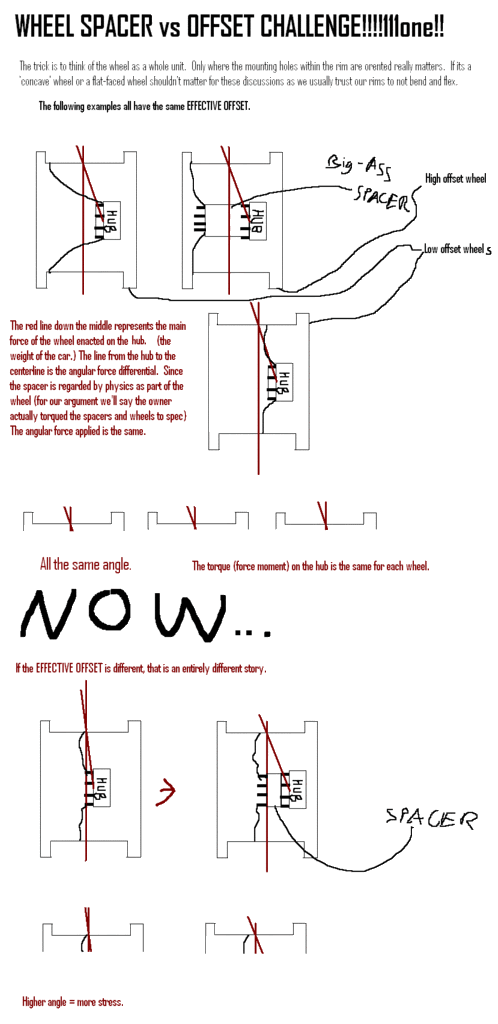
is everyone missing these two important posts?Crazyirish wrote:Whats funny is that you are both generally right. It seems like one of you is saying 1+1=2 and the other one is saying no, 1+2=3.
If you take a 9 inch, 0 offset rim and compare it to a 9 inch, 0 offset rim with a 20mm spacer then the load on the wheel bearings will be great with the spacer setup. (omgshawn is right)
If you take a 9 inch 0 offset rim and compare it to a 9 inch, -20 offset rim then the load on the wheel bearings will be greater with the -20 setup.
If you take a 9 inch 0 offset rim with a 20mm spacer and compare it to a 9 inch, -20 offset rim then the load on the wheel bearings will be the same. (iitywygms is also right...)
also
i believe that in a flat spoke design w/ no dish this would be true. for example the 4lug fno1rc where they lowered the offset simply by increasing the thickness of the wheel hub.omgshawn wrote:That's like saying a 8" wheel with a +40 offset and a 60mm spacer will put the same amount of load on bearings that a 8" wheel and -20 offset.
Re: wheel spacers, offsets, suspension wear

The setup on the left is using a wack wheel spacer. The setup on the right is using a wack offset rim.
the lever arms are equal.
It does not matter how the offset is achieved. If the offset is the same, the force at the wheel bearing is the same.

Re: wheel spacers, offsets, suspension wear
Dude, I have done nothing but agree with your last couple of post. What is it about my last post that is wrong?omgshawn wrote:
The lever arms are equal.
-
duffman1278
- Posts: 6816
- Joined: Sun Apr 01, 2007 3:09 pm
- Car: 89 240sx Hatch, the wildcats!
Re: wheel spacers, offsets, suspension wear
The force must be perpendicular to the distance if you want to take the moment. So use either cos or sin, depending on where you take your angle theta from.
To answer your question, assuming the horizontal distance, and vertical forces are exactly the same, then YES, there is NO difference in moment between the 2 images you have shown.
If you add a spacer and it pushes the wheel out further though, then your moment increases, even if the force is the same. Although even at a 1" spacer, the stress is negligible. If you're concerned about stresses on bearings and hubs, then you'll need to look at the stress concentrations at the hub.
To answer your question, assuming the horizontal distance, and vertical forces are exactly the same, then YES, there is NO difference in moment between the 2 images you have shown.
If you add a spacer and it pushes the wheel out further though, then your moment increases, even if the force is the same. Although even at a 1" spacer, the stress is negligible. If you're concerned about stresses on bearings and hubs, then you'll need to look at the stress concentrations at the hub.
Last edited by duffman1278 on Wed Jun 23, 2010 8:26 pm, edited 1 time in total.
-
thomasjamal
- Posts: 916
- Joined: Mon Jul 17, 2006 7:46 am
- Car: 93 coupe
Re: wheel spacers, offsets, suspension wear
Maybe this whole discussion is just over my head (I do suck at math) but earlier you said:omgshawn wrote:Omg....
The point of stress will not change, the AMOUNT of force applied to that point will change.
But if the point of the stress doesn't change then I don't understand why an offset that creates the same distance from hub to contact with the ground as spacers would doesn't also add more leverage.omgshawn wrote:Adding spacers increases the distance between the hub and wheel mating surface thus adding more leverage, which means there is more force being applied.
-
S14Kouki10

- Posts: 472
- Joined: Thu Feb 25, 2010 6:13 pm
- Car: 1997 240sx
- Location: TX

Re: wheel spacers, offsets, suspension wear
Because you are increasing the distance from the hub, to the face of the wheel..
-
duffman1278
- Posts: 6816
- Joined: Sun Apr 01, 2007 3:09 pm
- Car: 89 240sx Hatch, the wildcats!
Re: wheel spacers, offsets, suspension wear
You're an idiot for trying to make yourself look good and putting others down. It's obviously not common sense for you either.omgshawn wrote:... which means there is more force being applied. I thought this stuff was common sense..
The force does NOT!!!!! increase due to a spacer pushing the wheel out further. Only the MOMENT does.
Re: wheel spacers, offsets, suspension wear
PyroTecK. I agree with what you say.
I am not debating that a higher offset increases bearing load. A higher offset increases bearing loads. Anyone can quote me on that.
I am debating the fact that some people say using a wheel spacer to achieve a certain offset, opposed to using a offset rim, will increase the stress on the wheel bearing. You increase the load on the wheel bearing by increasing the entire wheel offset. Be it with a spacer or offset rim.
I am not debating that a higher offset increases bearing load. A higher offset increases bearing loads. Anyone can quote me on that.
I am debating the fact that some people say using a wheel spacer to achieve a certain offset, opposed to using a offset rim, will increase the stress on the wheel bearing. You increase the load on the wheel bearing by increasing the entire wheel offset. Be it with a spacer or offset rim.
Re: wheel spacers, offsets, suspension wear
but wouldnt increasing the distance from the hub to the center of the wheel with a spacer be the same as increasing the distance with a lower offset?omgshawn wrote:Because you are increasing the distance from the hub, to the face of the wheel..
Re: wheel spacers, offsets, suspension wear
LOL. Way to contradict yourself..idiot
OBVIOUSLY, there are people who agree with me, and people who 'somehow' agree with him
*directed to duffmom*
OBVIOUSLY, there are people who agree with me, and people who 'somehow' agree with him
*directed to duffmom*
Last edited by omgshawn on Wed Jun 23, 2010 8:34 pm, edited 1 time in total.
Re: wheel spacers, offsets, suspension wear
QFTduffman1278 wrote:The force must be perpendicular to the distance if you want to take the moment. So use either cos or sin, depending on where you take your angle theta from.
To answer your question, assuming the horizontal distance, and vertical forces are exactly the same, then YES, there is NO difference in moment between the 2 images you have shown.
If you add a spacer and it pushes the wheel out further though, then your moment increases, even if the force is the same. Although even at a 1" spacer, the stress is negligible. If you're concerned about stresses on bearings and hubs, then you'll need to look at the stress concentrations at the hub.
-
thomasjamal
- Posts: 916
- Joined: Mon Jul 17, 2006 7:46 am
- Car: 93 coupe
Re: wheel spacers, offsets, suspension wear
Ok, I went and read several articles to try to understand this better,omgshawn wrote:Because you are increasing the distance from the hub, to the face of the wheel..

and now I think I agree with you again. For whatever that's worth...

Re: wheel spacers, offsets, suspension wear
yeah... im thinking that, all things being equal, its the distance from the hub (or bearings) to the centerline of the tires contact patch that makes a difference in the stress load, regardless of how that distance is acheived.iitywygms wrote:PyroTecK. I agree with what you say.
I am not debating that a higher offset increases bearing load. A higher offset increases bearing loads. Anyone can quote me on that.
I am debating the fact that some people say using a wheel spacer to achieve a certain offset, opposed to using a offset rim, will increase the stress on the wheel bearing. You increase the load on the wheel bearing by increasing the entire wheel offset. Be it with a spacer or offset rim.
-
duffman1278
- Posts: 6816
- Joined: Sun Apr 01, 2007 3:09 pm
- Car: 89 240sx Hatch, the wildcats!
Re: wheel spacers, offsets, suspension wear
Agree with you how? If you're saying they agree with you about the force increasing as the distance increases then you're all wrong. That is EXTREMELY incorrect and basic engineering.omgshawn wrote:LOL. Way to contradict yourself..idiot
OBVIOUSLY, there are people who agree with me, and people who 'somehow' agree with him
*directed to duffmom*
Re: wheel spacers, offsets, suspension wear
Lord thank you. It is the moment that increases. Not the force.
