First of all, make sure your car is on a level surface.
Make sure you put one or two blocks of wood under each tire. This helps you get underneath to adjust the arms, and allows the tires to twist and actually move when you adjust toe, making your adjustments more accurate. This is something they don't do at alignment racks, but they measure from the rim too so a twisted tire might not affect it as much.
In general, you need to have the string on jackstands 3ft from the front and rear of the car. MAKE SURE the string is passing the center of the hubs for the wheels in the same plane, you know like the string is level with the exact wheel centers.
Use 1 string for each side. Go get your grandma's cotton wound thread for stitching because it'll be very skinny (mine was about .5mm diameter). This will ensure a good reading from your ruler. I'd suggest not using a thick twine or rope lol.
***Do camber first, then toe.***
CAMBER
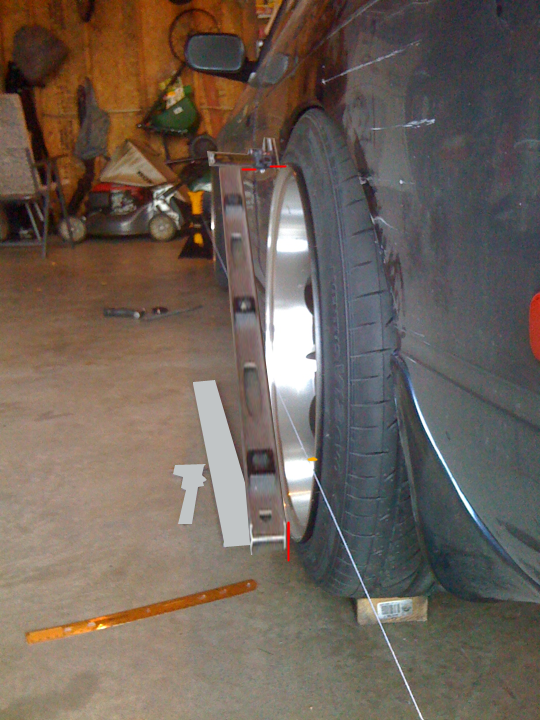
For camber just get a nice straight level, and digital calipers from harbor freight. Have a camber goal in mind (say 2.5 degrees) and set the caliper to this value. For example: If I want 2.5 degrees and I have about an 18" measuring surface from lip to lip, use this formula:
~450mm is 18inches of measuring surface, also known as the adjacent side of the right angle triangle trig for camber. 2.5* is the degree of camber desired.
We know SOHCAHTOA from high school, use the tangent (angle) function to get your opposite side triangle value. aka: tan(camber angle) = opposite(caliper length) / adjacent(length of wheel diameter).
Solving for O we get 19.647mm. My answer is in mm so I set my digital caliper to 19.647 and camber the wheel until the setup is perfectly level.
Imagine the 2 red lines where I moved the calipers is set to 19.65mm and you butt the caliper up to the wheels and level where the red lines are.
The bottom of the level should contact the lower lip. +1 for stretched tires making it SUPER easy to measure alignments!
The orange line I drew is for the orange ruler during toe measurement time which is done separately from camber obviously.
TOE
For the front:
Space the string 10mm away from the center of the hub or center of the wheel, have it level with the center of the rim
For the rear:
Space the string away from the car 12.5mm away from the center of hub/wheel (make sure it's the exact same center you measured from the front wheel).
This staggered spacing accounts for the rear wheelbase being .2inches smaller in the rear.
Now you have two strings completely parallel down your car, adjust toe so they're all the same.
To adjust toe, take measurements from the lip of your rim to the string in the front and rear of the wheel. Adjust the toe until both these measurements are equal distance to get 0 toe.
It helps to have a plastic see through metric ruler when measuring on the string as you can get a better reading by looking through the ruler to see where the string lands.
As far as accuracy goes, given you have about an 18" measuring length for your angle if you have a 17" rim, if you happen to mess up and be off by 1mm (.5mm on each lip to string measurement), you'd only be off by 0.127 degrees.
Tell me that isn't accurate. How laser precise do u wanna be? Do you have a Nascar race budget? :P If you're having to locate the tire with custom rear traction arms make sure they are absolutely the same length before installing, or else this method will not help you. My rear trac arms are oem.
Take your time, it takes awhile to do it well and re measure after making adjustments. Remember, do camber first because it changes toe, and I suggest doing the rear wheels simultaneously, then the fronts or vice versa.
Hope that covers it all!




 . I had to use a dohc ps reservior instead of my modded soch one so i had access to those bolt holes it uses.



 SEE below:


