Not everything from the retro fad lasted. The Thunderbird came and went like the candles on a birthday cake. Swing music made a comeback in 1998 and died by 1999. The PT Cruiser, despite its fading popularity, soldiered on through 2010, becoming the butt of jokes in automotive circles.
So here I am, putting my credibility on the line, coming to the defense of the PT Cruiser, the most-hated wagon in America (based on the “I made it up” survey).
We enthusiasts make fun of the PT for being cheap, dated, and inconsistently built. That’s all true, but we’re more shallow than we admit. We really hate it for looking dorky and appealing to grandmothers and aging boomers with outdated ideas of style.
Let’s start from the bottom and look at what else from 1999-2010 was unquestionably worse than the much-hated PT Cruiser:
–Anything from Daewoo
–The Chevy Aveo, a Chevy-badged Daewoo
–Any Kia from the late 90s or early 2000s
–Chevy Cavalier and Pontiac Sunfire
I admit, its a shorter list than I imagined. Cheaper cars tend to fall into a “blah” category at the bottom, and differentiating among them is like fishing through dog s*** looking for gold nuggets.
America Changes, PT Stays the Same
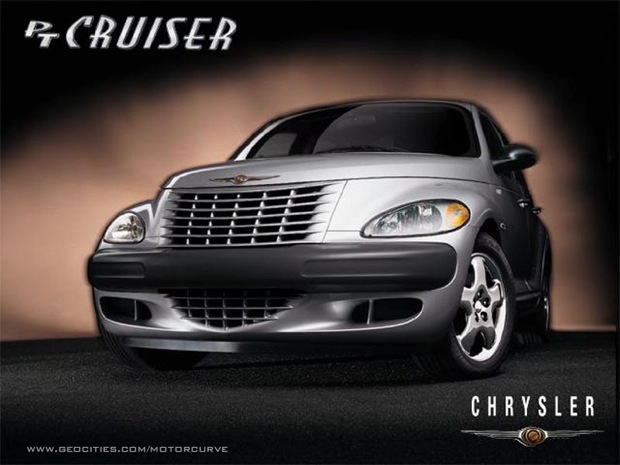
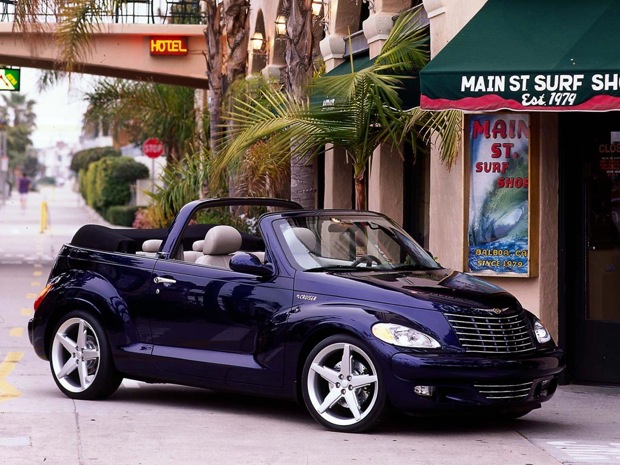
The PT Cruiser’s universal hatred among auto enthusiasts is mostly image-related. The parentally-favored PT was allowed to wither away on the market for over a decade without major improvements, leaving its perch in the spotlight when Car and Driver placed it among 2001’s Ten Best Cars and becoming decidedly uncool. Its social acceptability is polarized by the way it draws attention to itself with bright primary colors, a convertible version with a big structural ‘basket handle’ in the center, and dweeby (but friendly) owners who love flame stickers, stick-on portholes, and dog dish hub caps.
Chrysler offered flame stickers from the factory for those who didn’t want to go through the hassle of driving to Pep Boys. Below is an aftermarket treatment.

Remember that we once loved (or at least appreciated) this car for its sharp looks, design creativity, color-cued interior accents, and real-world utility. Its genuinely usable as a family vehicle, and it inspired an entire category of car-based boxes and wagons like the Honda Element, Chevy HHR, and Scion XB. Yes, all three of its knockoffs are deplorable turds, but that’s beside the point.
As baby boomers fade away, quite literally, my generation appears to have rejected the way the PT is directly associated with our parents, the same way so many of my peers have whined ad nauseam with documentaries about the dreariness of the boomer-created suburbs (the safe and peaceful communities that raised most of today’s spoiled white youth) or the non-free-range-ness of the chicken served at KFC.
Yet, they proudly embrace retro in the form of 30 year-old Volvos (covered in stupid “Coexist” bumper stickers), intentionally fuzzy photography, vinyl records, corded telephones, and vintage clothing. Such a fickle bunch of little monkeys, they are.
http://www.youtube.com/watch?v=3ZEmTIu9W1k
Sometimes, being outwardly unique earns a cult following, like Saab, Subaru, or Freddie Mercury. In other cases, it invites well-earned scorn, like the white-faced goth kids I remembered roaming the halls in high school. [I’m sure half of them are working in cubicles now, driving Toyota Highlanders to and from work.]
The little PT boldly puts itself out there like an amateur dressed up for the Olympics without any actual training. The PT’s tall, arrowhead-shaped hood looks fast standing still and big wheel arches suggest power and V8 strength, but in reality its a quiet, economical, loudly styled Dodge Neon wagon. Like the Plymouth Prowler, which I admit I love, it was style over substance.
How It Drives
The Dodge Neon was a decent little car, highly regarded for its safety, handling, and clean, friendly design. Neons are autocross favorites, and despite the occasional SOHC head gasket failure, they’re mostly dependable cars if you get the manual transmission.
The PT Cruiser drives little like its sporty Neon sibling. It looks like something quick and exciting, but it moves like an average lump of car.
I had the misfortune of renting a particularly bad one in Tampa. I can’t blame Chrysler for the way it smelled (like diapers), but it felt competent enough for commuting. The sound system was decent and there was more than enough room for luggage and passengers with rear seats that folded flat.
It really could have used more power.
[youtube]http://www.youtube.com/watch?v=4Gg6NpQuKFU[/youtube]
Nothing makes me more hateful than flying, and by the time the plane landed in Florida I was starving. The guy at the Enterprise rental counter was a d!ck and there was obvious dirt and grime all over the inside of the car. I didn’t get more than a few miles out of the airport before calling, complaining, and giving it back.
To the PT Cruiser’s credit, the 2007 (2006?) Kia Optima I received as a replacement was miserably bland by comparison, but at least it was clean. The Optima’s stereo sounded like a boombox shoved under piles of blankets and the steering and brakes were completely lifeless. Proof again that there are cars in this world worse than the PT Cruiser we all love to hate.
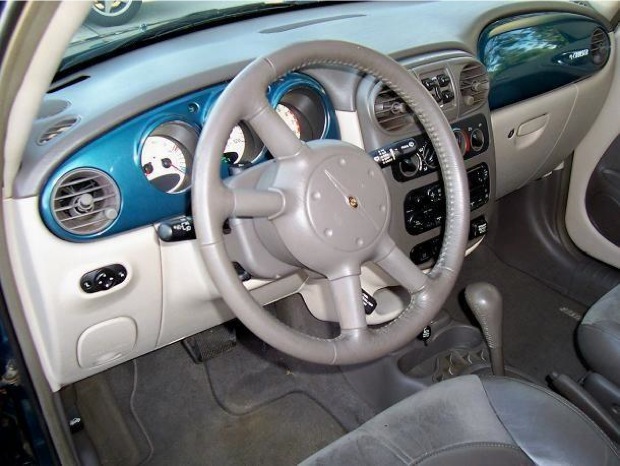
It would also be incorrect to call the PT Cruiser crude. It may be a bit cheap, but nothing seemed outstandingly bad for its class, and the cheerful body-matched interior panels, spherical paint shift knob, and white face gauges gave it some life. It beats the usual swaths of grey and black plastic you see in every other econobox.
On the highway, it was quiet and soft with light and easy steering. The automatic transmission did its job, but the 150-hp 2.4L engine was noisy and seriously showing its age, somewhat insufficient for moving 3100lbs of wagon. In this day and age, a car with the PT Cruiser’s specifications might see 30mpg, but the combination of a wheezy four-banger and 4-speed auto produce no more than 24mpg on the highway.
I can’t recall if the seating was any good — the odor from Enterprise’s lack of care made me want to get out as soon as I could. The seating position itself was tall and comfortable with good visibility, much like sitting in a 5-door Saab 900/9-3.
I suspect the turbo version might have been a hoot, with 230 horsepower and a stiffer suspension in the GT.
[youtube]http://www.youtube.com/watch?v=vx-ETgZQDz0[/youtube]
Conclusion
Don’t get the wrong idea — I’m not in love with it at all, and its highly unlikely I would buy one for myself, but this now-discontinued little car is hated for the wrong reasons by my fellow car snobs, so I was compelled to come to its defense.
The PT Cruiser was originally intended to be a Plymouth (PT means Plymouth Truck) in a full lineup of retro-styled cars, and came out of Chrysler’s 1990s design renaissance, the era that gave us the Viper, Ram, 300M, Grand Cherokee, and several stunning concept cars. In the end, more than a million PT Cruisers were sold, though a large number of them went to guys named Hertz, Avis, and Enterprise.
If the jackasses at Daimler-Benz hadn’t taken over and squeezed the life and soul out of the company, the PT could have evolved into an impressive little utility vehicle, just in time for $4 per gallon gasoline.
But that seems to be the story at Chrysler over the past decade: what could have been versus what really happened.
[youtube]http://www.youtube.com/watch?v=s9Sm5_dqbGM[/youtube]
http://jesda.com/2011/03/09/revisiting-the-pt-cruiser/




 he didnt bc we would of been the butt end of all jokes in my nabourhood
  .... Number one name for that car in my town PT-LOSER.