
To be honest, I tried this years ago to see what would happen but my memory faded. This happens with age. Telcoman's numbers were so convincing with regard to the savings between regular gas and premium, I thought I'd try one more time.
Until last week, I had used premium exclusively. First tank of regular, there was a marked increase in the clattering coming from the motor. The second full tank of regular, the clattering increased. No matter how light on the gas pedal, no mater the gear, from a stand still to a rolling acceleration, there is the horrible and consistent pinging and clattering. So the two questions that come to mind are:
Will the ECU eventually adjust to the low-cal piss-water regular fuel?
Will the constant clattering and pinging damage the motor (and my mental health)?
Warp

The Telcoman Low Cal. Gas Experiment
-
audtatious

- Moderator
- Posts: 25014
- Joined: Sun Oct 27, 2002 5:31 pm
- Car: 2017 Q60 Red Sport. Gone: 2014 Q50s, 2008 G37s coupe, 2007 G35s Sedan, 2002 Maxima SE, 2000 Villager Estate (Quest), 1998 Quest, 1996 Sentra GXE
- Location: Stalking You
- Contact:
Re: The Telcoman Low Cal. Gas Experiment
It does take a while for the ECU to really learn curves. I'd think after multiple tanks it would be enough but who knows.
Reset the ECU and start fresh.
Reset the ECU and start fresh.
-
telcoman

- Posts: 5762
- Joined: Sat Jul 08, 2006 11:30 am
- Car: Tesla 2022 Model Y, 2016 Q70 Bye 2012 G37S 6 MT w Nav 94444 mi bye 2006 Infiniti G35 Sedan 6 MT @171796 mi.
- Location: Central NJ
Re: The Telcoman Low Cal. Gas Experiment
I agree!
You need to give it more time
This was taken a few days after delivery
Photo taken while on cruise control at 62 MPH in a 55 MPH zone on the Garden State Parkway

It has been over 26.2 on the display but I didn't have the camera handy.
On my three fill ups thus far fill up # 1 at 402 miles, traveled 278 miles and it took 12.572 gallons for an initial 22.11 MPG
Fill up #2 at 733 miles I traveled 330 miles & it took 13.476 gallons giving me 24.49.MPG.
3rd fill up at 1085 miles traveled 352 miles and it took 13.893 gallons giving me 25.39 MPG all on WAWA regular 87 octane. I have experienced no pinging whatsoever.
This vehicle has much improved MPG over my 06 G35
I used regular initially with my 06 G35 and am doing the same with my new G37S
updated photo

Some photos of Telcomans performance test hill using regular 87 octane
Bottom of Hill


Partially up the hill
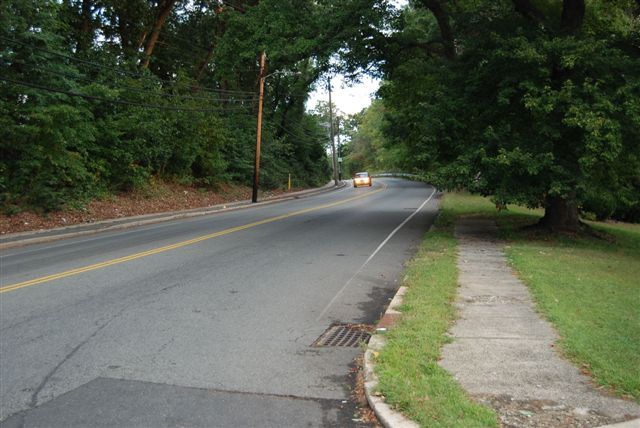


Looking down the hill

The elevation rises from 52ft above sea level at the bottom of the hill to 175 ft above sea level at the top a distance of over 1/2 mile. There is a very old cemetery still in use at the top of the hill.
The vehicle was under load starting at zero, accelerating and shifting from first to 5th reaching 55 MPH in a 35 MPH zone.
There was no pinging what so ever.
I judged the test results as a rousing success
I know what the owners manual says and I know what is printed on the gas filler flap.
In my opinion it is BS
The ECU adjusts accordingly
Telcoman
You need to give it more time
This was taken a few days after delivery
Photo taken while on cruise control at 62 MPH in a 55 MPH zone on the Garden State Parkway
It has been over 26.2 on the display but I didn't have the camera handy.
On my three fill ups thus far fill up # 1 at 402 miles, traveled 278 miles and it took 12.572 gallons for an initial 22.11 MPG
Fill up #2 at 733 miles I traveled 330 miles & it took 13.476 gallons giving me 24.49.MPG.
3rd fill up at 1085 miles traveled 352 miles and it took 13.893 gallons giving me 25.39 MPG all on WAWA regular 87 octane. I have experienced no pinging whatsoever.
This vehicle has much improved MPG over my 06 G35
I used regular initially with my 06 G35 and am doing the same with my new G37S
updated photo
Some photos of Telcomans performance test hill using regular 87 octane
Bottom of Hill
Partially up the hill
Looking down the hill
The elevation rises from 52ft above sea level at the bottom of the hill to 175 ft above sea level at the top a distance of over 1/2 mile. There is a very old cemetery still in use at the top of the hill.
The vehicle was under load starting at zero, accelerating and shifting from first to 5th reaching 55 MPH in a 35 MPH zone.
There was no pinging what so ever.
I judged the test results as a rousing success
I know what the owners manual says and I know what is printed on the gas filler flap.
In my opinion it is BS
The ECU adjusts accordingly
Telcoman
Last edited by telcoman on Sat Sep 29, 2012 5:21 am, edited 3 times in total.
-
SVTCOBRA

- Posts: 6046
- Joined: Wed Sep 03, 2003 2:26 am
- Car: 2018 Q60 AWD 2023 F150 4x4 5.0 FX4
- Location: LKN NC
Re: The Telcoman Low Cal. Gas Experiment
Telcoman, any spark knocking???? Try putting it under a little load. I know you normally don't, but put your foot into it just a weeeee bit.
-
audtatious
- Moderator
- Posts: 25014
- Joined: Sun Oct 27, 2002 5:31 pm
- Car: 2017 Q60 Red Sport. Gone: 2014 Q50s, 2008 G37s coupe, 2007 G35s Sedan, 2002 Maxima SE, 2000 Villager Estate (Quest), 1998 Quest, 1996 Sentra GXE
- Location: Stalking You
- Contact:
Re: The Telcoman Low Cal. Gas Experiment
Driving up a steep hill in a high gear will tell you if you are knocking 
-
telcoman
- Posts: 5762
- Joined: Sat Jul 08, 2006 11:30 am
- Car: Tesla 2022 Model Y, 2016 Q70 Bye 2012 G37S 6 MT w Nav 94444 mi bye 2006 Infiniti G35 Sedan 6 MT @171796 mi.
- Location: Central NJ
Re: The Telcoman Low Cal. Gas Experiment
Matt:
There is a hill nearby that I drive up frequently. When I get a chance I will stop at the bottom and get a GPS Map reading which will give me the elevation at the bottom as well as at the top. I never have heard any pinging and the service guys at the dealer confirmed that the ECU takes care of the use of regular 87 octane.
In March 2011 I had a brand new G37X 7 speed automatic loaner for two weeks while the wiring harness in my 06 G35 was replaced at the dealer.
The vehicle was given to me with a full tank of regular and I put about 1000 miles on it using regular with no pinging. I had a conversation with a few people at the dealer on this subject and they all told me the mandatory use of premium was BS confirming my thoughts.
For those that commute and don't compete I see no reason to waste the money.
Telcoman
There is a hill nearby that I drive up frequently. When I get a chance I will stop at the bottom and get a GPS Map reading which will give me the elevation at the bottom as well as at the top. I never have heard any pinging and the service guys at the dealer confirmed that the ECU takes care of the use of regular 87 octane.
In March 2011 I had a brand new G37X 7 speed automatic loaner for two weeks while the wiring harness in my 06 G35 was replaced at the dealer.
The vehicle was given to me with a full tank of regular and I put about 1000 miles on it using regular with no pinging. I had a conversation with a few people at the dealer on this subject and they all told me the mandatory use of premium was BS confirming my thoughts.
For those that commute and don't compete I see no reason to waste the money.
Telcoman
-
telcoman
- Posts: 5762
- Joined: Sat Jul 08, 2006 11:30 am
- Car: Tesla 2022 Model Y, 2016 Q70 Bye 2012 G37S 6 MT w Nav 94444 mi bye 2006 Infiniti G35 Sedan 6 MT @171796 mi.
- Location: Central NJ
Re: The Telcoman Low Cal. Gas Experiment
Update 7:10 AM
The elevation at the bottom of the hill is 52ft and 175 ft at the top.
The rise is roughly 1/2 mile long.
Accelerating from zero to 55 mph in a 35 MPH zone shifting from first to 5th produced no spark knock.
Telcoman
The elevation at the bottom of the hill is 52ft and 175 ft at the top.
The rise is roughly 1/2 mile long.
Accelerating from zero to 55 mph in a 35 MPH zone shifting from first to 5th produced no spark knock.
Telcoman
-
audtatious
- Moderator
- Posts: 25014
- Joined: Sun Oct 27, 2002 5:31 pm
- Car: 2017 Q60 Red Sport. Gone: 2014 Q50s, 2008 G37s coupe, 2007 G35s Sedan, 2002 Maxima SE, 2000 Villager Estate (Quest), 1998 Quest, 1996 Sentra GXE
- Location: Stalking You
- Contact:
Re: The Telcoman Low Cal. Gas Experiment
At the bottom of the hill start in 3rd gear. The motor won't be happy about it but it should not knock. My assumption here is that in a higher than optimal gear any strain would be found. It's like me, in my automatic, going up a hill and only using enough gas to keep the car in forward motion but not enough where it downshifts. Car will slow up and you can hear feel the torque pulling you up the hill. In cheaper cars that's where I would hear knocking.
Not sure if that test is really telling or not but looking back that's one way I could get engines in the past to knock. Maybe the ECU is just that good but it only has so much timing it can adjust.
Not sure if that test is really telling or not but looking back that's one way I could get engines in the past to knock. Maybe the ECU is just that good but it only has so much timing it can adjust.
-
telcoman
- Posts: 5762
- Joined: Sat Jul 08, 2006 11:30 am
- Car: Tesla 2022 Model Y, 2016 Q70 Bye 2012 G37S 6 MT w Nav 94444 mi bye 2006 Infiniti G35 Sedan 6 MT @171796 mi.
- Location: Central NJ
Re: The Telcoman Low Cal. Gas Experiment
Warpkor
What I think you should do is what I did when I first took delivery of my 06 G35 Sedan on 12/31/05.
Believing incorrectly that the vehicle came delivered with a full tank of premium gasoline I filled the tank after a little over 100 miles with the gas gauge on the 3/4 full mark.
I filled the tank again when the gauge reached the 1/2 full mark and refilled again when the gauge reached the 1/4 mark.
I never noticed any difference in performance and realized later when employees at the dealer told me the owner was too cheap to provide new car customers with a full tank of premium. (I wonder who I take after)?
The only time I ever used premium was for one month of 93 octane and one month of 91 octane in April 2009 with about 85k miles on my G35. There was no noticeable improvement in either performance or MPG so I've been using regular ever since.
Telcoman
What I think you should do is what I did when I first took delivery of my 06 G35 Sedan on 12/31/05.
Believing incorrectly that the vehicle came delivered with a full tank of premium gasoline I filled the tank after a little over 100 miles with the gas gauge on the 3/4 full mark.
I filled the tank again when the gauge reached the 1/2 full mark and refilled again when the gauge reached the 1/4 mark.
I never noticed any difference in performance and realized later when employees at the dealer told me the owner was too cheap to provide new car customers with a full tank of premium. (I wonder who I take after)?
The only time I ever used premium was for one month of 93 octane and one month of 91 octane in April 2009 with about 85k miles on my G35. There was no noticeable improvement in either performance or MPG so I've been using regular ever since.
Telcoman
-
SVTCOBRA
- Posts: 6046
- Joined: Wed Sep 03, 2003 2:26 am
- Car: 2018 Q60 AWD 2023 F150 4x4 5.0 FX4
- Location: LKN NC
Re: The Telcoman Low Cal. Gas Experiment
Google 'running regular gas in a premium engine'
there are some good reads that pop up. read the Car & Driver one..it's old, but good. Edmunds is worth reading too.
Basically, if you hear PINGING then go up in octane...if you hear PINGING with premium you need to look at a tuneup. Also, you will loose some performance going down in octane....probably not enough that you will be able to tell.
Also, remember that the 06 G35 Sedan that Telcoman had was designed for REGULAR and prem was just recommended per the owner's manual.
I drove our 05 G35 Sedan up and down the mountains of NC with regular and never heard any pinging.....and trust me, my ears are sensitive to that awful noise!!! THis was back when we couldn't find prem.
there are some good reads that pop up. read the Car & Driver one..it's old, but good. Edmunds is worth reading too.
Basically, if you hear PINGING then go up in octane...if you hear PINGING with premium you need to look at a tuneup. Also, you will loose some performance going down in octane....probably not enough that you will be able to tell.
Also, remember that the 06 G35 Sedan that Telcoman had was designed for REGULAR and prem was just recommended per the owner's manual.
I drove our 05 G35 Sedan up and down the mountains of NC with regular and never heard any pinging.....and trust me, my ears are sensitive to that awful noise!!! THis was back when we couldn't find prem.
-
telcoman
- Posts: 5762
- Joined: Sat Jul 08, 2006 11:30 am
- Car: Tesla 2022 Model Y, 2016 Q70 Bye 2012 G37S 6 MT w Nav 94444 mi bye 2006 Infiniti G35 Sedan 6 MT @171796 mi.
- Location: Central NJ
Re: The Telcoman Low Cal. Gas Experiment
I did!SVTCOBRA wrote:Google 'running regular gas in a premium engine'
there are some good reads that pop up. read the Car & Driver one..it's old, but good. Edmunds is worth reading too.
Basically, if you hear PINGING then go up in octane...if you hear PINGING with premium you need to look at a tuneup. Also, you will loose some performance going down in octane....probably not enough that you will be able to tell.
Also, remember that the 06 G35 Sedan that Telcoman had was designed for REGULAR and prem was just recommended per the owner's manual.
I drove our 05 G35 Sedan up and down the mountains of NC with regular and never heard any pinging.....and trust me, my ears are sensitive to that awful noise!!! THis was back when we couldn't find prem.
http://www.usatoday.com/money/autos/200 ... mgas_x.htm
Cliff Notes
“The main advantage of premium-grade gas is that it allows automakers to advertise a few more horsepower by designing and tuning engines to take advantage of premium's anti-knock properties. But auto engineers generally agree that if you use regular in a premium engine, the power loss is so slight, most drivers can't tell.”
“Burning regular when the owner's manual specifies premium won't void the warranty, nor damage the engine, even the most finicky automakers say. "You're giving up perhaps just a little bit of performance that a customer wouldn't really even notice, it's so slight," says Furey.”
http://www.cartalk.com/content/premium-vs-regular-0
http://www.edmunds.com/fuel-economy/to- ... emium.html
http://lenpenzo.com/blog/id1078-its-tru ... drugs.html
Cliff Notes
“So just for grins I recently completed my own month-long experiment using only premium gasoline in my 1997 Honda Civic. I already had plenty of gas mileage data using regular gas from a previous analysis I did of my new work commute. For the record, I was averaging 40 miles per gallon using regular gasoline over a roughly two month period.”
“The results? Well, over the past month I averaged one mpg less (39 mpg) using the premium gasoline and paid an additional $6.44 over that period for the privilege. Talk about feeling like a chump.”
I basically experienced the same result in my test a few years ago but I didn’t feel like a chump because I had been using regular all along
http://www.caranddriver.com/features/regular-or-premium
Cliff Notes
“We should note that even cars designed to run on regular fuel might require higher octane as they age. Carbon buildup inside the cylinder can create hot spots that can initiate knock. So can malfunctioning exhaust-gas-recirculation systems that raise cylinder temperatures. Hot temperatures and exceptionally low humidity can increase an engine's octane requirements as well. High altitude reduces the demand for octane”
“Our tests confirm that for most cars there is no compelling reason to buy more expensive fuel than the factory recommends, as any performance gain realized will surely be far less than the percentage hike in price. Cheapskates burning regular in cars designed to run on premium fuel can expect to trim performance by about the same percent they save at the pump. If the car is sufficiently new and sophisticated, it may not suffer any ill effects, but all such skinflints should be ready to switch back to premium at the first sign of knock or other drivability woes. And finally, if a car calibrated for regular fuel begins to knock on anything less than premium or midgrade, owners should invest in a tuneup, emissions-control-system repair, or detergent additives to solve, rather than bandage, the root problem. Class dismissed.”
Telcoman
-
SVTCOBRA
- Posts: 6046
- Joined: Wed Sep 03, 2003 2:26 am
- Car: 2018 Q60 AWD 2023 F150 4x4 5.0 FX4
- Location: LKN NC
Re: The Telcoman Low Cal. Gas Experiment
was for Warpkor. I knew that you had been doing your research!!!SVTCOBRA wrote:Google 'running regular gas in a premium engine'

Re: The Telcoman Low Cal. Gas Experiment
If you put premium in a car that isn't designed for it, your MPG can go down. I had a Honda Interceptor bike that hated premium! It had a difference of 3-5 MPG between the two.
However, on a vehicle that requires it, premium will give you better performance and usually better MPG. Now, if all you drive is highway, then regular should be fine if you don't race the engine.
However, on a vehicle that requires it, premium will give you better performance and usually better MPG. Now, if all you drive is highway, then regular should be fine if you don't race the engine.
Re: The Telcoman Low Cal. Gas Experiment
Thanks for all the input folks. While I enjoy the nature of the G, I don't drive it in a spirited way much any more. You guys may recall that about four years ago I got popped doing 124mph on a rural CA highway. The big bucks that flowed from my wallet served to burn the proper negative reinforcement in my brain. I haven't had a traffic violation of any kind since.
I was experimenting with regular gas for the savings as I don't worry too much about performance these days. I just wanted to make sure that I don't cause engine damage during the adjustment phase of the ECU. Geez, I was cruising the freeway at about 70mph and a gusty head wind made her ping. Frustrating to say the least.
Thanks again,
Warp
I was experimenting with regular gas for the savings as I don't worry too much about performance these days. I just wanted to make sure that I don't cause engine damage during the adjustment phase of the ECU. Geez, I was cruising the freeway at about 70mph and a gusty head wind made her ping. Frustrating to say the least.
Thanks again,
Warp
-
SteveTheTech

- Posts: 3751
- Joined: Sat Aug 16, 2008 3:20 pm
- Car: 15 Nissan Sentra SR
12 Infiniti G37x Coupe
-Formerly-
05 Mazda 6 L3 Sport
95 Infiniti J30
94 Nissan D22 - Location: Chantilly, Va
Re: The Telcoman Low Cal. Gas Experiment
From what I've seen the newer (07+ sedan and 08 coupe) engines take cheap gas better, their adaptive fuel mapping is a little better than the first generation engines. The older ones here prone to making noise with lower grade fuel.
Changing the temperature on the plugs might help a bit.
Changing the temperature on the plugs might help a bit.
-
telcoman
- Posts: 5762
- Joined: Sat Jul 08, 2006 11:30 am
- Car: Tesla 2022 Model Y, 2016 Q70 Bye 2012 G37S 6 MT w Nav 94444 mi bye 2006 Infiniti G35 Sedan 6 MT @171796 mi.
- Location: Central NJ
Re: The Telcoman Low Cal. Gas Experiment
SteveTheTech wrote:...... engines take cheap gas better, their adaptive fuel mapping is a little better than the first generation engines.
Regular 87 octane gasoline is cheaper. It is not inferior gasoline which the tern "cheap gas" infers.
I'm over 2200 miles and my 2012 G37S runs just fine on 87 octane just as I expected. I use mostly WaWa as the station is new with new tanks and is close to my house.
My MPG is improved over what I experienced with my previous 06 G35.
Just had my first oil change at 2200 miles
Telcoman
Re: The Telcoman Low Cal. Gas Experiment
I may change the plugs out with a step down in temperature.
In the mean time, I'm pretty much resigned to running the higher octane until I swap the plugs out. The pinging and clattering is just awful. I can't touch the accelerator, driving as timidly as possible without being honked at to avoid the consistent clattering. Starting out in first gear like a grandma...clattering, shift in to 2nd and lightly touch the accelerator...clattering, repeat through the gears clattering and pinging until the acceleration levels out. Touch the accelerator to increase speed a mile or two and....you guested it....pinging and clattering.
I'm convinced that the shear volume of pinging and clattering will damage the motor. It was my understanding that pinging/clattering is analogous to slamming a hammer on the piston during the up stroke. It can't be a good thing.
In the mean time, I'm pretty much resigned to running the higher octane until I swap the plugs out. The pinging and clattering is just awful. I can't touch the accelerator, driving as timidly as possible without being honked at to avoid the consistent clattering. Starting out in first gear like a grandma...clattering, shift in to 2nd and lightly touch the accelerator...clattering, repeat through the gears clattering and pinging until the acceleration levels out. Touch the accelerator to increase speed a mile or two and....you guested it....pinging and clattering.
I'm convinced that the shear volume of pinging and clattering will damage the motor. It was my understanding that pinging/clattering is analogous to slamming a hammer on the piston during the up stroke. It can't be a good thing.
-
telcoman
- Posts: 5762
- Joined: Sat Jul 08, 2006 11:30 am
- Car: Tesla 2022 Model Y, 2016 Q70 Bye 2012 G37S 6 MT w Nav 94444 mi bye 2006 Infiniti G35 Sedan 6 MT @171796 mi.
- Location: Central NJ
Re: The Telcoman Low Cal. Gas Experiment
I'm not sure why you are having such a problem?Warpkor wrote:I may change the plugs out with a step down in temperature.
In the mean time, I'm pretty much resigned to running the higher octane until I swap the plugs out. The pinging and clattering is just awful. I can't touch the accelerator, driving as timidly as possible without being honked at to avoid the consistent clattering. Starting out in first gear like a grandma...clattering, shift in to 2nd and lightly touch the accelerator...clattering, repeat through the gears clattering and pinging until the acceleration levels out. Touch the accelerator to increase speed a mile or two and....you guested it....pinging and clattering.
I'm convinced that the shear volume of pinging and clattering will damage the motor. It was my understanding that pinging/clattering is analogous to slamming a hammer on the piston during the up stroke. It can't be a good thing.
I've driven nember of new loaners over the years and although they were automatics they all used regular 87 octane and I never had any pinging issues
Photo taken after a 50 mile drive to work after filling up with regular
Update 11/2012
This photo was taken this morning
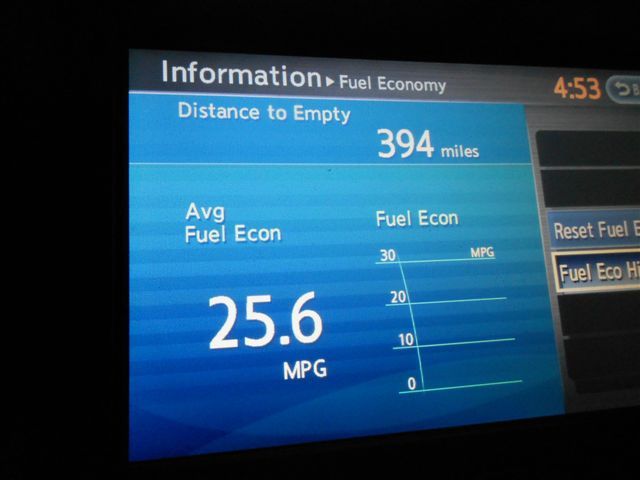
Same trip, same fill up at WaWa and the same 50 miles drive to work on cruise control at 65 MPH
The difference is the temperature. This morning 37 degrees. The one above the temperature was in the seventies
Temperature as does humidity does make a difference in MPG
Try filling up with regular when you your tank is at the 3/4 full mark. Repeat again at the 1/2 and 1/4 mark.
That is what I did when I first took delivery of my 06 G35 believing that it came delivered with a full tank of premium. I later found out it came with a full tank of regular which is why I never noticed any difference.
Telcoman
Last edited by telcoman on Tue Nov 20, 2012 1:42 pm, edited 1 time in total.
-
SVTCOBRA
- Posts: 6046
- Joined: Wed Sep 03, 2003 2:26 am
- Car: 2018 Q60 AWD 2023 F150 4x4 5.0 FX4
- Location: LKN NC
Re: The Telcoman Low Cal. Gas Experiment
If it's pinging that much, I can not believe that you will ever be able to run anything other than Prem.....Does it ping with premium too????Warpkor wrote:I may change the plugs out with a step down in temperature.
In the mean time, I'm pretty much resigned to running the higher octane until I swap the plugs out. The pinging and clattering is just awful. I can't touch the accelerator, driving as timidly as possible without being honked at to avoid the consistent clattering. Starting out in first gear like a grandma...clattering, shift in to 2nd and lightly touch the accelerator...clattering, repeat through the gears clattering and pinging until the acceleration levels out. Touch the accelerator to increase speed a mile or two and....you guested it....pinging and clattering.
I'm convinced that the shear volume of pinging and clattering will damage the motor. It was my understanding that pinging/clattering is analogous to slamming a hammer on the piston during the up stroke. It can't be a good thing.
-
audtatious
- Moderator
- Posts: 25014
- Joined: Sun Oct 27, 2002 5:31 pm
- Car: 2017 Q60 Red Sport. Gone: 2014 Q50s, 2008 G37s coupe, 2007 G35s Sedan, 2002 Maxima SE, 2000 Villager Estate (Quest), 1998 Quest, 1996 Sentra GXE
- Location: Stalking You
- Contact:
Re: The Telcoman Low Cal. Gas Experiment
Warpkor, try resetting the ECU.
-
jmann

- Posts: 247
- Joined: Tue Nov 06, 2007 11:42 am
- Car: 2017 Mercedes GLC300 4matic
2015 Infiniti QX70 AWD
Re: The Telcoman Low Cal. Gas Experiment
Here is what Tom & Ray had to say about this:
http://www.cartalk.com/content/i-recent ... -specifies
Yes, I know that article was from 1999, but the way the ECU deals with lower octane gas in these cars has not changed since that time.
http://www.cartalk.com/content/i-recent ... -specifies
Yes, I know that article was from 1999, but the way the ECU deals with lower octane gas in these cars has not changed since that time.
-
telcoman
- Posts: 5762
- Joined: Sat Jul 08, 2006 11:30 am
- Car: Tesla 2022 Model Y, 2016 Q70 Bye 2012 G37S 6 MT w Nav 94444 mi bye 2006 Infiniti G35 Sedan 6 MT @171796 mi.
- Location: Central NJ
Re: The Telcoman Low Cal. Gas Experiment
jmann wrote:Here is what Tom & Ray had to say about this:
http://www.cartalk.com/content/i-recent ... -specifies
Yes, I know that article was from 1999, but the way the ECU deals with lower octane gas in these cars has not changed since that time.
Well I had a computer in 1999 running windows 95
I find it hard to believe the the ECU in my 2012 G37S or even my 06 G35 are not more advanced than those in 1999.
I got 171796 happy miles on my 06 G35 and the engine ran like new when I traded it in.
I've got over 4k miles on my 2012 G37S now all using regular 87 octane with no issues so as far as I'm concerned that is what I use
We are lucky to be able to find any gas here in New Jersey since the storm
Telcoman
-
telcoman
- Posts: 5762
- Joined: Sat Jul 08, 2006 11:30 am
- Car: Tesla 2022 Model Y, 2016 Q70 Bye 2012 G37S 6 MT w Nav 94444 mi bye 2006 Infiniti G35 Sedan 6 MT @171796 mi.
- Location: Central NJ
Re: The Telcoman Low Cal. Gas Experiment
I think it has.jmann wrote:Here is what Tom & Ray had to say about this:
http://www.cartalk.com/content/i-recent ... -specifies
Yes, I know that article was from 1999, but the way the ECU deals with lower octane gas in these cars has not changed since that time.
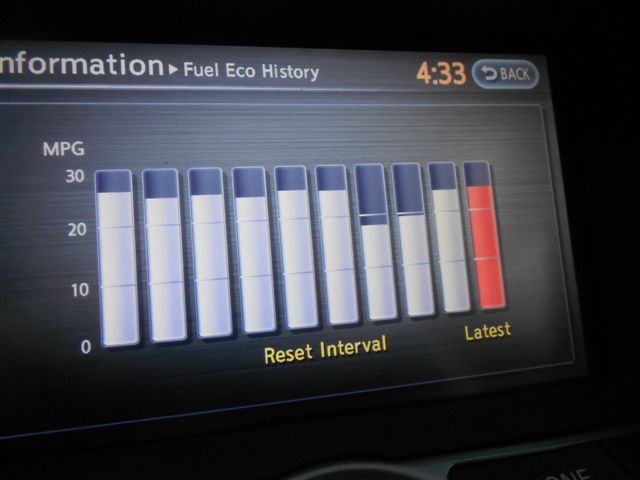
Photo taken yesterday a couple of weeks after Hurricane Sandy that shows the drop in MPG for short trips and gas lines.
Notice how it has returned to normal
Telcoman
Re: The Telcoman Low Cal. Gas Experiment
Warpkor:
Is the regular gas you tried to use 87 octane regular or 89 octane regular with 10% ethanol? If it's 87 octane, try the 89. If might be just enough to quiet the clattering. If you are already using 89, I don't see any alternative to premium.
Is the regular gas you tried to use 87 octane regular or 89 octane regular with 10% ethanol? If it's 87 octane, try the 89. If might be just enough to quiet the clattering. If you are already using 89, I don't see any alternative to premium.
Re: The Telcoman Low Cal. Gas Experiment
It was 87 octane that I tried though I knew better. I went back to running premium to preserve the engine and my sanity. Even running premium, the motor will ping a bit under load. I've always lived in warm climates (with ripping hot summers) and wonder if that has an impact.
-
kmckis1029

- Posts: 1768
- Joined: Wed Aug 13, 2008 8:45 am
- Car: 2016 Q50 RS400 AWD
2010 G37x w/Prem, Nav, & Wood (sold)
2005 G35x w/Prem C (traded in) - Location: Centerville, GA
- Contact:
Re: The Telcoman Low Cal. Gas Experiment
ive always been too scared to try 87, even though the manual says the g37 can adjust to 87 for short periods. then im spirited driver that gets to track every chance i get. now after reading this and other posts about the same thing, i highly doubt id ever try anything under the 93 octane here in GA unlessed forced.
-
SVTCOBRA
- Posts: 6046
- Joined: Wed Sep 03, 2003 2:26 am
- Car: 2018 Q60 AWD 2023 F150 4x4 5.0 FX4
- Location: LKN NC
Re: The Telcoman Low Cal. Gas Experiment
Still pinging with prem AND you have a MT.....that is strange.
had a 3.5 pathy 4x4 MT that I could get away with the middle grade, but the 3.5 pathy 4x4 AT HAD to have prem. or it would PING.
So, in my opinion, you can use a lower grade in a MT if you know how to shift.
how many miles?? I think I would look at my plugs.
had a 3.5 pathy 4x4 MT that I could get away with the middle grade, but the 3.5 pathy 4x4 AT HAD to have prem. or it would PING.
So, in my opinion, you can use a lower grade in a MT if you know how to shift.
how many miles?? I think I would look at my plugs.
-
spec-u-later

- Posts: 1002
- Joined: Wed May 07, 2003 4:47 pm
- Car: Yaris...FML
- Location: Cincinnati OH
Re: The Telcoman Low Cal. Gas Experiment
About an 18 Gallon fill up with about $0.40 extra for 93 only comes out to $3.20. I'll just stick with the premium and cut down my Monster Energy drink intake.
-
telcoman
- Posts: 5762
- Joined: Sat Jul 08, 2006 11:30 am
- Car: Tesla 2022 Model Y, 2016 Q70 Bye 2012 G37S 6 MT w Nav 94444 mi bye 2006 Infiniti G35 Sedan 6 MT @171796 mi.
- Location: Central NJ
Re: The Telcoman Low Cal. Gas Experiment
Update with my first long road trip from New Jersey to Florida.
1234 miles and used 48.745 gallons of 87 Octane regular for an over all 25.31 MPG.
Best tankful from Georgia to Florida 330 miles used 12.651 gallons for 26.08 MPG. Total round trip mileage 3204 and used 123.06 gallons of regular. Average MPG for the trip 26.03 MPG
Telcoman
1234 miles and used 48.745 gallons of 87 Octane regular for an over all 25.31 MPG.
Best tankful from Georgia to Florida 330 miles used 12.651 gallons for 26.08 MPG. Total round trip mileage 3204 and used 123.06 gallons of regular. Average MPG for the trip 26.03 MPG
Telcoman