In case you didn't read my earlier post, I purchased a 1999 Q45 with 127K miles and had it shipped to me. A day after it arrived the CEL came on with a single OBD II code - "System Too Lean - Bank 2". So far here is what I have done to try to resolve it:
1. Replaced Air Filter
2. Replaced Mass Air Flow Sensor
3. Replaced all 8 Spark Plugs
4. Replaced fuel filter
5. Ran 1 full bottle of Sea Foam Deep Creep fuel injector cleaner directly through throttle body
6. Ran 1 full bottle of regular Sea Foam mixed with 91 octane in the tank
7. Spent a combined total of 12+ hours looking for vaccum leaks inspecting every hose, fitting, and gasket (multiple times) and using every trick in the book (carb cleaner, soapy water, etc.). Nothing found.
8. Inspected Bank 2 exhaust manifold and uptake pipe upstream of Bank 2 O2 sensor - nothing found.
9. Inspected EGR and PCV valve - no overt carbon buildup or blockage
10. Replaced bank 2 upstream 02 sensor
11. Replaced bank 2 valve cover gasket
After each step i disconnected the battery to reset the ECU and each time the CEL came back on within 20 minutes of normal driving. I am no quitter, expecially when it comes to vehicle repairs but this one has me licked. I give up. If can't figure it out tomorrow I guess I will break down and take it into the shop Monday morning. I can't screw away another weekend chasing down phantom vaccum leaks and throwing good money at parts that didn't need replacing.
Keep in mind this is a single OBD code for 0174 only (system too lean - bank 2). It is NOT also throwing 0171 (lean - bank 1). Nor is it throwing any sort of 02 or MAF codes. Therefore, my thinking is it is very unlikely it is an intake manifold gasket, post-MAF air intake boot leak, throttle body leak. etc. because I would think those type of type of leaks would throw lean codes for both banks.
Any ideas I haven't considered yet?

Lean Bank 2 - I Give Up!!
-
Lokim
- Posts: 681
- Joined: Mon May 10, 2010 12:47 am
- Car: 1994 Infiniti Q45 acquired 4/25/10 w/192K
Now at 222K and going strong! - Location: Seattle, WA
- Contact:
Re: Lean Bank 2 - I Give Up!!
Remember, a leak on just the one side will likely throw a code for that side only. Unplug the IAC and spray some carb cleaner around the bank 2 intake manifold where it mates to the head. Betcha that's where yer leak is...
Re: Lean Bank 2 - I Give Up!!
Well that pretty much explains why my carb cleaner trick wasn't working. I never thought of disconnecting the IAC. No wonder I didn't notice an increase in RPMs. I could probably find out but do you know off the top of your head where the IAC is located on a 99 Q45?Lokim wrote:Remember, a leak on just the one side will likely throw a code for that side only. Unplug the IAC and spray some carb cleaner around the bank 2 intake manifold where it mates to the head. Betcha that's where yer leak is...
-
Lokim
- Posts: 681
- Joined: Mon May 10, 2010 12:47 am
- Car: 1994 Infiniti Q45 acquired 4/25/10 w/192K
Now at 222K and going strong! - Location: Seattle, WA
- Contact:
Re: Lean Bank 2 - I Give Up!!
Underside of the throttle body.
Re: Lean Bank 2 - I Give Up!!
Okay, thanks. Also, can I post pics on here? If so, how? I snapped a few pics of a possible source of this leak but I don't know how to post them within the message.
-
maxnix
- Posts: 22627
- Joined: Mon Jul 22, 2002 8:11 pm
- Car: 1995 Infiniti Q45
1995 Infiniti Q45t
2000 Infiniti Q45
Re: Lean Bank 2 - I Give Up!!
Read the stickies.Brody77 wrote:Okay, thanks. Also, can I post pics on here? If so, how?
do-you-need-pictures-posted-click-here-t215969.html
-
Lokim
- Posts: 681
- Joined: Mon May 10, 2010 12:47 am
- Car: 1994 Infiniti Q45 acquired 4/25/10 w/192K
Now at 222K and going strong! - Location: Seattle, WA
- Contact:
Re: Lean Bank 2 - I Give Up!!
You could also see if you can rent a Evap smoke machine and smoke the intake and exhaust systems...
Re: Lean Bank 2 - I Give Up!!
I thought of that but I don't know of anyplace around here that rents them. I didn't get around to checking it today b/c the wife had me busy all day. Can you do any longterm engine damage running a bank too lean for too long...or...is it just mainly a fuel economy issue???Lokim wrote:You could also see if you can rent a Evap smoke machine and smoke the intake and exhaust systems...
Also, completely unrelated question, how important is it to run 91 octane in these Q's? I know the manual and fuel cap say 91 only, but is it truly necessary? I've been putting premium in it since I bought it but I know of others who have ran 87 in their Q's for years without a problem.
-
Lokim
- Posts: 681
- Joined: Mon May 10, 2010 12:47 am
- Car: 1994 Infiniti Q45 acquired 4/25/10 w/192K
Now at 222K and going strong! - Location: Seattle, WA
- Contact:
Re: Lean Bank 2 - I Give Up!!
Running lean can overheat the valves and head, resulting in burnt valves, and can also overheat the catalytic converter, necessitating replacement.
As for the fuel grade, the primary issue you will encounter is lower performance and possibly poorer fuel economy. I know in the 90-96 Q's the compression ratio is 10.5:1, so premium fuel is necessary to prevent engine knock. If you put 87 in, the knock sensors will cause the ECM to retard ignition timing, resulting in poor performance. The timing can only do so much, though. If you are going over a pass or driving in hot weather w/ the A/C on and the engine heats up, it will become impossible to eliminate all engine knock as the fuel simply isn't stable enough to prevent combustion until the moment the ECM intends it. Engine knock can result in all kinds of severe internal engine damage...
As for the fuel grade, the primary issue you will encounter is lower performance and possibly poorer fuel economy. I know in the 90-96 Q's the compression ratio is 10.5:1, so premium fuel is necessary to prevent engine knock. If you put 87 in, the knock sensors will cause the ECM to retard ignition timing, resulting in poor performance. The timing can only do so much, though. If you are going over a pass or driving in hot weather w/ the A/C on and the engine heats up, it will become impossible to eliminate all engine knock as the fuel simply isn't stable enough to prevent combustion until the moment the ECM intends it. Engine knock can result in all kinds of severe internal engine damage...
-
maxnix
- Posts: 22627
- Joined: Mon Jul 22, 2002 8:11 pm
- Car: 1995 Infiniti Q45
1995 Infiniti Q45t
2000 Infiniti Q45
Re: Lean Bank 2 - I Give Up!!
Cooking the catalytic converter is a real possibility.
-
Lokim
- Posts: 681
- Joined: Mon May 10, 2010 12:47 am
- Car: 1994 Infiniti Q45 acquired 4/25/10 w/192K
Now at 222K and going strong! - Location: Seattle, WA
- Contact:
Re: Lean Bank 2 - I Give Up!!
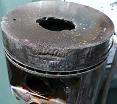
If you want to see what engine knock does over time, see my avatar...
Re: Lean Bank 2 - I Give Up!!
Yikes!! Yeah, I don't need a hole in my piston (that is what I'm looking at, correct?). Given the steps I've taken thus far, what I've deduced is it can only be either a vaccum leak on bank 2 or a exhaust leak before the bank 2 upstream O2 sensor. I don't think it's an exhaust leak because that should be fairly easy to notice (i.e. see, hear, & smell) and I've been all around that side of the engine for days and can't see any signs of an exhaust leak. Some people have mentioned things like a faulty EGR / PCV valve or even a malfunctioning bank 2 sensor but all those things have their own trouble codes when they malfunction and I see why I wouldn't be getting O2/EGR/PCV specific codes if indeed one of those items were malfunctioning.
My wife thinks I make problems with my cars because I am always "fiddling" with them. I'm starting to think maybe she's onto something. It does seem like people who don't care about their cars and just get in them and drive them don't have the problems I do. When I met my wife she drove a 1990 Honda Accord that she literally never did a single maintenence item on for the 5 years she owned it - never washed it, never changed the oil, nothing - and she never had a mechanical problem with it. And as I mentioned before, my dad bought a 1996 Q45 almost new and he wasn't much better. He drove it on miles of dirt roads everyday (lived in the country), only put 87 octane fuel in it, and maybe changed the oil every 10k miles or so at best with whatever the cheapest crap oil/filter the quickie oil change place happened to have on special that day and maybe changed the air filter once or twice. Never changed the transmission fluid. Never flushed the radiator. Never serviced the differential. Never even changed the spark plugs. Just got in and drove it. Drove it for 10 years and put over 250,000 miles on it without a single major repair. He's driving a 99 Toyota Avalon now that has 195,000 miles on it and is still on the original timing belt.
Maybe he's just lucky, I don' know. All I know is I have a 99 Q45 with a fraction of those miles on it and thus far I spent twice as much time under the hood than I have behind the wheel
My wife thinks I make problems with my cars because I am always "fiddling" with them. I'm starting to think maybe she's onto something. It does seem like people who don't care about their cars and just get in them and drive them don't have the problems I do. When I met my wife she drove a 1990 Honda Accord that she literally never did a single maintenence item on for the 5 years she owned it - never washed it, never changed the oil, nothing - and she never had a mechanical problem with it. And as I mentioned before, my dad bought a 1996 Q45 almost new and he wasn't much better. He drove it on miles of dirt roads everyday (lived in the country), only put 87 octane fuel in it, and maybe changed the oil every 10k miles or so at best with whatever the cheapest crap oil/filter the quickie oil change place happened to have on special that day and maybe changed the air filter once or twice. Never changed the transmission fluid. Never flushed the radiator. Never serviced the differential. Never even changed the spark plugs. Just got in and drove it. Drove it for 10 years and put over 250,000 miles on it without a single major repair. He's driving a 99 Toyota Avalon now that has 195,000 miles on it and is still on the original timing belt.
Maybe he's just lucky, I don' know. All I know is I have a 99 Q45 with a fraction of those miles on it and thus far I spent twice as much time under the hood than I have behind the wheel
-
Q451990

- Moderator
- Posts: 11030
- Joined: Tue Jul 23, 2002 8:21 am
- Car: 1990 Q45 - 118K, 2022 Toyota 4 Runner, 2004 Frontier M/T - 108K, 2012 Xterra (Mom's), 2023 Rogue (Inlaws)
- Location: Columbia, SC
- Contact:
Re: Lean Bank 2 - I Give Up!!
I like google's picasaweb for picture hosting. Once you have the picture uploaded to their site, you need to have the address for the picture. Then you just click the "Img" button up at the top of the form where you're entering your post, and put the link between the image tags that look like this >>> {img}{/img} - except your tags will have brackets like [ ] instead of { }.Brody77 wrote:Also, can I post pics on here?
Heath
-
paranoidjack

- Posts: 1417
- Joined: Mon Oct 03, 2005 3:57 pm
- Car: 2012 Infiniti M56 S
2003 Infiniti M45
2001 Infiniti QX4
2000 Infiniti Q45
1998 Nissan Pathfinder
1996 Infiniti J30
Re: Lean Bank 2 - I Give Up!!
I had similar problems for the first 5-8 years I worked on vehicles. I then discovered the beauty and importance of the torque wrench. Just because it is "similar" in resistance to turn two bolts does not mean they are even close in torque...rust and sand can work wonders on the difficulty to turn a small bolt.Brody77 wrote:Yikes!! Yeah, I don't need a hole in my piston (that is what I'm looking at, correct?). Given the steps I've taken thus far, what I've deduced is it can only be either a vaccum leak on bank 2 or a exhaust leak before the bank 2 upstream O2 sensor. I don't think it's an exhaust leak because that should be fairly easy to notice (i.e. see, hear, & smell) and I've been all around that side of the engine for days and can't see any signs of an exhaust leak. Some people have mentioned things like a faulty EGR / PCV valve or even a malfunctioning bank 2 sensor but all those things have their own trouble codes when they malfunction and I see why I wouldn't be getting O2/EGR/PCV specific codes if indeed one of those items were malfunctioning.
My wife thinks I make problems with my cars because I am always "fiddling" with them. I'm starting to think maybe she's onto something. It does seem like people who don't care about their cars and just get in them and drive them don't have the problems I do. When I met my wife she drove a 1990 Honda Accord that she literally never did a single maintenence item on for the 5 years she owned it - never washed it, never changed the oil, nothing - and she never had a mechanical problem with it. And as I mentioned before, my dad bought a 1996 Q45 almost new and he wasn't much better. He drove it on miles of dirt roads everyday (lived in the country), only put 87 octane fuel in it, and maybe changed the oil every 10k miles or so at best with whatever the cheapest crap oil/filter the quickie oil change place happened to have on special that day and maybe changed the air filter once or twice. Never changed the transmission fluid. Never flushed the radiator. Never serviced the differential. Never even changed the spark plugs. Just got in and drove it. Drove it for 10 years and put over 250,000 miles on it without a single major repair. He's driving a 99 Toyota Avalon now that has 195,000 miles on it and is still on the original timing belt.
Maybe he's just lucky, I don' know. All I know is I have a 99 Q45 with a fraction of those miles on it and thus far I spent twice as much time under the hood than I have behind the wheel
IN ALL AUTO PROJECTS, BE SURE TO:
-Always clean nuts and bolts.
-Lubricate if AT ALL necessary to remove tough bolts. If a bolt is hard to turn, you will do more damage horsing it out than lubing it quickly.
-Clean receiving threads whenever possible.
-Wire brush nasty stuff from ALL threads.
-MOST OVERLOOKED - replace bolts if necessary. My point is that it is OFTEN necessary and people don't even realize it.
-ALWAYS use PB blaster or equal on tough bolts so you don't reshape them and affect their effectiveness when re-torqued.
Remember, manufacturer's don't go through the tons of trouble to engineer torque values on nearly every bolt on the car for no reason. Suspension torques with rubber bushings, brake torques with caliper slides, ALL engine torques connecting aluminum especially.....
"Shadetree" mechanics get everything "just right" until everything is "just wrong."
I should know - I'm one of them

Re: Lean Bank 2 - I Give Up!!
Good points paranoidjack. I think, dare I say, I might have fixed it. Tonight I unplugged the IAC and sprayed starter fluid around the bank 2 side. I didn't notice any difference in idle but I swore I could hear a "sucking" sound I wasn't hearing with the IAC plugged in. However, after so many hours looking and listening for vaccum leaks I couldn't tell if it was just my mind playing tricks on me.
The sound was coming from directly on top of the plenum. Just to make sure I plugged the IAC back in and the sound wasn't nearly as noticeable. So I unplugged it again and actually crawled up under the hood with my ear like 2 inches away from the plenum. It seemed to be coming from the threaded screw-in port on the top-passenger side of the plenum. I don't know what it does, but It has a vaccum hose connected to it that runs to the EVAP valve.
I turned off the car, pulled off the vaccum hose, and unscrewed the port (has a 19mm nut on it). I inspected the hose and it looked fine. I blocked one end with my thumb and blew through the other end and it seemed to hold just fine, no leaks. So I figured the sucking sound must be coming from the port not be screwed in all the way (you could see threads on the port before I took it out that it wasn't screwed all the way into the plenum).
Knowing how easy it is to cross-thread alumnium I figured maybe somebody took it out before for some reason and cross threaded it putting it back in. So I laid a bead of black high-temp gasket maker around the threads and screwed it back in. Let it set for a couple hours, cleared the codes, and took it out for a test drive. Drove it about 20 miles at varying speeds and let it idle for about 15 mintues. No codes. Before, whenever I cleared the lean code, it would pop right back on either immediately or after just a few minutes of driving it / letting it idle. So who knows, maybe I fixed it. If it stays off, I'll let you know. Maybe my experience can help somebody else.
On a sidenote, is there any threads regarding problems with the power rear sunshade? Mine doesn't work. You can pull it up by hand, but when you push the button nothing happens. All I hear is a small "click" coming from back there somewhere but that's it. That's the next project on this Q I would like to tackle. Thanks for all the help, I really appreciate it.
The sound was coming from directly on top of the plenum. Just to make sure I plugged the IAC back in and the sound wasn't nearly as noticeable. So I unplugged it again and actually crawled up under the hood with my ear like 2 inches away from the plenum. It seemed to be coming from the threaded screw-in port on the top-passenger side of the plenum. I don't know what it does, but It has a vaccum hose connected to it that runs to the EVAP valve.
I turned off the car, pulled off the vaccum hose, and unscrewed the port (has a 19mm nut on it). I inspected the hose and it looked fine. I blocked one end with my thumb and blew through the other end and it seemed to hold just fine, no leaks. So I figured the sucking sound must be coming from the port not be screwed in all the way (you could see threads on the port before I took it out that it wasn't screwed all the way into the plenum).
Knowing how easy it is to cross-thread alumnium I figured maybe somebody took it out before for some reason and cross threaded it putting it back in. So I laid a bead of black high-temp gasket maker around the threads and screwed it back in. Let it set for a couple hours, cleared the codes, and took it out for a test drive. Drove it about 20 miles at varying speeds and let it idle for about 15 mintues. No codes. Before, whenever I cleared the lean code, it would pop right back on either immediately or after just a few minutes of driving it / letting it idle. So who knows, maybe I fixed it. If it stays off, I'll let you know. Maybe my experience can help somebody else.
On a sidenote, is there any threads regarding problems with the power rear sunshade? Mine doesn't work. You can pull it up by hand, but when you push the button nothing happens. All I hear is a small "click" coming from back there somewhere but that's it. That's the next project on this Q I would like to tackle. Thanks for all the help, I really appreciate it.
-
paranoidjack
- Posts: 1417
- Joined: Mon Oct 03, 2005 3:57 pm
- Car: 2012 Infiniti M56 S
2003 Infiniti M45
2001 Infiniti QX4
2000 Infiniti Q45
1998 Nissan Pathfinder
1996 Infiniti J30
Re: Lean Bank 2 - I Give Up!!
Mine's done that on and off for years. When she sticks, I gently move her in the desired direction manually and it seems to work again for a while. It's only happened 3 times in 5 years.