Well for my 02 qx4, it feels like it's always on 4wd without even detecting any slippage. I asked my mechanic and he said that it has the thermometer in it that makes it stay on 4wd when it says "ice" on the thermometer. Otherwise it would wait for slippage under warm weather
The weather has been very cold (-4 to -15 degree Celsius)...
What do you think ?

auto mode = always 4wd?
-
Towncivilian

- Posts: 4868
- Joined: Sun May 23, 2010 10:21 am
- Car: 2001.5 Nissan Pathfinder SE 3.5L 2WD A/T
2007 Nissan Altima 2.5L CVT
2012 Nissan Sentra 2.0L CVT Special
2012 Infiniti G37 Sedan 7A/T - Location: Florida, USA
- Contact:
Re: auto mode = always 4wd?
The thermometer has nothing to do with any operation of the vehicle, it just warns the driver that the road may be icy.
I don't know otherwise, I don't have any first-hand experience with 4WD vehicles.
I don't know otherwise, I don't have any first-hand experience with 4WD vehicles.
Re: auto mode = always 4wd?
I don't think so ..... When you have it in "auto" it will normally only be in 4wd for a brief period of time .... maybe you have a problem with the system.
Have you tried to cycle through the various setting to make sure the transfer case is working?
Have you tried to cycle through the various setting to make sure the transfer case is working?
Re: auto mode = always 4wd?
It was my understanding that in auto, right after you start it up, its in 50/50 torque distribution.
Then it switches to rear wheel drive when you get going. If it detects slip, it adjusts torque betwee the front and back axels to try and stabalize the vehicle (Thats the difference between Attesa ETS and Attesa ETS pro that the skyline had - pro could do side to side aswell. We are only front and back)
Anyway, apparently we also have a G-force sensor (I think its mounted under the center console) The Attesa ets system uses this to prevent under-steer and over-steer by varying the torque to the axels around corners. Also according to a news release (of I think a 1999.5 model) This G-force sensor also affects breaking around corners.
Also your mechanic may have been not totally wrong about the Ice light - Didn't Townciilian say that in the 2001.5 model year, there was an input from the abs sensors to the ice light instead of just the temp sensor. So in that way if the ice light was on, there may have been slip at some point, although I think the Attesa ETS system rechecked for slip 10 times a second - so the light wouldn't be exactley indicative of slippage at a specific point in time.
That is my collective knowlegde of the system that has been compiled from many different sources, some of which could be wrong - so feel free, anyone, to correct me.
Then it switches to rear wheel drive when you get going. If it detects slip, it adjusts torque betwee the front and back axels to try and stabalize the vehicle (Thats the difference between Attesa ETS and Attesa ETS pro that the skyline had - pro could do side to side aswell. We are only front and back)
Anyway, apparently we also have a G-force sensor (I think its mounted under the center console) The Attesa ets system uses this to prevent under-steer and over-steer by varying the torque to the axels around corners. Also according to a news release (of I think a 1999.5 model) This G-force sensor also affects breaking around corners.
Also your mechanic may have been not totally wrong about the Ice light - Didn't Townciilian say that in the 2001.5 model year, there was an input from the abs sensors to the ice light instead of just the temp sensor. So in that way if the ice light was on, there may have been slip at some point, although I think the Attesa ETS system rechecked for slip 10 times a second - so the light wouldn't be exactley indicative of slippage at a specific point in time.
That is my collective knowlegde of the system that has been compiled from many different sources, some of which could be wrong - so feel free, anyone, to correct me.
-
Towncivilian
- Posts: 4868
- Joined: Sun May 23, 2010 10:21 am
- Car: 2001.5 Nissan Pathfinder SE 3.5L 2WD A/T
2007 Nissan Altima 2.5L CVT
2012 Nissan Sentra 2.0L CVT Special
2012 Infiniti G37 Sedan 7A/T - Location: Florida, USA
- Contact:
Re: auto mode = always 4wd?
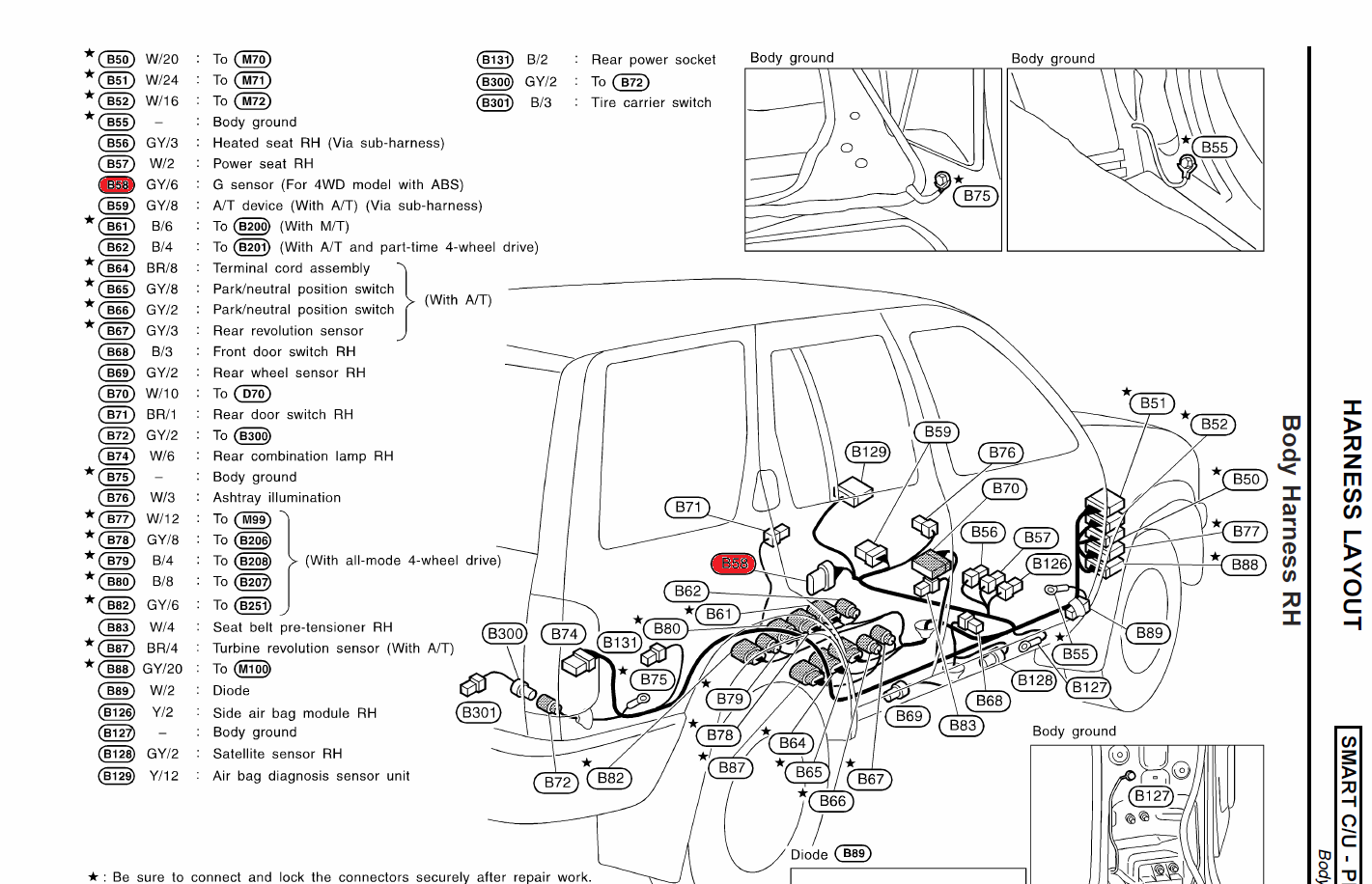
Yes, 4WD Pathfinders with ABS have a G sensor.
The overhead console is able to detect icy conditions by speed sensor input (1996-2001) or ABS system (2001.5-2004). It only warns the driver, it doesn't keep the vehicle in 4WD as the OP's mechanic suggested.
The overhead console is able to detect icy conditions by speed sensor input (1996-2001) or ABS system (2001.5-2004). It only warns the driver, it doesn't keep the vehicle in 4WD as the OP's mechanic suggested.
Re: auto mode = always 4wd?
I suppose I wasn't clear
Since our 4WD system uses the abs senors to detect slip, to then provide torque to the front wheels, that Abs sensor, when detecting slip, would both light up the ice light and provide more torque to the front wheels, engaged 4wd.
The sensor would trigger both things to happen.
Another thing I was trying to say was that the 4wd system refreshes 10 times a second (from what I've heard) whereas I'm pretty sure the light doesn't or it would be sparatically flashing, so the light may have a refresh rate of every min or something.
This means that the action of the light being on would not be an indication of slippage at the instant in time, but over some period, maybe a minite.
Since our 4WD system uses the abs senors to detect slip, to then provide torque to the front wheels, that Abs sensor, when detecting slip, would both light up the ice light and provide more torque to the front wheels, engaged 4wd.
The sensor would trigger both things to happen.
Another thing I was trying to say was that the 4wd system refreshes 10 times a second (from what I've heard) whereas I'm pretty sure the light doesn't or it would be sparatically flashing, so the light may have a refresh rate of every min or something.
This means that the action of the light being on would not be an indication of slippage at the instant in time, but over some period, maybe a minite.
-
Towncivilian
- Posts: 4868
- Joined: Sun May 23, 2010 10:21 am
- Car: 2001.5 Nissan Pathfinder SE 3.5L 2WD A/T
2007 Nissan Altima 2.5L CVT
2012 Nissan Sentra 2.0L CVT Special
2012 Infiniti G37 Sedan 7A/T - Location: Florida, USA
- Contact:
Re: auto mode = always 4wd?
I agree with your explanation, yes. I was correcting the OP's mechanic's misinterpretation of the overhead console.
-
Buzzman
- Posts: 2079
- Joined: Fri Feb 02, 2007 2:35 pm
- Car: 2016 Lexus RX 350
2023 Kia Stinger Elite V6 AWD.
Re: auto mode = always 4wd?
My gut feeling is that the ICE light on the overhead console has nothing to do with the ABS system or AWD system. I think it just lights up when the temp outside drops below around 3C, or about 36F. It's nothing more than a courtesy light/message.
My '06 Altima has the same thing. It says ICY when the outside temp gets below about 3C, and stays on until it warms up again (outside).
(The Altima doesn't have AWD)
From the manual:
This unit displays following items:
- Earth magnetism and heading direction of vehicle.
- Outside air temperature.
- Caution for frozen road surfaces.
OUTSIDE TEMPERATURE DISPLAY
NBEL0153S01
Push the switch when the ignition key is in the “ACC” or “ON” position. The outside temperature will be displayed
in “°F”.
- Selecting the indication range
Push the switch to change from “°F” to “°C”.
- When the outside temperature drops below freezing point, ICE is displayed on the unit.
- When the outside temperature is between 55°C (130°F) and 70°C (158°F), the display shows 55°C
(130°F).
- When the outside temperature is lower than −30°C (−20°F) or higher than 70°C (158°F), the display shows
only “---” though it is operating. This is not a problem.
My '06 Altima has the same thing. It says ICY when the outside temp gets below about 3C, and stays on until it warms up again (outside).
(The Altima doesn't have AWD)
From the manual:
This unit displays following items:
- Earth magnetism and heading direction of vehicle.
- Outside air temperature.
- Caution for frozen road surfaces.
OUTSIDE TEMPERATURE DISPLAY
NBEL0153S01
Push the switch when the ignition key is in the “ACC” or “ON” position. The outside temperature will be displayed
in “°F”.
- Selecting the indication range
Push the switch to change from “°F” to “°C”.
- When the outside temperature drops below freezing point, ICE is displayed on the unit.
- When the outside temperature is between 55°C (130°F) and 70°C (158°F), the display shows 55°C
(130°F).
- When the outside temperature is lower than −30°C (−20°F) or higher than 70°C (158°F), the display shows
only “---” though it is operating. This is not a problem.
Re: auto mode = always 4wd?
so i checked FSM and there is a fluid temperature sensor and and ABS sensor in the Transfer case, so i guess its true.
Now the fluid temperature sensor maybe use for the transfer case operations smoothly or to see the lowering of exterior temperature.
Now i agree with the fact that the ABS sensor will tell the transercase to change torque distribution but temperature thing might be cool too.
Now the fluid temperature sensor maybe use for the transfer case operations smoothly or to see the lowering of exterior temperature.
Now i agree with the fact that the ABS sensor will tell the transercase to change torque distribution but temperature thing might be cool too.
Re: auto mode = always 4wd?
The Pathfinder's 4wd system is not very advanced - it is a truck "cary over". Nissan added an electric transfer case to compete with the AWD vehicles available. Nissan was way behind with the introduction of AWD.
The Nissan system cannot do any T distribution -- the rears with the auto systems normally get LSD but the front is still locked. That is why you can not really use the 4 Hi without tire damage on paved roads for extended time.
So in "Auto" the system is on or off -- in 2wd it is always off .. and in 4 hi .... it is on ... 4 low gives you the reduction as well. All the electronics are interconnected and they all need the temp sensor -- but they are not doing all that much with it. The ABS also has to work with the rear drums - and the force valve -- or whatever Nissan calls it. Remember that the LE Pathfinder with leather in 2002 was 34k -- so it was competing with vehicles that had AWD.
I almost did not buy the Pathfinder because both my Jeep Grand Cherokee's had the fantastic Jeep awd system at the time -- but family members liked the Pathfinder and I figured I still had the other Jeep. I also did not like the drum brakes (still don't)The Pathfinder ended up being a great vehicle - I bought a second one. While I still wish it had AWD (especially in freezing rain) it has proven to be very reliable. I wish someone made another vehicle like it today - everything else is too big or based on a car.
The Nissan system cannot do any T distribution -- the rears with the auto systems normally get LSD but the front is still locked. That is why you can not really use the 4 Hi without tire damage on paved roads for extended time.
So in "Auto" the system is on or off -- in 2wd it is always off .. and in 4 hi .... it is on ... 4 low gives you the reduction as well. All the electronics are interconnected and they all need the temp sensor -- but they are not doing all that much with it. The ABS also has to work with the rear drums - and the force valve -- or whatever Nissan calls it. Remember that the LE Pathfinder with leather in 2002 was 34k -- so it was competing with vehicles that had AWD.
I almost did not buy the Pathfinder because both my Jeep Grand Cherokee's had the fantastic Jeep awd system at the time -- but family members liked the Pathfinder and I figured I still had the other Jeep. I also did not like the drum brakes (still don't)The Pathfinder ended up being a great vehicle - I bought a second one. While I still wish it had AWD (especially in freezing rain) it has proven to be very reliable. I wish someone made another vehicle like it today - everything else is too big or based on a car.
Re: auto mode = always 4wd?
I think that our 4WD systems are pretty damn good! Even though my car has tons of millage & is almost 13 years old, I cannot feel the system engaging, and it works exactly as it's supposed to. We had ~10-15cm of snow here a month or so ago when I still had my worn out summer tires on, and I drove through it without any problem at all. I only had trouble braking, as ABS would kick in almost instantly, but that has nothing to do with the 4WD system.
Sure the new 4wd systems can send power to individual wheels, and split torque every-which way; but considering the age & millage on most of our cars, I think they're fantastic!
Sure the new 4wd systems can send power to individual wheels, and split torque every-which way; but considering the age & millage on most of our cars, I think they're fantastic!
Re: auto mode = always 4wd?
I disagreeyeldogt wrote:The Pathfinder's 4wd system is not very advanced - it is a truck "cary over". Nissan added an electric transfer case to compete with the AWD vehicles available. Nissan was way behind with the introduction of AWD.
The Nissan system cannot do any T distribution
“Four-wheel drive Pathfinders feature a shift-on-the-fly transfer case, which can be engaged at speeds of up to 50 miles per hour. LE Pathfinders are now available with the push-button All-Mode 4WD system – a wet multi-plate clutch design, managed by a computerized electronic control unit, which allows up to 50 percent of available torque (infinitely adjustable) to the front wheels on demand.”
http://www.nissannews.com/newsrelease.d ... it&mid=129
All-mode 4WD has an electronically-controlled centre clutch which varies power distribution to the front or rear wheels depending on which wheels have the most traction. In this full-time mode, the Pathfinder can be driven on dry or slippery roads without harming the drivetrain.
http://www.autos.ca/car-test-drives/tes ... pathfinder
The Pathfinder's all-new All-Mode 4WD system is the most sophisticated 4WD system fitted to a recreational vehicle in the world today[1999]. Developed specifically to allow ease of use under a wide range of driving environments, the All-Mode 4WD system is computer controlled to vary torque to the front wheels.
In Auto mode, the heart of Pathfinder's all-new All-Mode 4WD system is a hydraulically operated multi-plate clutch which - in response to input from sensors measuring such aspects as front and rear propeller shaft speeds, engine speed, throttle sensors and the ABS braking system (Ti model only) - transfers drive to the front wheels as required to supplement the drive to the rear.
http://www.autoweb.com.au/cms/A_51104/t ... ticle.html
We don't have a front locking axle, if we did, you wouldn't be able to turn corners in general, we have a differential there just like we have one in the back which enables the wheel on either axle to turn more or less than the other.yeldogt wrote:
-- the rears with the auto systems normally get LSD but the front is still locked. That is why you can not really use the 4 Hi without tire damage on paved roads for extended time.
We have a center differential which allows the front and back wheels to turn different amounts. This becomes locked when you put it in 4wd hi - which is a part time full wheel drive system. This is why you can't use 4wd high on dry paved roads - because it doesn't allow the front and rear axles to turn different amounts, which puts strain on the axles until eventually an axle is forced to slip which wears the tires.
-Chris
Re: auto mode = always 4wd?
Damn Chriss... impressive research...
I love my QX4 4WD system thats for sure.
I love my QX4 4WD system thats for sure.
Re: auto mode = always 4wd?
Chris ........if you read the links you gave you will see that that they say exactly what I wrote -- we can wish anything we want .... but it does not make it true. The front differential is not LS -- put your truck in 4w high and place the truck into a sharp turn in a parking lot -- you will see what I am speaking of - The front wheels lock as the power is delivered. The torque split is up to 50 % ......off = 0 and on = 50% ...... because now the front wheels are included. You can't have any more because you can't remove the rear wheels. The wet clutches do slip in response to load ... but it is not being controlled the way you think. The power is given to the front wheels equally it is not controlled left and right --- it must have a variable component or you would have to stop to engage it - that is the infinite variable ... slip .. in the electric transfer case. Saying it is the "most advanced" is more than a stretch ..... and does not make it true.. Although ... it is an advanced conventional 4wd system...... since it uses electronics rather than manual shift levers common to those systems at the time. Nissan was loosing sales to other cars with various versions of AWD.
No difference between 4 hi and and "Auto" in 4wd ..... "Auto" puts in the truck in 4wd Hi when it senses slip in the rear . This truck does not have true AWD. The front/rear slip is in the transfer case. The reason you can drive in "Auto" on dry pavement is that you are not in 4wd - the control system has the truck in 2wd .... only when it slips does the transfer case move to 4wd and then back to 2wd.
I never said it did not work -- or that it was not robust and reliable - and it is great not having to play around with manual transfer cases. AWD allows you to distribute the engines power over the 4 wheels "all the time" -- this is especially valuable in rain or any car with a powerful engine.
No difference between 4 hi and and "Auto" in 4wd ..... "Auto" puts in the truck in 4wd Hi when it senses slip in the rear . This truck does not have true AWD. The front/rear slip is in the transfer case. The reason you can drive in "Auto" on dry pavement is that you are not in 4wd - the control system has the truck in 2wd .... only when it slips does the transfer case move to 4wd and then back to 2wd.
I never said it did not work -- or that it was not robust and reliable - and it is great not having to play around with manual transfer cases. AWD allows you to distribute the engines power over the 4 wheels "all the time" -- this is especially valuable in rain or any car with a powerful engine.
Re: auto mode = always 4wd?
I never said it was controlled left and right. Infact, in my first post on this topic I said;yeldogt wrote:Chris ........if you read the links you gave you will see that that they say exactly what I wrote -- we can wish anything we want .... but it does not make it true. The front differential is not LS -- put your truck in 4w high and place the truck into a sharp turn in a parking lot -- you will see what I am speaking of - The front wheels lock as the power is delivered. The torque split is up to 50 % ......off = 0 and on = 50% ...... because now the front wheels are included. You can't have any more because you can't remove the rear wheels. The wet clutches do slip in response to load ... but it is not being controlled the way you think. The power is given to the front wheels equally it is not controlled left and right
"it adjusts torque between the front and back axels to try and stabalize the vehicle (Thats the difference between Attesa ETS and Attesa ETS pro that the skyline had - pro could do side to side aswell. We are only front and back)"
Also, having a limited slip differential in the front would not help us in 4wd hi on dry ground. In a normal differential, if one wheel is slipping, more power will be applied to that wheel and less to the wheel with traction. Google "one wheeled wonder" if you want to hear how people dislike them. The limited slip differential makes it so that if one wheel is slipping, it can only slip a limited amount so that the other wheel is still getting power.
But, the whole concept of the differential was developed so that if a vehicle's wheels were turning at different speeds (say around a corner) the axle would not bind / a wheel would not be forced to slip. Since we DO have front and back axle differentials, this is not the cause of the binding issue.
See : http://www.youtube.com/watch?v=kJY9SxDOTog
That was the view of the person who wrote the article. I added that it was said in 1999 to emphasize that this view would be near irrelevant by todays standards.yeldogt wrote:
Saying it is the "most advanced" is more than a stretch ..... and does not make it true..
I'll maintain that I do not think our 4wd system is the best in the universe ever created... yadyada. I haven't actually made any judgement at all about our system. I'm just trying to explain how the system works.
I agree to that except that torque can be varied to the front when it gets slip.yeldogt wrote:
No difference between 4 hi and and "Auto" in 4wd ..... "Auto" puts in the truck in 4wd Hi when it senses slip in the rear . This truck does not have true AWD. The front/rear slip is in the transfer case. The reason you can drive in "Auto" on dry pavement is that you are not in 4wd - the control system has the truck in 2wd .... only when it slips does the transfer case move to 4wd and then back to 2wd.
Again, I'm not saying its the best ever.
One thing I'll correct about what I've said in the past, that you've convinced me of is that we do not have a strict center differential. In essence the the way they reduce driveline binding on the Pathy is by not providing power to the front axle in the form of the clutch pack in the transfer case. But I think it has been made thoroughly clear that torque can be varied between the front and back axles by the clutchpack in the transfer case, but only when some wheels are getting slip.
Chris
Re: auto mode = always 4wd?
Chris .... maybe I am giving too much information. The pathfinder has a very typical 4wheel drive set up -- otherwise known as "part time 4wd" It does not have full time 4wd or all wheel drive. If you read the owners manual as it pertains to the automatic control --it specifically says not to drive the truck in 4wd HI on dry pavement ... I believe it also references high speed.
The "auto" setting of the 4wd control does nothing more than "allow" the truck to shift into 4wd Hi when it senses slip in the rear. Nothing else special is happening. Since the system is designed to quickly and smoothly move in and out of 4 Hi you never feel it -- and the car never drives on dry pavement in 4wd because the system is obviously not noticing any slip in the rear when you are on dry pavement.
You can have a LSD in the front -- and it does the same thing as it does on the rear. Actually having a LSD in the front of the Path would be great. The problem with part time 4wd is that when power is given to the front drive shaft the wheels then lock together -- and turn together at the same speed -- that is what is happening with the Pathfinder ... the only thing saving the tires is the system quickly goes back to 2wd when it stops slipping. Nissan uses a rather slick electronic transfer case to modify a part time system in order for it to be able to do this -- that is the split ... but it is on and off. Plus the added a servo to control the 4wd low shift.
I am in no way attacking the 4wd system in the Pathfinder -- it is a proven system that works great. What I am trying to explain is that the system is not capable of any real power control like an AWD system and it does not have an open clutch front differential that allows 4wd on dry pavement. Some think by placing the system in 2wd vs AUTO that they are saving money on gas ........ its always in 2wd ...... it only goes into 4wd HI when the rear wheels slip.
The "auto" setting of the 4wd control does nothing more than "allow" the truck to shift into 4wd Hi when it senses slip in the rear. Nothing else special is happening. Since the system is designed to quickly and smoothly move in and out of 4 Hi you never feel it -- and the car never drives on dry pavement in 4wd because the system is obviously not noticing any slip in the rear when you are on dry pavement.
You can have a LSD in the front -- and it does the same thing as it does on the rear. Actually having a LSD in the front of the Path would be great. The problem with part time 4wd is that when power is given to the front drive shaft the wheels then lock together -- and turn together at the same speed -- that is what is happening with the Pathfinder ... the only thing saving the tires is the system quickly goes back to 2wd when it stops slipping. Nissan uses a rather slick electronic transfer case to modify a part time system in order for it to be able to do this -- that is the split ... but it is on and off. Plus the added a servo to control the 4wd low shift.
I am in no way attacking the 4wd system in the Pathfinder -- it is a proven system that works great. What I am trying to explain is that the system is not capable of any real power control like an AWD system and it does not have an open clutch front differential that allows 4wd on dry pavement. Some think by placing the system in 2wd vs AUTO that they are saving money on gas ........ its always in 2wd ...... it only goes into 4wd HI when the rear wheels slip.
Re: auto mode = always 4wd?
All technichal discussion aside, my problem is that in my AUTO mode, it is always in 4wd, and how do i know that? because when i go up 80 km/h -100 km/h in auto mode, i can feel the grinding from the transfer case and without any slippage detection this is occurring.
Now when i am at 80km/h and i feel the grinding and i turn the AUTO more to 2WD mode, the grinding goes away.
SO I GUESS I HAVE A PROBLEM WITH THE AUTO MODE...
Now when i am at 80km/h and i feel the grinding and i turn the AUTO more to 2WD mode, the grinding goes away.
SO I GUESS I HAVE A PROBLEM WITH THE AUTO MODE...
Re: auto mode = always 4wd?
It does sound like you have a problem with the auto mode -- are you getting any blinking lights.
What does it do in 4wd HI?
Have you checked the fluid? Although ...I would not think low fluid would cause the problem. The system uses a bit less than 2 QTS of the same Nissan D Matic as the transmission. I wonder if a servo is hanging up -- I have not read the service manual on this in a while -- did you look at it?
What does it do in 4wd HI?
Have you checked the fluid? Although ...I would not think low fluid would cause the problem. The system uses a bit less than 2 QTS of the same Nissan D Matic as the transmission. I wonder if a servo is hanging up -- I have not read the service manual on this in a while -- did you look at it?
Re: auto mode = always 4wd?
Can you cite some sources that it is just 100:0 or 50:50?yeldogt wrote: that is the split ...but it is on and off.
I'm not trying to attack your credibility, but when I research the system, I am either seeing that the torque is infinitly variable to the front wheels up to 50:50 and based on the attesa ets system or ambiguously that torque can be varied to the front wheels from 0-50%. I have not seen someone say strictly that its 50:50 or 100:0 except you.
What sort of front differential does it have then?yeldogt wrote: and it does not have an open clutch front differential that allows 4wd on dry pavement.
Re: auto mode = always 4wd?
Look over the service information available in the beginning of the forum - they have a diagram of the differentials and of the transfer case..... as well as an outline of the control path for the transfer case. You can see the power pathways and the clutch pack - so slipping is less then 50% and the locked is 50%. Obviously 2wd is 0 to front and 100 to rear -- and fully locked would be 50/50
I see your reference to the ets system - but that was a completely different awd system -- for a sedan initially only sold in Japan......... they may have used control components in the Path ............ The problem with designing an AWD system for a truck is that the intended use puts a lot of strain on the components -- and you have limited space to install them.
The next time your truck is on a lift -- give it a good look. Thinking about the front differential: It has no controls going to it .... so it simply reacts to the front prop shaft turning. The part numbers are the same for different versions without the "auto" control. The front shat has no idea what setting you have it in. So if the truck can't be driven on dry pavement on Hi -- what is the auto transfer case doing that allows you do drive in "Auto" ...... it is not engaging the front shaft ....... in reality the only thing that the system is doing in "AUTO" is placing the truck in and out of HI in response to slipping.
Once again I'm not attacking the system .....it is a slick way of giving you the control when you need it and still having a robust conventional system. Designing a robust front differential to be "all time 4wd" is not only expensive they tend to be larger.
Still a lot of vehicles around designed the same way.
I see your reference to the ets system - but that was a completely different awd system -- for a sedan initially only sold in Japan......... they may have used control components in the Path ............ The problem with designing an AWD system for a truck is that the intended use puts a lot of strain on the components -- and you have limited space to install them.
The next time your truck is on a lift -- give it a good look. Thinking about the front differential: It has no controls going to it .... so it simply reacts to the front prop shaft turning. The part numbers are the same for different versions without the "auto" control. The front shat has no idea what setting you have it in. So if the truck can't be driven on dry pavement on Hi -- what is the auto transfer case doing that allows you do drive in "Auto" ...... it is not engaging the front shaft ....... in reality the only thing that the system is doing in "AUTO" is placing the truck in and out of HI in response to slipping.
Once again I'm not attacking the system .....it is a slick way of giving you the control when you need it and still having a robust conventional system. Designing a robust front differential to be "all time 4wd" is not only expensive they tend to be larger.
Still a lot of vehicles around designed the same way.
Re: auto mode = always 4wd?
Just to let u know your not alone my 03 Pathfinder does the same thing 2WD can't feel transfer case in auto mode you can feel it's engaged all the time if I put it in 4HI the tone/feeling gets a little stronger. I have had the transfer case replaced last year(scrap yard) New Front axles front drive shaft ballanced rear drive shaft for a different reason and it was the same feeling before and after exchanging it. If this is not normal I also would like to know how or what is required to have this fixed.
Re: auto mode = always 4wd?
Wait, so are we on the same page that the torque distribution for the front and back do not have to be 100:0 or 50:50 in auto?yeldogt wrote:Look over the service information available in the beginning of the forum - they have a diagram of the differentials and of the transfer case..... as well as an outline of the control path for the transfer case. You can see the power pathways and the clutch pack - so slipping is less then 50% and the locked is 50%. Obviously 2wd is 0 to front and 100 to rear -- and fully locked would be 50/50
If not, I've dug up this graph from the service manual.


If you see that the graph is titled torque distribution and not just torque to the front wheels in general. As you can see, the graph is linear and has a slope greater than zero. This means that it varies; and since torque to the back would be 100% - torque to the front, it could be 70:30 and so on.
Included is a graph I made that would be indicative of a strict 100:0 /50:50 setup, where the slope = zero with no y intercept.
The front drive shaft is a mechanical differential. It needs no controls because that differential is not the problem when making turns in 4wd hi.yeldogt wrote:
The next time your truck is on a lift -- give it a good look. Thinking about the front differential: It has no controls going to it .... so it simply reacts to the front prop shaft turning. The part numbers are the same for different versions without the "auto" control. The front shat has no idea what setting you have it in. So if the truck can't be driven on dry pavement on Hi -- what is the auto transfer case doing that allows you do drive in "Auto" ...... it is not engaging the front shaft ....... in reality the only thing that the system is doing in "AUTO" is placing the truck in and out of HI in response to slipping.
When driving in a parking lot in 4wd hi, the reason it seems to lock-up is not because of soley the front nor the back axle, but whats between them - the now locked transfer case. Since when making a turn, the sum of the distance that the front wheels turn is not the same as the sum of the distance that the rear wheels turn. Just look at this:

The green track indicates the path of the rear wheels. Since this curve is "sharper" that means it has a smaller radias. If it were a full circle, the circumerfance of the green circle would be smaller than the circumferance of the red cirlce of the respective side. Thus, the back wheels are traveling a different distance than the front wheels. This discrepency is responsible for the locking up of the wheels when in 4wd hi (with locked transfer case). The different distances force the driveshaft to bind. When you switch to auto, there is no slip detected, it disengages the front axle, which eliminates the tension of the driveshaft.
That is the problem with part time 4wd systems. If you google "front wheels locking in 4wd" this is the explanation in every one of the responces
Chris
Re: auto mode = always 4wd?
For some reason I can't edit the post without it disapearing, but there is a y intercept at x=0
Re: auto mode = always 4wd?
Yes that linear graph is very evident... And it will change my mentality about the whole system now... Because I thought it was either on or off.
that is why it is an electronic transfer case with electronic control system
that is why it is an electronic transfer case with electronic control system
Re: auto mode = always 4wd?
http://www.autoworld.com/news/Infiniti/ ... -Wheel.htm
All-Mode 4WD System Hardware
The heart of the All-Mode 4WD mechanical system is a wet multi-plate clutch in the center differential. Managed by an electronic control unit, the multi-plate clutch precisely and instantly apportions the right amount of torque for the driving conditions to the front and rear axles.
A critical aspect of the system is that the multi-plate clutch provides infinitely variable torque transfer as opposed to the limited pre-set "steps" of adjustment typical of other systems. The amount of torque apportioned to the front wheels depends on two factors.
First is the amount of wheel slippage detected by the control unit, such as may occur when the vehicle is traveling on a dirt or icy road (wheel slippage is determined as the difference in speed between the front and rear driveshafts). The second factor is throttle opening. All-Mode 4WD (when in the AUTO setting) also transfers torque to the front wheels during initial acceleration (more throttle opening means more torque is distributed to the front wheels).
For rigorous off-road conditions, an optional limited-slip rear differential (LSD) further enhances traction. LSD provides even greater traction and control in the most challenging driving conditions.
All-Mode 4WD System Software
Governing the QX4's All-Mode 4WD hardware is an advanced computerized control unit. This unit gathers information from front and rear driveshaft sensors (to determine wheel slippage), a throttle position sensor, an engine rpm sensor, a transfer unit lever selector, and the Anti-lock Braking System (ABS) control unit.
The control unit continually compares the data and automatically selects the right amount of power to be transferred to the front and rear axles to achieve maximum traction. In the event that front and rear wheels are slipping, the greater amount of torque is directed to the axle with the least amount of slippage.
A pair of controls provide simple and effective operation: An instrument panel-mounted drive mode display switch used to select automatic or manual operation, and a floor-mounted lever which engages and disengages low range (4Lo). This allows drivers the opportunity to choose the drive mode most appropriate for a particular driving surface.
All-Mode 4WD System Hardware
The heart of the All-Mode 4WD mechanical system is a wet multi-plate clutch in the center differential. Managed by an electronic control unit, the multi-plate clutch precisely and instantly apportions the right amount of torque for the driving conditions to the front and rear axles.
A critical aspect of the system is that the multi-plate clutch provides infinitely variable torque transfer as opposed to the limited pre-set "steps" of adjustment typical of other systems. The amount of torque apportioned to the front wheels depends on two factors.
First is the amount of wheel slippage detected by the control unit, such as may occur when the vehicle is traveling on a dirt or icy road (wheel slippage is determined as the difference in speed between the front and rear driveshafts). The second factor is throttle opening. All-Mode 4WD (when in the AUTO setting) also transfers torque to the front wheels during initial acceleration (more throttle opening means more torque is distributed to the front wheels).
For rigorous off-road conditions, an optional limited-slip rear differential (LSD) further enhances traction. LSD provides even greater traction and control in the most challenging driving conditions.
All-Mode 4WD System Software
Governing the QX4's All-Mode 4WD hardware is an advanced computerized control unit. This unit gathers information from front and rear driveshaft sensors (to determine wheel slippage), a throttle position sensor, an engine rpm sensor, a transfer unit lever selector, and the Anti-lock Braking System (ABS) control unit.
The control unit continually compares the data and automatically selects the right amount of power to be transferred to the front and rear axles to achieve maximum traction. In the event that front and rear wheels are slipping, the greater amount of torque is directed to the axle with the least amount of slippage.
A pair of controls provide simple and effective operation: An instrument panel-mounted drive mode display switch used to select automatic or manual operation, and a floor-mounted lever which engages and disengages low range (4Lo). This allows drivers the opportunity to choose the drive mode most appropriate for a particular driving surface.
Re: auto mode = always 4wd?
Agreed,
Thats actually the most indepth explanation of what it does that I've come across
-Thanks
-Chris
Thats actually the most indepth explanation of what it does that I've come across
-Thanks
-Chris
-
Legend11
- Posts: 51
- Joined: Thu Jul 24, 2014 11:36 pm
- Car: My Car: 2001 Infiniti QX4
Dad's Car: 2001.5 Infiniti QX4
Re: auto mode = always 4wd?
bumping this almost 10-year old thread.. Did you ever get this fixed? I'm having the same issue with my 01 - Stays in 4x4 while in Auto-Mode. Going to try changing Transfer Case Fluid tomorrow (never done) and check all the fuses. Tried toggling between 2wd>auto>4hi a few times to day no change. Oddly, 2wd stays in 2wd, but prefer to get this fixed rather than toggling back and forth all the time
-
Legend11
- Posts: 51
- Joined: Thu Jul 24, 2014 11:36 pm
- Car: My Car: 2001 Infiniti QX4
Dad's Car: 2001.5 Infiniti QX4
Re: auto mode = always 4wd?
Update: Ordered 4 qts of Nissan Matic D Fluid. Going to try to change out fluid as soon as it gets in to see if there is any change. I have not changed out the Transfer Case Fluid or the differentials since I purchased the truck 
Going to make this a part of my maintenance going forward. Will update as soon as maintenance is done to see if there is any change.
Going to make this a part of my maintenance going forward. Will update as soon as maintenance is done to see if there is any change.
Re: auto mode = always 4wd?
Warning: the drain and fill plugs on the transfer case were the most challenging plugs that I had to deal with in a long time. They have a thread sealant applied during assembly and after 20 years it will be almost impossible to remove the plug. My advice, DO NOT attempt removal of the plugs using regular 3/8-in square driver, it will just gouge into the plug metal as if it is made of cheese! You need to buy a 10mm drain plug square tool to do this job.Legend11 wrote: ↑Mon Oct 25, 2021 11:06 amUpdate: Ordered 4 qts of Nissan Matic D Fluid. Going to try to change out fluid as soon as it gets in to see if there is any change. I have not changed out the Transfer Case Fluid or the differentials since I purchased the truck
Going to make this a part of my maintenance going forward. Will update as soon as maintenance is done to see if there is any change.
The differentials also use the metric square equivalent to the 1/2-in. I was able to remove all 4 plugs with 1/2-in breaker bar but one plug got pretty chewed up. I wish I knew this before attempting the removal! These plugs are very hard to find now.
Also, always remove the fill plug first before the drain.
Re: auto mode = always 4wd?
I had the same concern but after heating them up with a torch they came with not too much effort.Soliyou wrote: ↑Sun Dec 05, 2021 7:18 amWarning: the drain and fill plugs on the transfer case were the most challenging plugs that I had to deal with in a long time. They have a thread sealant applied during assembly and after 20 years it will be almost impossible to remove the plug. My advice, DO NOT attempt removal of the plugs using regular 3/8-in square driver, it will just gouge into the plug metal as if it is made of cheese! You need to buy a 10mm drain plug square tool to do this job.Legend11 wrote: ↑Mon Oct 25, 2021 11:06 amUpdate: Ordered 4 qts of Nissan Matic D Fluid. Going to try to change out fluid as soon as it gets in to see if there is any change. I have not changed out the Transfer Case Fluid or the differentials since I purchased the truck
Going to make this a part of my maintenance going forward. Will update as soon as maintenance is done to see if there is any change.
The differentials also use the metric square equivalent to the 1/2-in. I was able to remove all 4 plugs with 1/2-in breaker bar but one plug got pretty chewed up. I wish I knew this before attempting the removal! These plugs are very hard to find now.
Also, always remove the fill plug first before the drain.