I bought an old set of exhaust manifolds and am experimenting different locations for a turbo.
Basically, my plan is to install the manifolds backwards, with the outlets facing towards the front.
So far, there is some potential in locating the turbo where the air box sits. I removed the air box and loosened the power steering reservoir.
After I cut the manifold a bit, it fits in there nicely with a good amount of space for the piping.
I am thinking of putting the PS reservoir on the fender behind the headlight.
Now concerning the pass side. I could put a turbo where the battery sits, but there are a few things to take care of first.
The first thing would be to relocate the fuel filter. That's pretty straightforward.
The second thing is the AC hose. I think it is the low side. Anyway, it is in the path of where the piping would run.
Now, my question is: "How difficult would it be to make another hose and reroute it? "
Any suggestions from you guys is greatly appreciated.
Right now, I am just messing around with this idea. I can't say for sure if it will work. But so far, it looks good.
-sijoko

Some ideas for turbo install in a Q45.
-
AZhitman

- Administrator
- Posts: 54540
- Joined: Mon Apr 29, 2002 2:04 am
- Car: 58 L210, 63 Bluebird RHD, 64 NL320, 65 SPL310, 66 411 RHD, 67 WRL411, 68 510 SR20, 75 280Z RB25, 77 620 SR20, 79 B310, 90 Z32, 91 GTi-R, 92 Silvia Qs, 98 S14, 23 Z.
- Location: Surprise, Arizona
- Contact:
There's a place here in Phoenix (AAPAK) that manufactures almost ALL A/C hoses on every car. Best-kept secret in A/C repair.
They will custom-make a new hose using your old ends and to your specifications. Let me know if you need me to take something to them.
Battery relocation is a simple one - Put it where the CD changer was, and buy an Optima to avoid the whole "venting" hassle.
They will custom-make a new hose using your old ends and to your specifications. Let me know if you need me to take something to them.
Battery relocation is a simple one - Put it where the CD changer was, and buy an Optima to avoid the whole "venting" hassle.
-
sijoko
- Posts: 961
- Joined: Fri Jul 26, 2002 6:54 am
- Car: Black 1994 Infiniti Q45 Turbo, Pearl White 2014 Maxima Sport
- Contact:
The AC hose would have to be lengthened so that it can be rerouted. It would have to go around the strut tower instead of near the exhaust manifold.
With the AC hose modified, I think that 2 turbos can be installed. This would keep the exhaust side plumbing small.
I will do some work on the headers tonight. Maybe I'll post some pics also.
With the AC hose modified, I think that 2 turbos can be installed. This would keep the exhaust side plumbing small.
I will do some work on the headers tonight. Maybe I'll post some pics also.
-
sijoko
- Posts: 961
- Joined: Fri Jul 26, 2002 6:54 am
- Car: Black 1994 Infiniti Q45 Turbo, Pearl White 2014 Maxima Sport
- Contact:
Hitman, the hose is the low pressure suction side. It has the service valve on it, which is located near the firewall next to the ABS valves.
How much would the company near you charge to do a custom hose like this? If you have time, maybe you can take your car over to them and get an estimate.
Basically, we just need the hose lengthened so that it can routed around the battery and the strut tower. I figure about 2 feet longer. It would have to pretty flexible.
I am putting the car back together. I want to line up all the parts and then start again.
How much would the company near you charge to do a custom hose like this? If you have time, maybe you can take your car over to them and get an estimate.
Basically, we just need the hose lengthened so that it can routed around the battery and the strut tower. I figure about 2 feet longer. It would have to pretty flexible.
I am putting the car back together. I want to line up all the parts and then start again.
-
SOCAL91Q45a
- Posts: 403
- Joined: Sat Aug 16, 2003 2:28 pm
- Contact:
Vrooooom
Perhaps some inspiration .....
Here's a 5.4L DOHC Linc Navigator motor - fit for a mustang, with a nice turbo system on it.
Here's a 5.4L DOHC Linc Navigator motor - fit for a mustang, with a nice turbo system on it.
-
sijoko
- Posts: 961
- Joined: Fri Jul 26, 2002 6:54 am
- Car: Black 1994 Infiniti Q45 Turbo, Pearl White 2014 Maxima Sport
- Contact:
SOCAL,
That's a real nice piece of work. Is that going in your Mustang?
Unfortunately, the Q doesn't have that much space available for the turbo (or turbos) to be in front like that.
The two locations that I have selected are where the airbox sits and the battery sits. Once these are moved, a good amount of space opens up.
There is also some space behind the fog lights on the 94-96 Q45. Maybe this can be used for 2 small intercoolers such as on the 300zx.
I know that the only way to get any more power from our cars is go the FI route. I was hoping some company would build a kit.
B.A.D was supposed to put out an Eaton supercharger kit, but that never got put into production. I was on the waiting list.
So the only options are: DIY or pay some company buckets of cash to build a custom kit.
I figure that a single turbo kit can be made for around $2500 in parts. A twin turbo setup would probably add another $1000.
Labor is another story. As long as you do your own work, then costs can be kept under control.
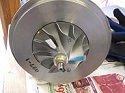
So far I have picked up two turbos for less than $600. They are rebuilt T04E14's (a/r .70 and 1.32). I will probably have a shop look at them before I decide if I want to use them. Otherwise, they go back into the Wonderful World of Ebay.
My plan is to keep the boost level at around 7 psi, with the power to come on at the high end. I have a high-stall converter and 4.08 gears, so my car is not lacking down low.
If the turbos are setup for power at higher rpms, that should help keep the heat and backpressure down. Also, if the turbos are high flow on the exhaust side, then more heat would reach the converters for proper light off.
This approach could be wrong. I am in no way an expert on turbos and am always open for suggestions.
-sijoko
That's a real nice piece of work. Is that going in your Mustang?
Unfortunately, the Q doesn't have that much space available for the turbo (or turbos) to be in front like that.
The two locations that I have selected are where the airbox sits and the battery sits. Once these are moved, a good amount of space opens up.
There is also some space behind the fog lights on the 94-96 Q45. Maybe this can be used for 2 small intercoolers such as on the 300zx.
I know that the only way to get any more power from our cars is go the FI route. I was hoping some company would build a kit.
B.A.D was supposed to put out an Eaton supercharger kit, but that never got put into production. I was on the waiting list.
So the only options are: DIY or pay some company buckets of cash to build a custom kit.
I figure that a single turbo kit can be made for around $2500 in parts. A twin turbo setup would probably add another $1000.
Labor is another story. As long as you do your own work, then costs can be kept under control.
So far I have picked up two turbos for less than $600. They are rebuilt T04E14's (a/r .70 and 1.32). I will probably have a shop look at them before I decide if I want to use them. Otherwise, they go back into the Wonderful World of Ebay.
My plan is to keep the boost level at around 7 psi, with the power to come on at the high end. I have a high-stall converter and 4.08 gears, so my car is not lacking down low.
If the turbos are setup for power at higher rpms, that should help keep the heat and backpressure down. Also, if the turbos are high flow on the exhaust side, then more heat would reach the converters for proper light off.
This approach could be wrong. I am in no way an expert on turbos and am always open for suggestions.
-sijoko
-
SOCAL91Q45a
- Posts: 403
- Joined: Sat Aug 16, 2003 2:28 pm
- Contact:
"That's a real nice piece of work."
Agreed .. glad you can appreciate craftmanship even on an AMERICAN hunk of iron :-)
"Is that going in your Mustang? "
Sadly NO. I prefer to be BLOWN :-) ... centrifugally
"I am in no way an expert on turbos and am always open for suggestions."
That makes 2 of US!!! I was just aware of that photo from another forum - thought Id share some "inspiration". There are however a few dudes around here that likely can help you more:
Q45Tech of course, and AGM, Chally[sp?] et al ..... sorry if anyone was left out. Perhaps NismoFreak can help too :-)
Agreed .. glad you can appreciate craftmanship even on an AMERICAN hunk of iron :-)
"Is that going in your Mustang? "
Sadly NO. I prefer to be BLOWN :-) ... centrifugally
"I am in no way an expert on turbos and am always open for suggestions."
That makes 2 of US!!! I was just aware of that photo from another forum - thought Id share some "inspiration". There are however a few dudes around here that likely can help you more:
Q45Tech of course, and AGM, Chally[sp?] et al ..... sorry if anyone was left out. Perhaps NismoFreak can help too :-)
-
sijoko
- Posts: 961
- Joined: Fri Jul 26, 2002 6:54 am
- Car: Black 1994 Infiniti Q45 Turbo, Pearl White 2014 Maxima Sport
- Contact:
SOCAL,
I always had an appreciation for technology. Out of all the domestic manufacturers, I like the Ford engines the best.
A 5.4 liter with DOHC would be nice on the Q. On the same note, I am very interested to see how many parts the new 5.6 liter engine in the Titan shares with our cars.
I read somewhere that the new engine is based on the VH45DE. This would make sense as the VH has a stronger block which would be better for a heavy duty application than the VK series.
How nice would it be if the 5.6 liter crank would fit the VH45DE?
-sijoko
I always had an appreciation for technology. Out of all the domestic manufacturers, I like the Ford engines the best.
A 5.4 liter with DOHC would be nice on the Q. On the same note, I am very interested to see how many parts the new 5.6 liter engine in the Titan shares with our cars.
I read somewhere that the new engine is based on the VH45DE. This would make sense as the VH has a stronger block which would be better for a heavy duty application than the VK series.
How nice would it be if the 5.6 liter crank would fit the VH45DE?
-sijoko
-
SOCAL91Q45a
- Posts: 403
- Joined: Sat Aug 16, 2003 2:28 pm
- Contact:
Personally I dont think there's much benefit to trying to STROKE the Q ..... Perhaps lower compression pistons, and forged rods for a forced Induction application would be all that is needed. The stock early model 90-93 Q crakshafts sound like a work of art as it is.
Lots of folks in mustang world move the battery to the trunk nd use the space for FI applications. Too bad there's not a viable aftermarket ELECtric fan option for the Q thats "streetable" - seems like it'd open up lots o room.
Lots of folks in mustang world move the battery to the trunk nd use the space for FI applications. Too bad there's not a viable aftermarket ELECtric fan option for the Q thats "streetable" - seems like it'd open up lots o room.
-
sijoko
- Posts: 961
- Joined: Fri Jul 26, 2002 6:54 am
- Car: Black 1994 Infiniti Q45 Turbo, Pearl White 2014 Maxima Sport
- Contact:
You are right about the benefits of stroking the VH versus forced induction. In the long run, it will always be cheaper to put a turbo on it.
The only problems are related to the high compression ratio and packaging of the turbo setup.
If the Q45 had any sort of aftermarket, I would be happy. But the other side of me enjoys fixing problems. Where I live, no one knows what a Q is. Everyone drives pickups and domestic cars.
When I went for inspection, the guy put the front wheels on the rollers.
-sijoko
The only problems are related to the high compression ratio and packaging of the turbo setup.
If the Q45 had any sort of aftermarket, I would be happy. But the other side of me enjoys fixing problems. Where I live, no one knows what a Q is. Everyone drives pickups and domestic cars.
When I went for inspection, the guy put the front wheels on the rollers.
-sijoko
-
SOCAL91Q45a
- Posts: 403
- Joined: Sat Aug 16, 2003 2:28 pm
- Contact:
-
SOCAL91Q45a
- Posts: 403
- Joined: Sat Aug 16, 2003 2:28 pm
- Contact:
More Turbo Inspiration ..........
sijoko - more inspiration :-)
"Here is a pic of our 03' Cobra small frame turbo kit (76mm), it uses a sheetmetal upper with the stock lower and stock intercooler. The kit pictured now belongs to the New owner of nitrous petes old car that had the KB. We made 724 to the wheels at 21lbs, NO NITROUS, see So Cal Diablo website for videos."
For those who dont know - thats a 4.6L DOHC Forced Induction from the factory motor - but comes from ford with a Eaton Roots atop the lower intake. I dont know what theyve done to the heads or cams - but thats pretty crazy!
How high can ya spin a Q motor?
"Here is a pic of our 03' Cobra small frame turbo kit (76mm), it uses a sheetmetal upper with the stock lower and stock intercooler. The kit pictured now belongs to the New owner of nitrous petes old car that had the KB. We made 724 to the wheels at 21lbs, NO NITROUS, see So Cal Diablo website for videos."
For those who dont know - thats a 4.6L DOHC Forced Induction from the factory motor - but comes from ford with a Eaton Roots atop the lower intake. I dont know what theyve done to the heads or cams - but thats pretty crazy!
How high can ya spin a Q motor?
-
sijoko
- Posts: 961
- Joined: Fri Jul 26, 2002 6:54 am
- Car: Black 1994 Infiniti Q45 Turbo, Pearl White 2014 Maxima Sport
- Contact:
Nice pictures, SOCAL. Is that the Cobra engine minus the supercharger? 724 hp at the wheels is ludicrous. Looks like they swapped out the Eaton blower for a turbo, but kept the intercooler. Great idea.
I think that the turbo will be more efficient than the Eaton blower any day. If someone wants high boost, they have to go with a turbo or a centrifugal supercharger. A Roots type will heat the air too much.
I picked up a copy of 5.0 Mustangs & Super Fords today. They have an article on a 2000 Cobra that is puting out 520 rwhp with a turbo non-intercooled setup. The boost was kept at 6 psi. Imagine what kind of power can be had with intercooling and higher boost.
A Q45 with a good turbo setup can easily make over 400 hp at only 7 psi. The engine is overbuilt and I think that it can take more easily. The only thing that concerns me is the compression ratio.
You asked how high can you spin the Q engine.
I know that the Jim Wolf ECU upgrade moves redline to 7200 rpm. I don't think there are many stock v8's that can handle that kind of rpm.
-sijoko
I think that the turbo will be more efficient than the Eaton blower any day. If someone wants high boost, they have to go with a turbo or a centrifugal supercharger. A Roots type will heat the air too much.
I picked up a copy of 5.0 Mustangs & Super Fords today. They have an article on a 2000 Cobra that is puting out 520 rwhp with a turbo non-intercooled setup. The boost was kept at 6 psi. Imagine what kind of power can be had with intercooling and higher boost.
A Q45 with a good turbo setup can easily make over 400 hp at only 7 psi. The engine is overbuilt and I think that it can take more easily. The only thing that concerns me is the compression ratio.
You asked how high can you spin the Q engine.
I know that the Jim Wolf ECU upgrade moves redline to 7200 rpm. I don't think there are many stock v8's that can handle that kind of rpm.
-sijoko
-
SOCAL91Q45a
- Posts: 403
- Joined: Sat Aug 16, 2003 2:28 pm
- Contact:
"Is that the Cobra engine minus the supercharger? "
Correct.
""Looks like they swapped out the Eaton blower for a turbo, but kept the intercooler. ""
Correct.
""Great idea. "" Agreed, not too bad.
"Imagine what kind of power can be had with intercooling and higher boost. "
Uhh I dont have to imagine - its 724 RWHP :-)
"They have an article on a 2000 Cobra that is puting out 520 rwhp with a turbo non-intercooled setup."
The 5.4L DOHC Ford modular gurus are getting 501 RWHP out of them - nat aspirated!!! Custom intakes, forged bottom end internals, custom valve train and CAM grinds, as well as port matched heads.
Correct.
""Looks like they swapped out the Eaton blower for a turbo, but kept the intercooler. ""
Correct.
""Great idea. "" Agreed, not too bad.
"Imagine what kind of power can be had with intercooling and higher boost. "
Uhh I dont have to imagine - its 724 RWHP :-)
"They have an article on a 2000 Cobra that is puting out 520 rwhp with a turbo non-intercooled setup."
The 5.4L DOHC Ford modular gurus are getting 501 RWHP out of them - nat aspirated!!! Custom intakes, forged bottom end internals, custom valve train and CAM grinds, as well as port matched heads.
-
mattd1979
- Posts: 710
- Joined: Fri Oct 29, 2004 6:08 am
- Car: 1990 Pearl White Q45 plain Jane with 266,000 miles. 2015 moonlight white metallic Q70L with 20” wheels, sport brakes and a 5.6L at 58,000 miles.
- Location: Jacksonville
Re: Some ideas for turbo install in a Q45. (sijoko)
I got a recent issue of Mustang Monthly that has an article on an 05' Mustang GT with twin turbos mounted at the rear right behind the bumper where the mufflers would be and the air is forced back up to the front with no need for an intercooler. The name of the company is STS(Squires Turbo Systems) in Utah.
-
maxnix
- Posts: 22627
- Joined: Mon Jul 22, 2002 8:11 pm
- Car: 1995 Infiniti Q45
1995 Infiniti Q45t
2000 Infiniti Q45
Re: Some ideas for turbo install in a Q45. (mattd1979)
Intercoolers will always increase power, reduce predetonation, and increase reliability.mattd1979 wrote:I...twin turbos mounted at the rear right behind the bumper where the mufflers would be and the air is forced back up to the front with no need for an intercooler.
A rear set-up like that is the perfect formula for turbo lag.
-
mattd1979
- Posts: 710
- Joined: Fri Oct 29, 2004 6:08 am
- Car: 1990 Pearl White Q45 plain Jane with 266,000 miles. 2015 moonlight white metallic Q70L with 20” wheels, sport brakes and a 5.6L at 58,000 miles.
- Location: Jacksonville
Re: Some ideas for turbo install in a Q45. (maxnix)
Did you look at the website. I thought about the turbo lag when I first read about it but after reading an article in a Mustang Monthly mag I started thinking about the possibility. It is an '05 Mustang GT that got a twin turbo setup at the rear and an intercooler. The intakes are at the front. They used 2 Garret Airesearch T2/3 Hybrid turbochargers which are putting out 5 pounds of boost minimun. They also upgraded the GT with Cobra injectors, Diablosport tuning, and a Tial blowoff valve. The car is now pushing 470 HP at the rear.
-
maxnix
- Posts: 22627
- Joined: Mon Jul 22, 2002 8:11 pm
- Car: 1995 Infiniti Q45
1995 Infiniti Q45t
2000 Infiniti Q45
Re: Some ideas for turbo install in a Q45. (mattd1979)
The larger the air volume to be compressed, the more compressible it is. Turbo lag is a measure of compressibility.
Doubt if they have surpassed Boyle's law.
Doubt if they have surpassed Boyle's law.
-
elwesso

- Posts: 30810
- Joined: Sun Feb 23, 2003 4:52 pm
- Car: 94 Infiniti Q45t 5 spd
2007 BMW M Coupe
2007 Infiniti G35 S 6MT - Location: Indiana
- Contact:
Re: Some ideas for turbo install in a Q45. (maxnix)
I would much rather see you run a centrifgual supercharger than one of those turbos...

I've read about those STS systems. I'm a little befuddled that they work at all, let alone work what is claimed to be well. It does almost all facets of turbocharging "wrong", and I'm surprised the turbo spins up in any effective way- turbos aren't supposed to be air fans, they work primarily off the heat of the exhaust (as counter-intuitive as that is), not the gas flow.Still, if you're starting from zero boost, I suppose any seems impressive (well, and it is).So, when's someone putting a Paxton belt-driven off the drive shaft?
-
Jeff Williams

- Posts: 3394
- Joined: Fri Aug 02, 2002 4:17 am
- Car: 1994 Infiniti Q45t
2000 Infiniti I30t
2004 Infiniti M45
71, 72, 73, 82 & 2000 Corvettes - Contact:
Re: (Defiant)
You are partially right.
A lot of people think that it is the heat that runs the turbo. I used to, before I did some research (and studying Mechanical Engineering in college didn't hut any. If you haven't spent much time in thermodynamics or fluid dynamics study, you might think because all turbos have heat issues and are placed so close to the engine, that the heat is what does the work. Heat changes the dynamic of the air, and the turbo must be sized based on the air density and temperature. Try grabbing your exhaust pipe behind the rear diff and tell me there is no heat there. Once the air gets to the rear of the car, the density is different, so a different size turbo must be matched to the car. Turbo lag is a byproduct of the turbo size. At the rear of the car, the turbo is much smaller, therefore spools up much faster.
I am not affiliated with the STS system in any way, but I have experienced the incredible power created by them. It is real power, jsut like the turbo system under the hood, there is just less work to install, and no heat issues with everything under the hood. The Q has little room as it is under the hood.
If I was going to invest in a forced induction system for the Q, this is what I would do. That way you don't have to fabricate headers or move stuff around in the engine bay.
For those of you that have not done been there, here are some FAQ's from their website.
With the turbo so far back, don't you get a lot of turbo lag?
No, our turbochargers are sized to operate at this remote location. Just like any turbocharger, once the turbo is up to temperature and in the rpm range for which it was designed to operate. The boost comes on hard and fast. All of our systems will produce full boost below 3000 rpm. If you were to take a conventional turbo and place it at the rear, you would have lots of lag and consequently, our turbo wouldn't work properly if mounted up front.
Doesn't water get into your engine with the filter mounted down low?
No, every kit includes either a snorkel kit which locates the air filter high in the rear quarter panel or an air filter shield. We also include an Outerwears Dry Charger which is a "sock" that protects the filter under very dusty or wet conditions. The only thing you don't want to do is completely submerge the filter. This would draw water through the filter and into the intake tubing. For most vehicles that would mean you would have water coming in your doors before you'd have a problem with the turbo's air filter.
Without a muffler, how does the vehicle sound?
The turbo does an amazing job of muffling sound. Most people think it sounds like a performance muffler. You can add a high flow muffler to the system, but most of our customers like the performance sound with just the turbo.
With so long of intake and exhaust tubes, doesn't it take a while for the boost to build up?
No, our intake tubing volume is about the same as most conventional turbo setups that are running a front mounted intercooler, and less than many of them that run large intercoolers. We aren't talking about a small compressor filling up a large air tank, we are talking about a huge compressor filling up a very small volume which only takes a fraction of a second. Our systems compress the intake tubing in about .05 seconds. So much for turbo lag...
How is the turbo lubricated?
Our system uses the engine's pressurized oiling system to supply the turbocharger. This pressurized oil travels approximately 12 feet through tubing which dissipates heat out of the oil just like an oil cooler to provide cool oil to the turbocharger. The oil is then scavenged from the turbocharger via an electric oil pump which returns the oil to the engines valve cover through another long length of tubing which again cools down the turbo-heated oil before entering the engine.
With the turbo located under the fuel tank on the Camaro, doesn't it heat up the fuel?
We have done temperature testing on this issue and found that the factory heat shield does a great job of preventing the transfer of heat into the fuel tank. The temperature of the air on top of the heat shield only rose about 15F higher than ambient temperature with a full boost run. The only time you might see an increase in actual fuel temperature would be during extensive stationary dyno testing when there isn't any substantial airflow around the turbocharger and rear of the car. We recommend running a full tank of gas for any dyno testing.
How much boost can I run with this turbocharger?
The basic kits run 5-6 psi boost. The turbocharger on our basic kits is capable of producing higher boost of 15+ psi. However, in most cases a larger turbocharger would be more efficient at higher boost levels. There is more to running higher boost than just turning the boost up. You must also be able to meet the fuel demands of higher boost as well as set up the engine to handle the extra power so that you don't cause mechanical failures with the engine. Higher boost will also raise the "boosted" compression ratio of the engine that will require higher octane fuel to prevent detonation. Bottom line - Don't crank up the boost unless you have done your homework and made the necessary modifications to handle the boost.
We handle high boost applications on an individual basis to ensure that you are getting the right turbocharger setup for your specific needs.
What happens if something goes wrong with the oil pump?
In the event of an oil pump failure, the system is equipped with an alarm which will sound inside the vehicle to warn you that you are experiencing an oil system problem so that you can prevent any damage to the turbo or engine. This alarm is designed to warn you of any problems with the oil pump well before a complete shutdown of the pump.
If water hits the hot turbo, will it crack?
Seems like it might when you first think about it, however, when I asked the Garrett engineers this questions they just laughed. There is a big difference in water splashing on a hot turbo and submerging it in enough water and fast enough to really cool it down fast. Both the new turbocharged Vette systems and the new Porsche systems sit the turbo down low and exposed to water and anything else that goes under a car. Plus, our turbos just don't get that hot and when weather conditions are such that there is a lot of water around, you can't push enough boost to get the turbo hot anyway because you'd just spin the tires.
What type of tuning is needed with this setup?
We recommend tuning with any forced induction. There are a variety of options available from custom dyno tuning, to mail order tunes to FMUs.
Our recommended tuning solution is Nelson Performance in Texas. He has tuning available for the GM vehicles and his tuning package can be purchased through the STS Power Dealers. For more information see Tuning on the Products page. For Toyota trucks running additional boost we recommend a FMU and an aftermarket fuel pump. For high boost applications we recommend a fuel pressure regulator combined with the Unichip tuning solution. All of these parts are available through your local STS Power Dealer.
Is a turbo timer or pre-lube device necessary with your system?
No, the turbocharger temperatures on our systems are approximately 500F cooler than turbo temps on conventional systems so the oil doesn't get hot enough to carbonize in the turbocharger bearings. With the turbocharger located where it is exposed to ambient air rather than trapped under the hood, the turbocharger quickly cools down as well so cool down times after runs don't need to be 5 to 10 minutes. As far as pre-lubrication, our system incorporates our "Wet Start" system which keeps oil at the turbo inlet at all times so that the turbocharger has an instant oil supply at start up.
Do I need to put headers on to optimize the turbo system?
No, the extra expense and work to install aftermarket headers isn't necessary. Headers are designed to eliminate backpressure in the exhaust system and facilitate exhaust scavenging and flow on normally aspirated engines. Turbocharged engines work on slightly different principles. Namely, there is exhaust "Pressure" between the cylinder heads and the turbocharger because the turbocharger is the smallest diameter orifice in the exhaust system. The turbine housing gets smaller in diameter to increase the velocity of the exhaust gasses before they hit the turbine wheel. This is how you get 100,000 rpm wheel speeds. Turbocharged exhaust gas pressures can see as high as 30+ psi on high boost applications. So spending money on higher flowing exhaust components designed to lower exhaust backpressure is usually a waste of money. This money would be better spent on an upgraded turbocharger which would produce more efficient boost with less backpressure or just spending the money on upgrading the engine and fuel system to handle more boost.
Doesn't heat create the velocity in the exhaust gasses to spool the turbo?
No, heat doesn't create velocity. Heat creates volume. If you look at any of the physics laws for gasses, you will find that pressure and volume and heat are related. PV=NRT is a popular one, The V isn't for velocity, it is for Volume. The turbine housing is what creates the velocity. The scrolling design that reduces the volume of the exhaust chamber as it scrolls around causes the gasses to have to increase in velocity and pressure to maintain the same flow rate.
Hotter gasses have more volume, thus requiring a higher A/R which in effect means that it starts at say 3" and scrolls down to approximately 1". Lower temperature gasses are denser and have less volume, so they require a lower A/R housing which would start at the same 3" volume, as the turbine housings use standard flanges, and scroll down to say 3/4".
Now if you were to reverse the housings in application, the conventional turbo would spool up extremely quick, at say around 1500 rpm but would cause too much backpressure at higher rpms because the higher volume of gas couldn't squeeze through the 3/4" hole without requiring a lot of pressure to force it through. On the reverse side, the remote mounted turbo with its cooler denser gasses, wouldn't spool up till say around 4000 rpms but once spooled up would make efficient power because it doesn't require hardly any backpressure to push the lower volume of gas through the larger 1" hole.
How efficient is the intercooling from your tubing?
At 5 to 6 psi we typically get at least 50% intercooler efficiency numbers from our systems and some of the truck systems which have better exposure to cold air are even better. Combine this with a pressure drop of only about 1/4 to 3/4 psi and it makes for very good numbers. Testing on our LS1 produced the following results:
Turbo outlet temps at 5 psi boost were 175F and intake temps were 115F which is about 52% efficient.
Turbo outlet temps at 8 psi boost were 225F. This is a 50F increase with only 3 psi added to turbocharger boost.
For those wanting to run more boost we recommend a front mounted intercooler. We sell bolt-on solutions for the Hemi and the GTO. We will be coming out with more applications soon.
Isn't there a huge pressure drop with such long intake tubes?
No, if the pipes were 100' long there would be but we are only talking a few extra feet and we size the charge air tubing so that it will flow without a large pressure drop. We typically will get about 1/4 to 3/4 lb difference between the turbo compressor and the intake manifold, which is nothing compared to the pressure drop across an intercooler. With high boost applications, these numbers will increase slightly.
Don't turbos have to be really hot to work properly?
Putting a torch to your turbo and getting it hot doesn't produce boost. What produces boost is airflow across the turbine which causes the turbine to spin. If turbochargers required very high temperatures to produce boost, Diesel trucks and Methanol Race cars wouldn't be able to run turbos. However, each of these "Low Exhaust Temperature" vehicles work very well with turbochargers when, like any turbo application, the turbocharger is sized correctly. In a conventional, exhaust manifold mounted turbocharger system, the extra heat causes the air molecules to separate and the gas becomes "thinner" because of the extra space between the molecules. This extra space increases the volume of air but doesn't increase the mass of the air. Because the volume is higher, the velocity of the gas has to be higher to get it out in the same amount of time.
By mounting the turbo further downstream, the gasses do lose heat energy and velocity, however, there is just as much mass (the amount of air) coming out of the tailpipe as there is coming out of the heads. So you are driving the turbine with a "denser" gas charge. The same number of molecules per second are striking the turbine and flowing across the turbine at 1200F as there is at 1700F.
Front mounted turbos typically run an A/R ratio turbine housing about 2 sizes larger because the velocity is already in the gasses and the volume is so big that the turbine housing must be larger to not cause a major restriction in the exhaust system which would cause more backpressure. With the remote mounted turbo, the gasses have condensed and the volume is less, so a smaller A/R ratio turbine housing can be used which increases the velocity of the gasses while not causing any extra backpressure because the gas volume is smaller and denser.
Sizing is everything with turbos. There is more to sizing a turbo for an application than cubic inches, Volumetric Efficiency, and RPM ranges. A turbo must also be sized for the exhaust temperatures. A turbine housing sized for 1700F gasses would have lag if the gasses were 1200F. This is why turbo cars have lag when they are cold and not warmed up yet. Both systems work well if sized correctly.
How much octane do I need to run a turbocharger?
We recommend running Premium gasoline on vehicles that are running 5 to 12 psi.
What about ground clearance with the turbo down low on Camaro?
Ground clearance hasn't been a problem as all of the kit sits higher than the stock equipment. The lowest areas are near the wheels which give it added clearance going over bumps.
What is the difference between a Supercharger and a Turbocharger?
First of all, there are a couple different types of superchargers (positive displacement and centrifugal). The most popular these days seems to be the centrifugal supercharger which is basically the same design compressor as a turbocharger compressor. These compressors both increase in airflow and efficiency with impeller RPM's. (Which basically means that doubling the impeller RPM doesn't double the airflow, it increases the air flow exponentially.) So in the case of the supercharger, where it is directly run from a belt and pulley attached to the crankshaft which ties impeller RPM in a direct ratio to crankshaft RPM, the boost increases linearly with engine RPM. Example: If you want to run maximum boost of 8 psi, you would gear the drive pulleys to produce 8 psi at maximum engine RPM. Lower RPM's would produce less boost linearly. I.E. 8 psi @ 6000rpm, 5 psi @ 4500rpm, 3 psi @ 3000rpm, and 2 psi @ 2500rpm.) Thus, maximum boost is only attained at maximum engine RPM which only lasts for a fraction of a second then when the engine shifts to the next gear and the RPM's drop back down, so does the boost which then builds up again with increasing engine RPM's.
Supercharged engines produce good "maximum rpm" dyno numbers. Don't be fooled by maximum dyno numbers. Unless you have a "Snowmobile Clutch" in your vehicle which allows your engine to stay at peak RPM all the way down the track, what you need is "Usable Power" which comes from sustained boost levels across the entire RPM range. This is where the Turbocharger outperforms the Supercharger.
By using exhaust gasses to drive the turbocharger you gain two benefits: First is that you don't pull Horsepower off of your crankshaft to drive the compressor (Just like you wouldn't replace your electric fan with a large "belt driven" fan or run your A/C down the track because these devices take Horsepower to run as does a Supercharger compressor capable of pumping 50 pounds of air per minute @ 8 psi). Secondly, since the turbocharger is driven by exhaust gasses, the more air the turbocharger puts into the engine, the more exhaust gasses the engine produces, which in turn produces more turbocharger RPM's and air discharge or "Boost". So, to sum it all up, the turbocharger can go from literally "No Boost" to "Full Boost" in a fraction of a second because of the compounding effects of the Compressor Efficiency increasing with impeller RPM's and the compounding effects of the Exhaust Gas increasing exponentially with increasing Boost.
So if you are only concerned with Peak Dyno Numbers the supercharger does produce good "Peak" numbers, but if you want "Full Boost" across a broader RPM range along with those high "Peak" Dyno numbers. The Turbocharger is a better solution.
If I want to run higher boost will I need a bigger wastegate?
Running higher boost doesn't require a larger wastegate, in fact in most situations running lower boost requires a larger wastegate than high boost applications. The wastegate flows exhaust out to lower the boost level. The lower the boost requirements, the more exhaust has to flow through the wastegate valve. Running higher boost will require a stiffer wastegate spring or the use of a boost controller. Our Electronic Dual Stage Boost Controller works very well and gives you the option of Hi or Low boost at the flip of a switch.
How does your dual stage boost controller work?
The electronic dual stage boost controller lets your wastegate operate normally on the "low" setting on the switch. When you flip the switch to "high" the system adds pressure to the other side of the wastegate diaphragm. You can choose how much pressure is added, 0-5 psi or 0-15 psi. The "high" setting is adjustable and once set at your predetermined amount, will give you that much more boost above the "low" setting. If your wastegate is 5 psi, you'll run 5 psi on the low setting. If you set your controller to 3 psi, when you flip the switch to "high" you will have 8 psi boost. This system can also be used to "arm" the methanol injection or water injection system so that it only runs on "high" when you need it and doesn't run out of fluid driving around town. System can also be set up so that when the methanol system isn't working (if it runs out of fluid) the boost can be defaulted back to "low" boost as to not damage the engine.
Will a bigger cam make more power with a turbo?
Cam choice in turbo applications is critical. In many cases, a stock cam will work better than a typical "race cam" that would work well with an aspirated engine. What you want to avoid is the "intake and exhaust valve overlap". This is the time that the exhaust and intake valves are open at the same time. In aspirated engines, this theory facilitates the scavenging of all burnt exhaust gasses from the cylinder after the power stroke so that an "uncontaminated" and 100% burnable charge fills the cylinder on the next cycle which produces maximum power. Some of this condition can be tolerated with supercharged applications as it merely blows some of the boost out with the exhaust. However, on turbocharged applications (many people believe that the boost also is just blown out with the exhaust) however, the opposite is truer to the case. With exhaust pressures sometimes exceeding boost pressures, the exhaust can flow into the cylinder and into the intake manifold during this overlap time which contaminates the intake charge, decreases HP, and can cause pre-ignition as well. Also, most cam applications begin flow at .050" of valve lift. On forced induction systems, there can be substantial flow below this amount of lift because of the higher pressures behind the valves. So, if in doubt go smaller on your cam rather than larger. Go wider on lobe separation angles (114 degrees is usually safe) Smaller on durations (stick around 220) and check with the cam manufacturer to make sure that it is a good "turbo" cam and not just a generic supercharger/turbo cam. A good option is to install a set of higher ratio roller rockers on your stock cam. Better pushrods and stiffer valve springs will help as well because boost and cylinder pressures will be way higher than stock. Stiffer springs will help close the valves against the pressure of incoming air and stronger pushrods will help open the exhaust valve against the increased cylinder pressures.
Aren't the stock manifolds and exhaust system restrictive?
For certain normally aspirated or supercharged systems, stock exhaust is somewhat restrictive and can cause backpressure in the system and rob HP. However, with turbocharged applications, the turbocharger is the biggest restriction in the exhaust system. All of the exhaust gasses (except the ones that are vented out the wastegate) pass through the turbine housing. The inlet hole in the turbine housing is about 2"x3", however, as it scrolls around the housing it gets smaller and smaller causing the exhaust gasses to increase in velocity. At the smallest point where the gasses exit and hit the turbine wheel, the hole is no bigger than about 1" in diameter. This tiny hole will create backpressure in the entire exhaust system prior to the turbo and clear back to the exhaust valves. So sticking larger diameter pipes and high flowing headers doesn't make lots of sense when you have a 1" tailpipe hole. These additions probably won't hurt, but the money would be far better spent elsewhere. Our Turbo Camaro put down 522 RWHP and 620 RWTQ through the same restrictive exhaust manifolds and I-pipe that came stock on the car. Turbocharging is very different than Supercharging or Normally aspirated. That is good news because you don't have to spend the extra money on the exhaust system!
Will your methanol injection setup work with any turbocharged car?
Yes, our Methanol System is designed to work with any turbocharged, supercharged, or even Normally Aspirated engines. We typically will see 100F intake temperature drops with this system. The Octane requirements are lowered, the cylinder temperatures are lowered, and the exhaust temperatures are lowered. It's all good! We installed our Methanol System on a Supercharged Viper. We lowered his intake temperatures from 220F down to 100F. The extra fuel allowed him to lean out his injector map and the water cooled the cylinder temps down enough to add 4 degrees of ignition timing. He lowered his ET from a 10.8 down to a 10.6. He raised his MPH from 134 to 140 MPH!
How does your methanol system work?Unlike many methanol or water injection systems on the market. Ours doesn't just turn on at a predetermined boost level and dump fluid in, causing flooding at lower rpms and part throttle positions and leaning out at high rpms and WOT. With our Sequential Methanol System, you inject your extra fuel and/or water mixture at the same rate as your stock fuel injectors do. The more throttle you give it, the more fluid goes in. The higher the rpms go, the more fluid goes in. The system is adjustable as to when it kicks on, and also adjustable as to the gallons/minute flow rate, as well as tunable with the Methanol/Water ratio. It is simple to install and easy to adjust and tune for optimum performance. Combine this with our Electronic Dual Stage Boost Controller and set it up to only run on High Boost. You can also set it up so that if the Injection shuts off for any reason, such as it runs out of fluid, the boost controller will default back to low boost. It is a definite "Must Have" for any turbocharged or supercharged vehicle.
How much cooling is provided by the Methanol system?
The amount of intercooling provided by the Methanol Injection System is somewhat varied by how much methanol you are injecting. Here are results of testing we did on the LS1 Camaro: At 5 psi without methanol, the turbo outlet temps were 175F and intake temps were 115F which is about 50% efficient.
At 8 psi with the Methanol Injection System running, turbo outlet temps were 225F and intake temps were 70F. This is 94% intercooling efficiency. All this without the cost and installation problems that go along with trying to put a large intercooler into the front of your vehicle.
Where do you mount the Methanol Injection tank?
The tank can mount just about anywhere. We usually stick it in the rear and mount the pump there also just for better weight transfer. FWD's would probably want it up front though. You don't want it to be exposed to a lot of heat though as the Methanol boils at about 150F. We also have several tank sizes to better accommodate individual needs.
What intake air temps do you get?
IATs on vehicles with our intercoolers run about 10-20 degrees above ambient under boost. If you are running 5 psi without an intercooler you should see IATs 50 to 70 degrees above ambient under boost.
Will this system work with my modified stroker and high stall converter?
Yes, the system will work with different engine sizes and converter options. However, we handle these modified cars on an individual basis so that the proper size of turbocharger can be installed with the kit. We have several turbocharger options that we can tailor to suit individual needs without adding extra costs to the kit. We also offer upgraded turbochargers for those who want to get maximum efficiency and HP.
A lot of people think that it is the heat that runs the turbo. I used to, before I did some research (and studying Mechanical Engineering in college didn't hut any. If you haven't spent much time in thermodynamics or fluid dynamics study, you might think because all turbos have heat issues and are placed so close to the engine, that the heat is what does the work. Heat changes the dynamic of the air, and the turbo must be sized based on the air density and temperature. Try grabbing your exhaust pipe behind the rear diff and tell me there is no heat there. Once the air gets to the rear of the car, the density is different, so a different size turbo must be matched to the car. Turbo lag is a byproduct of the turbo size. At the rear of the car, the turbo is much smaller, therefore spools up much faster.
I am not affiliated with the STS system in any way, but I have experienced the incredible power created by them. It is real power, jsut like the turbo system under the hood, there is just less work to install, and no heat issues with everything under the hood. The Q has little room as it is under the hood.
If I was going to invest in a forced induction system for the Q, this is what I would do. That way you don't have to fabricate headers or move stuff around in the engine bay.
For those of you that have not done been there, here are some FAQ's from their website.
With the turbo so far back, don't you get a lot of turbo lag?
No, our turbochargers are sized to operate at this remote location. Just like any turbocharger, once the turbo is up to temperature and in the rpm range for which it was designed to operate. The boost comes on hard and fast. All of our systems will produce full boost below 3000 rpm. If you were to take a conventional turbo and place it at the rear, you would have lots of lag and consequently, our turbo wouldn't work properly if mounted up front.
Doesn't water get into your engine with the filter mounted down low?
No, every kit includes either a snorkel kit which locates the air filter high in the rear quarter panel or an air filter shield. We also include an Outerwears Dry Charger which is a "sock" that protects the filter under very dusty or wet conditions. The only thing you don't want to do is completely submerge the filter. This would draw water through the filter and into the intake tubing. For most vehicles that would mean you would have water coming in your doors before you'd have a problem with the turbo's air filter.
Without a muffler, how does the vehicle sound?
The turbo does an amazing job of muffling sound. Most people think it sounds like a performance muffler. You can add a high flow muffler to the system, but most of our customers like the performance sound with just the turbo.
With so long of intake and exhaust tubes, doesn't it take a while for the boost to build up?
No, our intake tubing volume is about the same as most conventional turbo setups that are running a front mounted intercooler, and less than many of them that run large intercoolers. We aren't talking about a small compressor filling up a large air tank, we are talking about a huge compressor filling up a very small volume which only takes a fraction of a second. Our systems compress the intake tubing in about .05 seconds. So much for turbo lag...
How is the turbo lubricated?
Our system uses the engine's pressurized oiling system to supply the turbocharger. This pressurized oil travels approximately 12 feet through tubing which dissipates heat out of the oil just like an oil cooler to provide cool oil to the turbocharger. The oil is then scavenged from the turbocharger via an electric oil pump which returns the oil to the engines valve cover through another long length of tubing which again cools down the turbo-heated oil before entering the engine.
With the turbo located under the fuel tank on the Camaro, doesn't it heat up the fuel?
We have done temperature testing on this issue and found that the factory heat shield does a great job of preventing the transfer of heat into the fuel tank. The temperature of the air on top of the heat shield only rose about 15F higher than ambient temperature with a full boost run. The only time you might see an increase in actual fuel temperature would be during extensive stationary dyno testing when there isn't any substantial airflow around the turbocharger and rear of the car. We recommend running a full tank of gas for any dyno testing.
How much boost can I run with this turbocharger?
The basic kits run 5-6 psi boost. The turbocharger on our basic kits is capable of producing higher boost of 15+ psi. However, in most cases a larger turbocharger would be more efficient at higher boost levels. There is more to running higher boost than just turning the boost up. You must also be able to meet the fuel demands of higher boost as well as set up the engine to handle the extra power so that you don't cause mechanical failures with the engine. Higher boost will also raise the "boosted" compression ratio of the engine that will require higher octane fuel to prevent detonation. Bottom line - Don't crank up the boost unless you have done your homework and made the necessary modifications to handle the boost.
We handle high boost applications on an individual basis to ensure that you are getting the right turbocharger setup for your specific needs.
What happens if something goes wrong with the oil pump?
In the event of an oil pump failure, the system is equipped with an alarm which will sound inside the vehicle to warn you that you are experiencing an oil system problem so that you can prevent any damage to the turbo or engine. This alarm is designed to warn you of any problems with the oil pump well before a complete shutdown of the pump.
If water hits the hot turbo, will it crack?
Seems like it might when you first think about it, however, when I asked the Garrett engineers this questions they just laughed. There is a big difference in water splashing on a hot turbo and submerging it in enough water and fast enough to really cool it down fast. Both the new turbocharged Vette systems and the new Porsche systems sit the turbo down low and exposed to water and anything else that goes under a car. Plus, our turbos just don't get that hot and when weather conditions are such that there is a lot of water around, you can't push enough boost to get the turbo hot anyway because you'd just spin the tires.
What type of tuning is needed with this setup?
We recommend tuning with any forced induction. There are a variety of options available from custom dyno tuning, to mail order tunes to FMUs.
Our recommended tuning solution is Nelson Performance in Texas. He has tuning available for the GM vehicles and his tuning package can be purchased through the STS Power Dealers. For more information see Tuning on the Products page. For Toyota trucks running additional boost we recommend a FMU and an aftermarket fuel pump. For high boost applications we recommend a fuel pressure regulator combined with the Unichip tuning solution. All of these parts are available through your local STS Power Dealer.
Is a turbo timer or pre-lube device necessary with your system?
No, the turbocharger temperatures on our systems are approximately 500F cooler than turbo temps on conventional systems so the oil doesn't get hot enough to carbonize in the turbocharger bearings. With the turbocharger located where it is exposed to ambient air rather than trapped under the hood, the turbocharger quickly cools down as well so cool down times after runs don't need to be 5 to 10 minutes. As far as pre-lubrication, our system incorporates our "Wet Start" system which keeps oil at the turbo inlet at all times so that the turbocharger has an instant oil supply at start up.
Do I need to put headers on to optimize the turbo system?
No, the extra expense and work to install aftermarket headers isn't necessary. Headers are designed to eliminate backpressure in the exhaust system and facilitate exhaust scavenging and flow on normally aspirated engines. Turbocharged engines work on slightly different principles. Namely, there is exhaust "Pressure" between the cylinder heads and the turbocharger because the turbocharger is the smallest diameter orifice in the exhaust system. The turbine housing gets smaller in diameter to increase the velocity of the exhaust gasses before they hit the turbine wheel. This is how you get 100,000 rpm wheel speeds. Turbocharged exhaust gas pressures can see as high as 30+ psi on high boost applications. So spending money on higher flowing exhaust components designed to lower exhaust backpressure is usually a waste of money. This money would be better spent on an upgraded turbocharger which would produce more efficient boost with less backpressure or just spending the money on upgrading the engine and fuel system to handle more boost.
Doesn't heat create the velocity in the exhaust gasses to spool the turbo?
No, heat doesn't create velocity. Heat creates volume. If you look at any of the physics laws for gasses, you will find that pressure and volume and heat are related. PV=NRT is a popular one, The V isn't for velocity, it is for Volume. The turbine housing is what creates the velocity. The scrolling design that reduces the volume of the exhaust chamber as it scrolls around causes the gasses to have to increase in velocity and pressure to maintain the same flow rate.
Hotter gasses have more volume, thus requiring a higher A/R which in effect means that it starts at say 3" and scrolls down to approximately 1". Lower temperature gasses are denser and have less volume, so they require a lower A/R housing which would start at the same 3" volume, as the turbine housings use standard flanges, and scroll down to say 3/4".
Now if you were to reverse the housings in application, the conventional turbo would spool up extremely quick, at say around 1500 rpm but would cause too much backpressure at higher rpms because the higher volume of gas couldn't squeeze through the 3/4" hole without requiring a lot of pressure to force it through. On the reverse side, the remote mounted turbo with its cooler denser gasses, wouldn't spool up till say around 4000 rpms but once spooled up would make efficient power because it doesn't require hardly any backpressure to push the lower volume of gas through the larger 1" hole.
How efficient is the intercooling from your tubing?
At 5 to 6 psi we typically get at least 50% intercooler efficiency numbers from our systems and some of the truck systems which have better exposure to cold air are even better. Combine this with a pressure drop of only about 1/4 to 3/4 psi and it makes for very good numbers. Testing on our LS1 produced the following results:
Turbo outlet temps at 5 psi boost were 175F and intake temps were 115F which is about 52% efficient.
Turbo outlet temps at 8 psi boost were 225F. This is a 50F increase with only 3 psi added to turbocharger boost.
For those wanting to run more boost we recommend a front mounted intercooler. We sell bolt-on solutions for the Hemi and the GTO. We will be coming out with more applications soon.
Isn't there a huge pressure drop with such long intake tubes?
No, if the pipes were 100' long there would be but we are only talking a few extra feet and we size the charge air tubing so that it will flow without a large pressure drop. We typically will get about 1/4 to 3/4 lb difference between the turbo compressor and the intake manifold, which is nothing compared to the pressure drop across an intercooler. With high boost applications, these numbers will increase slightly.
Don't turbos have to be really hot to work properly?
Putting a torch to your turbo and getting it hot doesn't produce boost. What produces boost is airflow across the turbine which causes the turbine to spin. If turbochargers required very high temperatures to produce boost, Diesel trucks and Methanol Race cars wouldn't be able to run turbos. However, each of these "Low Exhaust Temperature" vehicles work very well with turbochargers when, like any turbo application, the turbocharger is sized correctly. In a conventional, exhaust manifold mounted turbocharger system, the extra heat causes the air molecules to separate and the gas becomes "thinner" because of the extra space between the molecules. This extra space increases the volume of air but doesn't increase the mass of the air. Because the volume is higher, the velocity of the gas has to be higher to get it out in the same amount of time.
By mounting the turbo further downstream, the gasses do lose heat energy and velocity, however, there is just as much mass (the amount of air) coming out of the tailpipe as there is coming out of the heads. So you are driving the turbine with a "denser" gas charge. The same number of molecules per second are striking the turbine and flowing across the turbine at 1200F as there is at 1700F.
Front mounted turbos typically run an A/R ratio turbine housing about 2 sizes larger because the velocity is already in the gasses and the volume is so big that the turbine housing must be larger to not cause a major restriction in the exhaust system which would cause more backpressure. With the remote mounted turbo, the gasses have condensed and the volume is less, so a smaller A/R ratio turbine housing can be used which increases the velocity of the gasses while not causing any extra backpressure because the gas volume is smaller and denser.
Sizing is everything with turbos. There is more to sizing a turbo for an application than cubic inches, Volumetric Efficiency, and RPM ranges. A turbo must also be sized for the exhaust temperatures. A turbine housing sized for 1700F gasses would have lag if the gasses were 1200F. This is why turbo cars have lag when they are cold and not warmed up yet. Both systems work well if sized correctly.
How much octane do I need to run a turbocharger?
We recommend running Premium gasoline on vehicles that are running 5 to 12 psi.
What about ground clearance with the turbo down low on Camaro?
Ground clearance hasn't been a problem as all of the kit sits higher than the stock equipment. The lowest areas are near the wheels which give it added clearance going over bumps.
What is the difference between a Supercharger and a Turbocharger?
First of all, there are a couple different types of superchargers (positive displacement and centrifugal). The most popular these days seems to be the centrifugal supercharger which is basically the same design compressor as a turbocharger compressor. These compressors both increase in airflow and efficiency with impeller RPM's. (Which basically means that doubling the impeller RPM doesn't double the airflow, it increases the air flow exponentially.) So in the case of the supercharger, where it is directly run from a belt and pulley attached to the crankshaft which ties impeller RPM in a direct ratio to crankshaft RPM, the boost increases linearly with engine RPM. Example: If you want to run maximum boost of 8 psi, you would gear the drive pulleys to produce 8 psi at maximum engine RPM. Lower RPM's would produce less boost linearly. I.E. 8 psi @ 6000rpm, 5 psi @ 4500rpm, 3 psi @ 3000rpm, and 2 psi @ 2500rpm.) Thus, maximum boost is only attained at maximum engine RPM which only lasts for a fraction of a second then when the engine shifts to the next gear and the RPM's drop back down, so does the boost which then builds up again with increasing engine RPM's.
Supercharged engines produce good "maximum rpm" dyno numbers. Don't be fooled by maximum dyno numbers. Unless you have a "Snowmobile Clutch" in your vehicle which allows your engine to stay at peak RPM all the way down the track, what you need is "Usable Power" which comes from sustained boost levels across the entire RPM range. This is where the Turbocharger outperforms the Supercharger.
By using exhaust gasses to drive the turbocharger you gain two benefits: First is that you don't pull Horsepower off of your crankshaft to drive the compressor (Just like you wouldn't replace your electric fan with a large "belt driven" fan or run your A/C down the track because these devices take Horsepower to run as does a Supercharger compressor capable of pumping 50 pounds of air per minute @ 8 psi). Secondly, since the turbocharger is driven by exhaust gasses, the more air the turbocharger puts into the engine, the more exhaust gasses the engine produces, which in turn produces more turbocharger RPM's and air discharge or "Boost". So, to sum it all up, the turbocharger can go from literally "No Boost" to "Full Boost" in a fraction of a second because of the compounding effects of the Compressor Efficiency increasing with impeller RPM's and the compounding effects of the Exhaust Gas increasing exponentially with increasing Boost.
So if you are only concerned with Peak Dyno Numbers the supercharger does produce good "Peak" numbers, but if you want "Full Boost" across a broader RPM range along with those high "Peak" Dyno numbers. The Turbocharger is a better solution.
If I want to run higher boost will I need a bigger wastegate?
Running higher boost doesn't require a larger wastegate, in fact in most situations running lower boost requires a larger wastegate than high boost applications. The wastegate flows exhaust out to lower the boost level. The lower the boost requirements, the more exhaust has to flow through the wastegate valve. Running higher boost will require a stiffer wastegate spring or the use of a boost controller. Our Electronic Dual Stage Boost Controller works very well and gives you the option of Hi or Low boost at the flip of a switch.
How does your dual stage boost controller work?
The electronic dual stage boost controller lets your wastegate operate normally on the "low" setting on the switch. When you flip the switch to "high" the system adds pressure to the other side of the wastegate diaphragm. You can choose how much pressure is added, 0-5 psi or 0-15 psi. The "high" setting is adjustable and once set at your predetermined amount, will give you that much more boost above the "low" setting. If your wastegate is 5 psi, you'll run 5 psi on the low setting. If you set your controller to 3 psi, when you flip the switch to "high" you will have 8 psi boost. This system can also be used to "arm" the methanol injection or water injection system so that it only runs on "high" when you need it and doesn't run out of fluid driving around town. System can also be set up so that when the methanol system isn't working (if it runs out of fluid) the boost can be defaulted back to "low" boost as to not damage the engine.
Will a bigger cam make more power with a turbo?
Cam choice in turbo applications is critical. In many cases, a stock cam will work better than a typical "race cam" that would work well with an aspirated engine. What you want to avoid is the "intake and exhaust valve overlap". This is the time that the exhaust and intake valves are open at the same time. In aspirated engines, this theory facilitates the scavenging of all burnt exhaust gasses from the cylinder after the power stroke so that an "uncontaminated" and 100% burnable charge fills the cylinder on the next cycle which produces maximum power. Some of this condition can be tolerated with supercharged applications as it merely blows some of the boost out with the exhaust. However, on turbocharged applications (many people believe that the boost also is just blown out with the exhaust) however, the opposite is truer to the case. With exhaust pressures sometimes exceeding boost pressures, the exhaust can flow into the cylinder and into the intake manifold during this overlap time which contaminates the intake charge, decreases HP, and can cause pre-ignition as well. Also, most cam applications begin flow at .050" of valve lift. On forced induction systems, there can be substantial flow below this amount of lift because of the higher pressures behind the valves. So, if in doubt go smaller on your cam rather than larger. Go wider on lobe separation angles (114 degrees is usually safe) Smaller on durations (stick around 220) and check with the cam manufacturer to make sure that it is a good "turbo" cam and not just a generic supercharger/turbo cam. A good option is to install a set of higher ratio roller rockers on your stock cam. Better pushrods and stiffer valve springs will help as well because boost and cylinder pressures will be way higher than stock. Stiffer springs will help close the valves against the pressure of incoming air and stronger pushrods will help open the exhaust valve against the increased cylinder pressures.
Aren't the stock manifolds and exhaust system restrictive?
For certain normally aspirated or supercharged systems, stock exhaust is somewhat restrictive and can cause backpressure in the system and rob HP. However, with turbocharged applications, the turbocharger is the biggest restriction in the exhaust system. All of the exhaust gasses (except the ones that are vented out the wastegate) pass through the turbine housing. The inlet hole in the turbine housing is about 2"x3", however, as it scrolls around the housing it gets smaller and smaller causing the exhaust gasses to increase in velocity. At the smallest point where the gasses exit and hit the turbine wheel, the hole is no bigger than about 1" in diameter. This tiny hole will create backpressure in the entire exhaust system prior to the turbo and clear back to the exhaust valves. So sticking larger diameter pipes and high flowing headers doesn't make lots of sense when you have a 1" tailpipe hole. These additions probably won't hurt, but the money would be far better spent elsewhere. Our Turbo Camaro put down 522 RWHP and 620 RWTQ through the same restrictive exhaust manifolds and I-pipe that came stock on the car. Turbocharging is very different than Supercharging or Normally aspirated. That is good news because you don't have to spend the extra money on the exhaust system!
Will your methanol injection setup work with any turbocharged car?
Yes, our Methanol System is designed to work with any turbocharged, supercharged, or even Normally Aspirated engines. We typically will see 100F intake temperature drops with this system. The Octane requirements are lowered, the cylinder temperatures are lowered, and the exhaust temperatures are lowered. It's all good! We installed our Methanol System on a Supercharged Viper. We lowered his intake temperatures from 220F down to 100F. The extra fuel allowed him to lean out his injector map and the water cooled the cylinder temps down enough to add 4 degrees of ignition timing. He lowered his ET from a 10.8 down to a 10.6. He raised his MPH from 134 to 140 MPH!
How does your methanol system work?Unlike many methanol or water injection systems on the market. Ours doesn't just turn on at a predetermined boost level and dump fluid in, causing flooding at lower rpms and part throttle positions and leaning out at high rpms and WOT. With our Sequential Methanol System, you inject your extra fuel and/or water mixture at the same rate as your stock fuel injectors do. The more throttle you give it, the more fluid goes in. The higher the rpms go, the more fluid goes in. The system is adjustable as to when it kicks on, and also adjustable as to the gallons/minute flow rate, as well as tunable with the Methanol/Water ratio. It is simple to install and easy to adjust and tune for optimum performance. Combine this with our Electronic Dual Stage Boost Controller and set it up to only run on High Boost. You can also set it up so that if the Injection shuts off for any reason, such as it runs out of fluid, the boost controller will default back to low boost. It is a definite "Must Have" for any turbocharged or supercharged vehicle.
How much cooling is provided by the Methanol system?
The amount of intercooling provided by the Methanol Injection System is somewhat varied by how much methanol you are injecting. Here are results of testing we did on the LS1 Camaro: At 5 psi without methanol, the turbo outlet temps were 175F and intake temps were 115F which is about 50% efficient.
At 8 psi with the Methanol Injection System running, turbo outlet temps were 225F and intake temps were 70F. This is 94% intercooling efficiency. All this without the cost and installation problems that go along with trying to put a large intercooler into the front of your vehicle.
Where do you mount the Methanol Injection tank?
The tank can mount just about anywhere. We usually stick it in the rear and mount the pump there also just for better weight transfer. FWD's would probably want it up front though. You don't want it to be exposed to a lot of heat though as the Methanol boils at about 150F. We also have several tank sizes to better accommodate individual needs.
What intake air temps do you get?
IATs on vehicles with our intercoolers run about 10-20 degrees above ambient under boost. If you are running 5 psi without an intercooler you should see IATs 50 to 70 degrees above ambient under boost.
Will this system work with my modified stroker and high stall converter?
Yes, the system will work with different engine sizes and converter options. However, we handle these modified cars on an individual basis so that the proper size of turbocharger can be installed with the kit. We have several turbocharger options that we can tailor to suit individual needs without adding extra costs to the kit. We also offer upgraded turbochargers for those who want to get maximum efficiency and HP.