^^ SICK car.
Glad to hear you have a bumper support.

How many people run w/o bumper supports??
-
allenms240

- Posts: 661
- Joined: Sun Mar 08, 2009 5:54 pm
- Car: 1991 Nissan 240SX
-
biggie

- Moderator
- Posts: 8302
- Joined: Wed Jul 24, 2002 2:31 am
- Car: '16 Q70L/'14 Q60S Vert/'19 Armada/'09 FX35
- Location: Clemmons, NC
Re: How many people run w/o bumper supports??
I like smiley faces, just not when its my bumper smiling at me, so therefore bumper support is good.
-
TheBlaiant
- Posts: 300
- Joined: Sat Jul 25, 2009 9:54 am
- Car: Slow40sx
- Location: Miami, FL
- Contact:


Re: How many people run w/o bumper supports??
i had mine out while i was working on the car, drove it for a few days without it re installed.
i hit a deer full stride at 70+mph i was actually lucky i didnt have the support on...the hood shoveled and the deer went up and over the entire car. i was told if it had been there it wouldve most likely hit the windshield on its way up. no good.
BUT thats a freak coincidence. i think you should have some sort of support there, whether you cut it or half it and run the sides, i mean have somthing there man. because i know had i hit a car or a tree, id have been fubar to the enth degree.
i hit a deer full stride at 70+mph i was actually lucky i didnt have the support on...the hood shoveled and the deer went up and over the entire car. i was told if it had been there it wouldve most likely hit the windshield on its way up. no good.
BUT thats a freak coincidence. i think you should have some sort of support there, whether you cut it or half it and run the sides, i mean have somthing there man. because i know had i hit a car or a tree, id have been fubar to the enth degree.
-
rsmithdrift

- Posts: 1984
- Joined: Fri Jan 27, 2006 2:18 pm
- Car: 1993 240sx fastback se.
Re: How many people run w/o bumper supports??
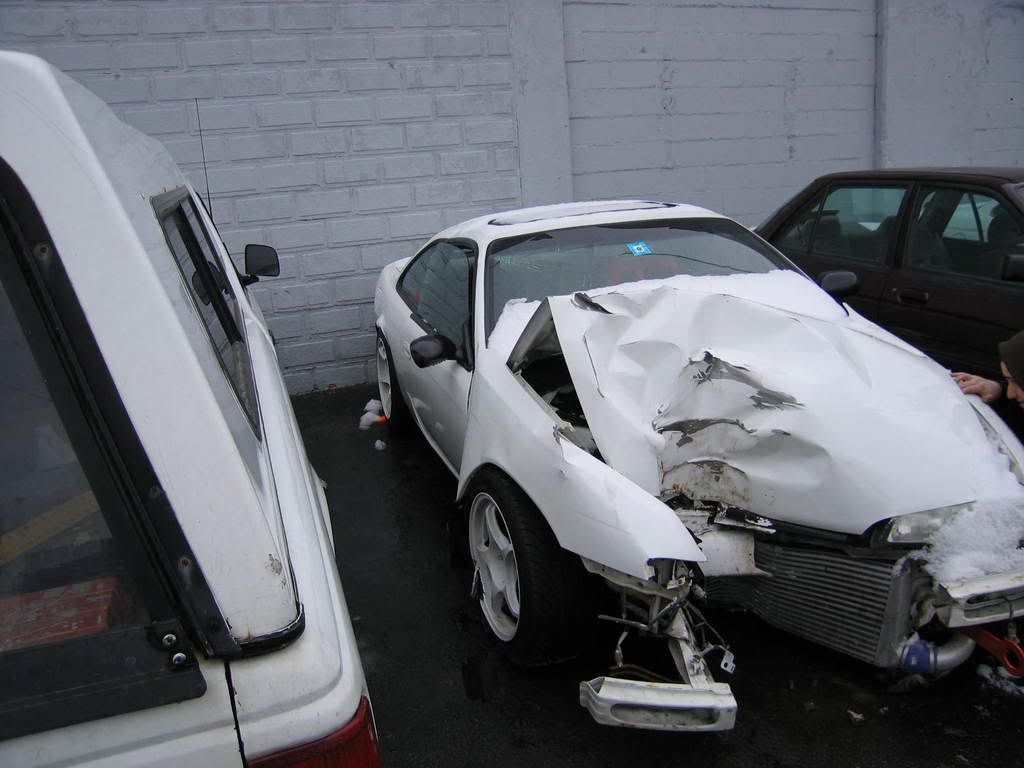
^^^^ Look at this picture. Look at the car from the cockpit back. It's nearly undamaged.... Sure the front clip is gone... but the rest of it is undamaged... Not even a broken windshild. New front clip and that car is good to go.krash wrote:Get a new/used bumper support. Its there for a reason and it weighs so much for a reason.
And thats with a cut support.
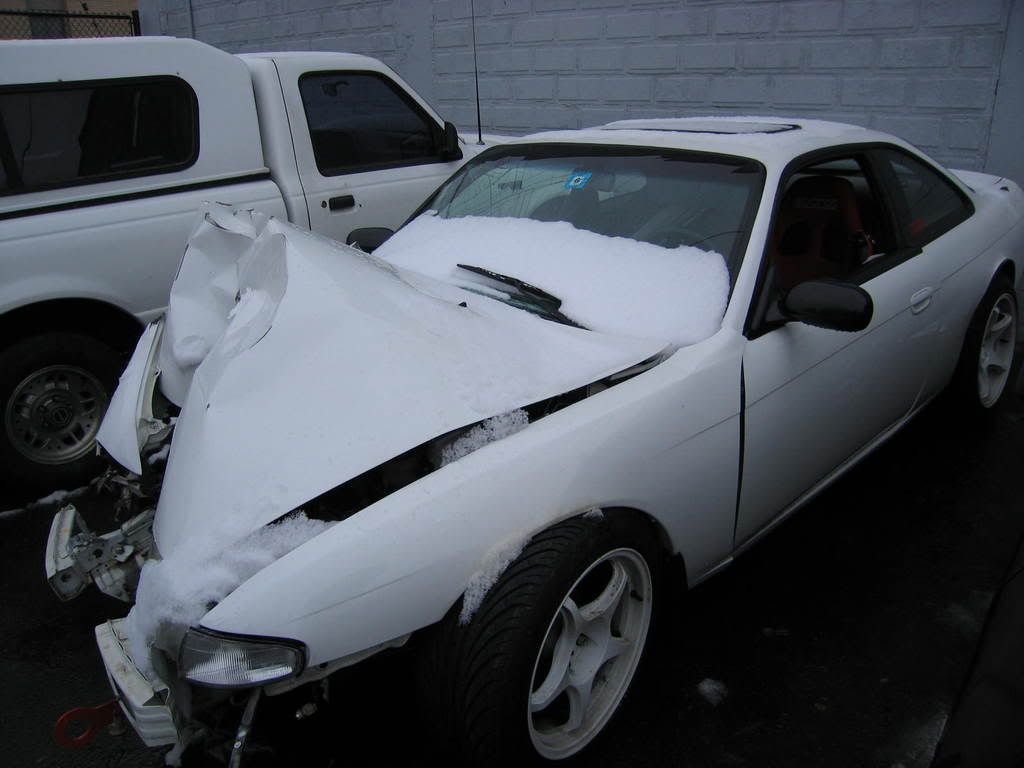
Now look at this one... with the support installed and it taking the impact the car is totalled from front to rear... broken windshields, doors, rear end damage, the works. Nothing is salvageable.krash wrote:Uhm. The bumper support would of helped. I don't know if you see the big piece of crushed car where the middle of the bumper support would have been.
Thats a head on collision, both cars going faster than 30. Compare the relative damage.

So why is this??? let me tell you why...
*WARNING* Science content below, you might learn something about the laws of physics and how cars are made from my wall of text
If your lazy just read the LARGE BOLD TEXT paragraph.
The bumper support connects the front bumper with the chasis of the vehicle. The chasis runs front to rear and is solid as f***. The first car (white one) hit a pole, probably around 40-50 mph, and it split the difference of the chasis. Right down the middle. Because their was no support structure in the middle it never touched the chasis. The core support, hood and engine took the impact. None of it got transfered into the chasis and none of it hit the cockpit or back end of the vehicle and thus none of it hit the driver. Thus the driver experienced SIGNIFICANTLY less g-force than the driver of the red car, whose impact was similar to that of hitting a wall head on at 30+mph. Even at 30mph with the bumper support the g-force transfered through the chaisis via the bumper support and got dispersed throughout the whole vehicle INCLUDING the drivers compartment (AKA greenhouse). That is why the red car is crumpled all the way to the back bumper and the white one isnt, even though the impacts were similar in force. The difference being that the white car absorbed it better. The front end crumpled and absorbed the impact transfering none of the dangerous g-forces to the chasis and thus sending none of it to the driver. Of course both had a sudden stop that created a short lived high g force, but that type of g is sustainable by the human body and does not create injury. Tests were done with a man on a rocket sled in the desert to show just how much short lived high g force can be sustained without injury. It was enough that the first injury recieved as they ramped up the test and the g's increased was his eyes popping out of socket. What is NOT sustainable is the sudden impact g-force spike that you recieve with a metal on metal type (solid) impact. When the car crumples it is absorbing the impact and its a short lived high g. When the car disperses the impact into the drivers compartment it sends it into you. Your body cannot sustain that type of super-high spike g force impact because it is a solid impact and that is what causes injuries. If your lucky the seatbelt will give a little but not enough for you to hit the wheel and thus will absorb some of it. If you hit something in the car then that is a DEFINATE solid spike g-force and that will injure you.
Think of it this way, if it damages the greenhouse, it will damage you. That is your safety zone. Government testing tests to see how much the greenhouse is affected by the accident. That is a main part of their data. The more it's affected the worse the rating. The red car just FAILED. The white car just got a very good rating. (by that criteria alone, other criteria aslo affect the actual rating) That's why when you see a race car get ripped to shreds the driver usually walks away. The roll cage keeps the greenhouse strong and the rest of the car absorbs the impact and doesn't transfer it to the driver. Also why you hear them say a side impact to a race car is the worse because the roll cage doesn't allow it to dissapate any energy when hit in the door meaning it's all transfered to the driver.
A bumper support is made to make the car safer and acumulate less damage in a LOW SPEED collision. So that a minor fender bender doesn't total the car. It does this by giving the bumper something solid to push against instead of the core support, hood and fenders before reaching the solid chasis. Anything over 25-30 mph head on worth of force and they actually make it worse. You don't want a high g impact transfered into the chasis from the front bumper. That's why newer cars have "crumple zones" built into their chasis in the front clip so that a high g impact is not transfered any farther than the firewall and thus keeps the greenhouse high g and damage free for the most part. Our cars do not have this feature built into the chasis and theirfore not having a bumper support is actually SAFER at higher speeds because it allows the car to absorb the impact in the front end and not farther into the chasis. It will still transfer when the actual chasis hits the object and that will protect you just as well as having the bumper support does as far as the "tin can" affect is concerned, but it will have more "crumple zone" before the chasis is affected and thus will dissapate more energy in the front end before transfering it to the greenhouse and beyond to the rest of the car. Think of how much difference the styrofoam in the "safer barriers" makes. Without a bumper support your front end before your chasis (core support forward) is now your safer barrier.
Nissan's FAILED attempts at creating this crumple zone were to put styrofoam in the bumpers between the support and the cover. However because the support is mounted solidly to a solid chasis that means even at 5mph the impact is transfered to the greenhouse and the driver. My '84 Z was a little better at this because along with the foam, the bumper was mounted to the frame with "shocks" so that it didn't send the low speed stuff into the chasis like that. It actually worked too. Of course this makes very little difference at high speeds because only a front clip chasis crumple zone can perform that task properly. Not having a bumper support is better than having bumper shocks at high speeds. It helps, it's better than having it solidly mounted to the frame, but it wont save you. Eventually the impact will get past the core support and tranfer into the frame which will not crumple properly and transfer it into the greenhouse.
But yes, in a low speed collision you are screwed if you don't have a support because the parts of your car before your chasis will take all the impact. That means your bumper, hood, headlights, fenders and core support are screwed even at 5mph. But that said I've gotten into a 5mph collision with the bumper support installed and had to replace all those parts because of how damned dumb nissan was when they designed the front end. No bumper shocks means that energy has to go somewhere... straight into the core support and hood/headlights and all the way to the back bumper it goes. retards. It's not much but your roof will move even in a low speed collision because of this. My auto seat belts got stuck half way because the roof was warped after that 5mph collision. That shows that the energy got transfered straight into the greenhouse and the roof was the weakest point.

But all of that is why I say a cut support with atleast SOME piece left inbetween connecting the two sides is best.
BTW this whole post has been refering to front end collisions only. The back end is a different story. No point having one back their at all because the body IS the chasis... hints the phrase "unibody" So with or without your screwed just the same. And the rear one does weigh in excess of 75 pounds and that weight over just the rear tires makes a HUGE difference in drifting. But I still want my tow hooks and my license plate and I don't want my bumper sagging so I'm just going to cut it too leaving only the two sides that the tow hooks are on and the top and bottom bumper flanges and the small part the license plate attaches to. I'll take as much weight as I can out of it.
That way its still ok at 5mph front and rear and it's a little better at higher speeds in the front. But mainly it'll just weigh alot less. About 100 lbs less total. (that is alot for a car with only 150hp btw)
Last edited by rsmithdrift on Wed Sep 01, 2010 12:20 am, edited 4 times in total.

Re: How many people run w/o bumper supports??
no bumper support = deathwish.
-
S13AL
- Posts: 444
- Joined: Sun May 03, 2009 4:31 pm
- Car: 1991 240sx hatch with blacktop s13 sr20det, HKS Hipermax III suspension, HKS Sport exhaust, Blitz downpipe, S15 Sylvia HLSD, 300zx/J30 5 lug and brakes, and mesh wheels
- Location: Kirkland, Wa
Re: How many people run w/o bumper supports??
I have to say that wall of text contains some valid points.
But, there's got to be some flaws in your logic somewhere.
why else would manufacturers even install a bumper support? to protect the engine but destroy the chassis?
edit* Might want to take into account the red car was a flimsy vert.
But, there's got to be some flaws in your logic somewhere.
why else would manufacturers even install a bumper support? to protect the engine but destroy the chassis?
edit* Might want to take into account the red car was a flimsy vert.
-
rsmithdrift
- Posts: 1984
- Joined: Fri Jan 27, 2006 2:18 pm
- Car: 1993 240sx fastback se.
Re: How many people run w/o bumper supports??
They put it in because of the main reason I'm keeping part of mine... because a big part of the crash testing ratings is the cars ability to resist damage in a low speed 5mph collision. No bumper support means HUGE damage and an instant fail. On the plus side you won't even feel the impact though cause the car will take it all. lol. I tried to elude to that. Maybe I wasn't clear enough with that point.S13AL wrote:I have to say that wall of text contains some valid points.
But, there's got to be some flaws in your logic somewhere.
why else would manufacturers even install a bumper support? to protect the engine but destroy the chassis?
edit* Might want to take into account the red car was a flimsy vert.
You are very correct about the "vert" being flimsy though. Remember I said the roof of my car bent in my 5mph front end collision?? well, the vert doesn't even have that to bend, so it's likely to fold in half if hit right and hard enough... verts are just plain scary in accidents. They essentially have no greenhouse... no bueno.
-
krash
- Posts: 4836
- Joined: Mon Apr 11, 2005 10:43 am
- Car: 1993 Nissan 240sx Convertible
- Location: Memphis, TN
- Contact:
Re: How many people run w/o bumper supports??
Bottom line, compromising safety to install aero is stupid.
-
kungPOWadobo
- Posts: 7
- Joined: Wed Sep 01, 2010 3:16 am
- Car: 1991 Nissan 240sx Fastback
Re: How many people run w/o bumper supports??
that looks really good!simmode1 wrote:Like this one?chaosli wrote:make one welder + tubings
that what i am doing when i get bodykit

-
kungPOWadobo
- Posts: 7
- Joined: Wed Sep 01, 2010 3:16 am
- Car: 1991 Nissan 240sx Fastback
Re: How many people run w/o bumper supports??
as far as running a bumper support. I know that when I had an aftermarket bumper made by Vis Racing. The bumper wouldn't fit without removing the support.
-
SolaraOnBronze

- Posts: 725
- Joined: Wed Oct 08, 2008 5:04 am
- Car: 1993 240sx SR20DET
- Contact:
Re: How many people run w/o bumper supports??
I can really appreciate the detail and logic put into your post, but I've gotta believe that car is trash now.rsmithdrift wrote:New front clip and that car is good to go.krash wrote:
And thats with a cut support.
 I can't imagine that car ever driving right again, but I could be wrong.
I think another important factor to consider is the ride height of your car. My Solara was rear ended by a Buick sedan going about 15 mph and totaled. Because of the ride height of the car, the car that hit me took out the trunk/ trunk wall metal and didn't even hit my rear bumper support. If you car is decently low and you get hit- front or rear- by MOST of the cars on the road today, a bumper support isn't even going to matter... it's going to hit above the bar anyway.
I should also not that mine was installed purely to keep my bumper from sagging.
-
Metal Angel
- Posts: 291
- Joined: Fri May 01, 2009 1:56 pm
- Car: 1990 240sx hatchback
Re: How many people run w/o bumper supports??
^Does that mean you get screwed on insurance? Or do they just note that different cars are different heights and the bumper support is not always going to help? I'm just afraid now that if I lower my car and get hit and totaled that the insurance will avoid paying because of the lowered stance of the car...
-
S13AL
- Posts: 444
- Joined: Sun May 03, 2009 4:31 pm
- Car: 1991 240sx hatch with blacktop s13 sr20det, HKS Hipermax III suspension, HKS Sport exhaust, Blitz downpipe, S15 Sylvia HLSD, 300zx/J30 5 lug and brakes, and mesh wheels
- Location: Kirkland, Wa
Re: How many people run w/o bumper supports??
From what I have learned insurance companies will do anything they can to not give you money (mainly when your at fault) so, I wouldn't doubt it..Metal Angel wrote:^Does that mean you get screwed on insurance? Or do they just note that different cars are different heights and the bumper support is not always going to help? I'm just afraid now that if I lower my car and get hit and totaled that the insurance will avoid paying because of the lowered stance of the car...
-
SolaraOnBronze
- Posts: 725
- Joined: Wed Oct 08, 2008 5:04 am
- Car: 1993 240sx SR20DET
- Contact:
Re: How many people run w/o bumper supports??
My cars are stock as far as insurance is concerned. I converted everything back to stock on my Solara before the adjuster saw it- so they would have never known that is was modified.
-
Mattmahn11
- Posts: 32
- Joined: Mon Aug 02, 2010 7:51 pm
- Car: 1996 240sx
Re: How many people run w/o bumper supports??
I know this isn't on topic but we are talking about bumpers. Does anyone know what the clips are called that hold on the rear bumper cover? I'm ordering some stuff off this website and i might as well go ahead and order what i need. My car is at a shop right now so i don't know how many clips there are, could anyone help me out? I was thinking it was #3 on the illustration below.
http://www.factorynissanparts.com/partl ... atalogid=0
Also do you think i have to buy 1 by one? Or if i buy 1 it should be the whole kit?
http://www.factorynissanparts.com/partl ... atalogid=0
Also do you think i have to buy 1 by one? Or if i buy 1 it should be the whole kit?
-
biggie
- Moderator
- Posts: 8302
- Joined: Wed Jul 24, 2002 2:31 am
- Car: '16 Q70L/'14 Q60S Vert/'19 Armada/'09 FX35
- Location: Clemmons, NC
Re: How many people run w/o bumper supports??
Probably some form of plastic push pins. Should be able to find what you need at a hardware store (Lowe's, etc). Most will have plastic push pins labeled as automotive and by company (ie Nissan).Mattmahn11 wrote:I know this isn't on topic but we are talking about bumpers. Does anyone know what the clips are called that hold on the rear bumper cover? I'm ordering some stuff off this website and i might as well go ahead and order what i need. My car is at a shop right now so i don't know how many clips there are, could anyone help me out? I was thinking it was #3 on the illustration below.
http://www.factorynissanparts.com/partl ... atalogid=0
Also do you think i have to buy 1 by one? Or if i buy 1 it should be the whole kit?
-
Mattmahn11
- Posts: 32
- Joined: Mon Aug 02, 2010 7:51 pm
- Car: 1996 240sx
Re: How many people run w/o bumper supports??
That's what my original plan was, i think i'll just stick to it. Well thanks for your input biggie!