My interest in Wal-Mart is primarily as a traveler, and as someone with a degree in business and an interest in economics, I’m fascinated by the company’s discipline, determination, and strict unwavering adherence to its operating principles.
Our family did quite a bit of cross-country touring in the 80s and 90s, and as a kid I had the privilege of seeing Florida, California, the Carolinas, Texas, Utah, Arizona, Branson, the Pacific Northwest, New York City, Washington DC, the Dakotas, and one visit to Thailand. We weren’t wealthy and for most of my youth I remember living below middle class standards, but we functioned well within our means and had enough set aside for sightseeing. Much of that travel was, unfortunately, in a crude and gutless Nissan Sentra (which years later became my first car).
If we were on the road in a remote part of the country or traveling late at night, fresh food and basic services were difficult to come by. Road trippers were relegated to a selection of soda, chips, and snack cakes at gas stations (assuming they were open late). And in some regions, like the Rockies and Great Plains, gas stations were sparse with unnervingly long distances between fill-ups.
By 2000, at the age of eighteen, I noticed a change in America’s landscape as I began taking long-distance journeys on my own. The remoteness and sparseness that defined interstate travel west of the Mississippi River was quietly replaced by standardized familiarity.
Wal-Mart spread itself wide, extending its reach far beyond the midwest to Mexico and Canada in the 1990s and Germany, China, Great Britain, and Japan in the 2000s. It was possible to tour the continent (and some of the world) and encounter a Wal-Mart Supercenter with “always low” prices in almost every city. If you needed something, anything at all, Wal-Mart was there.
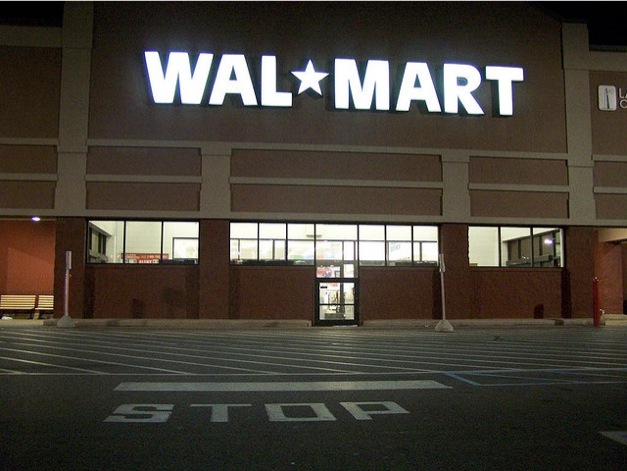
Large blue and white fluorescent Wal-Mart signs visible from the highway drew the hungry and weary to an oasis of consumer decadence. Rather than navigating through a town’s main square where stores typically closed at 6pm and products came with a premium price, a traveler could stay close to the interstate and stop in for motor oil, extra clothing, a decent sandwich, fresh fruit, power connectors, computer parts, CDs, tires, tire plugs, gas caps, oil caps, gasoline, and anything else a traveler could ever need, all within 100,000 square feet.
If you needed automotive basics, you no longer had to stay in town overnight and wait for ‘Joe’s Parts Depot’ to open at 7am to replace your dead headlight bulbs or the gas cap you left behind several miles ago, and you weren’t stuck with the frozen hot pockets at the gas station for your evening meal. Whatever you needed, unless it was particularly exotic, Wal-Mart probably had it. There was no need to settle for limited selection, unpredictable quality, unknown brands, or high prices. With Wal-Mart Supercenters on the road, I had direct access to the same array of goods as I did at home.
So, what’s a Supercenter?
Wal-Mart Supercenters are defined by their massive floor space, usually 80,000 to 120,000 square feet, generous operating hours, usually 24/7, and combination of full-line groceries and consumer goods. Almost everything you could find on the shelf in Chicago or St Louis was readily available in Denver, Cheyenne, Salt Lake City, Tampa, Miami, or Seattle. Like the McDonald’s Big Mac, Wal-Mart had standardized and nationalized shopping. Differences are found in international regions like China, where Wal-Mart sells locally-desired fresh meats like turtle. [I like turtles.]
For me, its retail heaven. To skeptics, its a corporate monster unaware of its brutal impact, sending manufacturing jobs overseas, reducing consumer expectations for quality, killing capitalism, and homogenizing American culture.
Charles Fishman, a business writer for Fast Company magazine, began working on The Wal-Mart Effect in 2004 and published his findings in 2006, just as Wal-Mart ramped up its openings of massive 24-hour supercenters across the globe. Sam Walton had been dead since 1992.
http://www.fastcompany.com/user/charles-fishman
“The Wal-Mart Effect,” abbreviated as TWME from here onward, begins with the good news first, documenting the way Wal-Mart turned Makin’ Bacon, a plastic microwaveable tray developed by one man and his eight year old daughter, into a major success story for an American entrepreneur. Makin’ Bacon was previously sold through mail-in labels on Armour bacon packages but Mr. Fleck, the designer and patent holder, convinced Wal-Mart in 1996 to carry the product in all of its stores.

Fleck, a one-man basement operation, has the same direct access to Wal-Mart’s computerized ordering system as Proctor and Gamble, and has the ability to fulfill orders at a moment’s notice. Fleck investigated Chinese manufacturing but found the quality to be inconsistent with long lead times for slow container shipments. Producing his product in Wisconsin, he says, allows him to respond quickly to changes in demand and keep the quality consistent.
To this day, the price of the Makin Bacon at $6.97 has not changed. Wal-Mart typically asks its suppliers for price concessions every year, but Fleck has been inexplicably immune. The book does hint at Wal-Mart’s tendency to prefer American-made goods, but if offshore manufacturing produce it for less with similar (though often inferior) quality, Wal-Mart may encourage suppliers to move their operations overseas to reduce costs.
Not all supplier relationships with Wal-Mart were as easygoing.
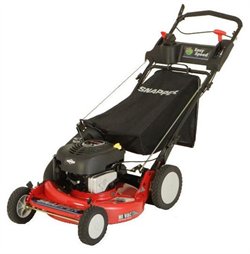
Fishman investigates Snapper, a company that builds premium lawn mowers and outdoor equipment, and their decision to pull out of Wal-Mart to protect its brand identity and create value for its customers. Wal-Mart sells mowers from $99 to $200 and asked Snapper to create a line of lower-end mowers for the store. Snapper, which prices its mowers at $299 and up (way up), decided to remove its products from Wal-Mart completely, bolstering its independent dealers (which still made up 80% of Snapper’s business) and maintaining production in the United States.
Snapper’s CEO drove directly to Bentonville, met personally with Wal-Mart, and explained why his company was removing its products.
The book touches briefly on Sam Walton’s philosophy, with his emphasis on humility and efficiency for the good of the customer, and his encouragement for and inspiration of Wal-Mart’s thousands of employees, traveling to every store and remembering as many faces as he could by name. There was no disconnect between the CEO and the front line in Walton’s Wal-Mart.
As a recipient of the Presidential Medal of Freedom, Sam Walton was an icon of entrepreneurial America, an example of how freedom and determination enabled a man from Missouri to become the wealthiest man in the world. Fishman notes a change in Wal-Mart’s character after Walton’s death in 1992, from one of American pride and openness to one of secretive, close-doored intensity.
Fishman goes on to explain how Wal-Mart plays a major role in controlling the rate of inflation (CPI) and in keeping living costs down for American families despite rapidly rising costs of energy, food, and housing.
Wal-Mart is, as described by Fishman, an advocate of the consumer, pushing for lower prices no matter what. It begins with Wal-Mart’s streamlined shipping and warehousing, all done in-house with the largest privately-owned truck fleet in America.
It follows with Wal-Mart’s intimate relationships with its suppliers, asking over and over where price concessions, efficiencies, and cost reductions could be found, sometimes reaching deep into the production process, asking firms to use cheaper overseas manufacturing.
It is easy to portray Wal-Mart has a hungry, faceless beast, devouring America’s manufacturing sector as it feeds its greed and addictive growth. However, unlike oil barons and railroad barons from a century ago, Wal-Mart continues to run a remarkably lean operation.
Shareholders, many of whom are Wal-Mart employees, referred to as “associates,” have done quite well. If you owned a hundred or so shares of WMT in the 80s, you would be a millionaire by the mid 1990s. Employees who believed and invested in Wal-Mart in its early years enjoyed rewarding and highly profitable careers.
But Wal-Mart, unlike oil barons of the distant past, doesn’t use its profits to fund lavish lifestyles, build offices with marble tile, shuttle its people around in limos, or feed its executives with Russian caviar. Instead, its Bentonville headquarters are shockingly spartan.
The company’s home office looks, as Fishman described it, like a call center for a credit card company, lined with small, plain-looking cubicles, walls and ceilings similar to a warehouse or storage unit, and carpeting out of the cheapest, thinnest grade available.
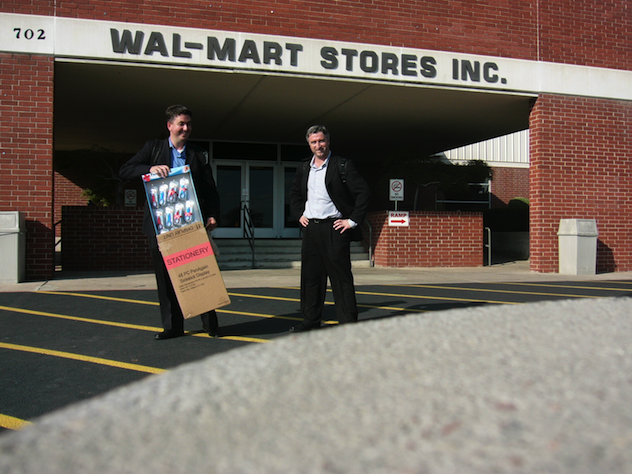
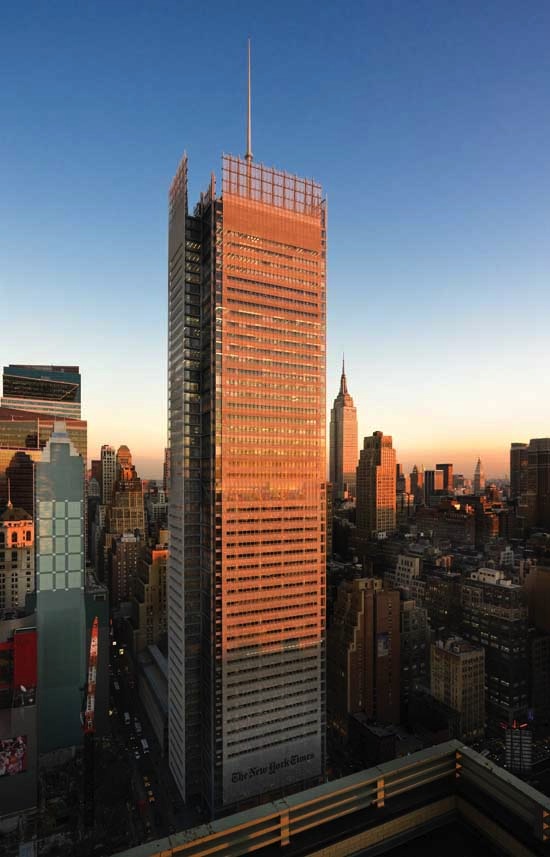
Compare Wal-Mart’s global headquarters above to the building owned and occupied by The New York Times in Manhattan:
I took a macroeconomics class a few years ago where my professor shared a documentary on Wal-Mart’s damaging impact on America. There was video footage of Wal-Mart’s supplier negotiation rooms in Bentonville that looked much like suspect interview rooms on Law and Order, sparsely appointed with uncomfortable furniture. The documentary then suggested that these spartan looking rooms with cheap folding tables and plastic chairs were intentionally designed to “sweat” suppliers into lower prices.
Maybe they have that effect, but that isn’t the intent.
The truth is, most of the cheap furniture used by Wal-Mart’s corporate offices was free, sent as samples from manufacturers and deployed into daily use. Wal-Mart’s adherence to humility and cost-cutting is so strict that it doesn’t even buy its own chairs. The head office hardly has any windows.
And Wal-Mart could have built a sprawling museum dedicated to Sam Walton’s legacy and the company’s history, but it instead uses the original Walton’s Five and Dime store in downtown Bentonville as a diminutive visitor’s center, staffed by two or three people with small exhibits and a tiny gift shop.
Unlike some of America’s large corporations, Wal-Mart doesn’t toot its own horn or use its power to intimidate the commoners. There is, after all, no Wal-Mart Tower stretching into the sky in the center of a large metropolis. There is, however, a Sears Tower, and Sears had to sell it and move to a suburban office park after only twenty years. Sears Roebuck and Co, once a retail powerhouse, was recently forced to merge with K-Mart.
With America’s history of saving and investing, Ben Franklin’s “penny saved is a penny earned” mantra, and the legacy of The Great Depression, spending less has become a virtue. Wal-Mart’s skeleton operations are indeed, by that standard, virtuous and distinctly American.
Sam Walton and his family became tremendously wealthy and combined, the Waltons are among the wealthiest people in the world. Despite becoming the richest man in the world, Sam continued living a quiet life in Arkansas, building a large, comfortable, secluded home for himself and his wife and dogs.
He continued driving this orange 1979 Ford pickup until his death in 1992.
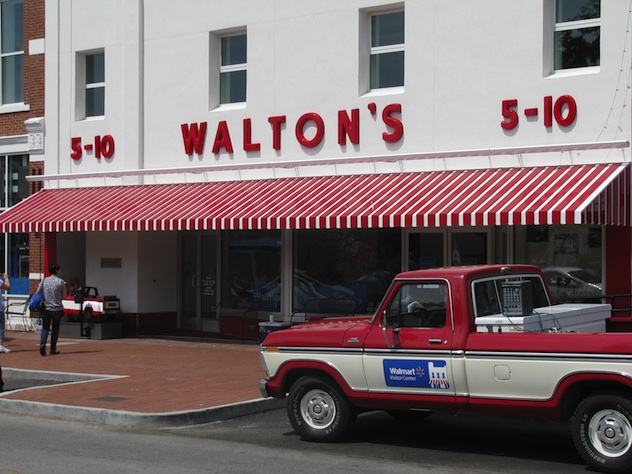
Walton famously said in his autobiography, “Why do I drive a pickup truck? What am I supposed to haul my dogs around in, a Rolls Royce?”
Even Sam Walton’s Arkansas grave, buried in a cemetery on the same block as the company’s headquarters, is plain and undecorated, with a small stone that reads “SAMUEL MOORE.” The epitaph doesn’t say he changed the world, was a great man, was a great leader, or even the founder of Wal-Mart. He was in death as he was in life — humble and dignified.
The company was built on discipline, consistency, and seriously hard work. Even critics are compelled to acknowledge Wal-Mart’s virtues. And TWME’s author, Charles Fishman, concedes that point, and later in his book explains that Wal-Mart isn’t the faceless monster that some make it out to be. Its instead a corporation run by people with a clear mission, attempting to serve its customers above all else, trying to spread Wal-Mart’s low prices around the globe.
It isn’t that Wal-Mart intends any ill will to the public or to factory workers. Its that Wal-Mart is so unaware of itself and its impact that it causes damage without even realizing it, like a tank driving through a crowded city street, knocking over fire hydrants unintentionally.
Fishman asks that in pursuit of always low prices, perhaps Wal-Mart should acknowledge its now massive size and use its tremendous influence on markets and suppliers to save energy, improve working conditions, clean up the environment, and become a better corporate citizen.
In response to criticism, Wal-Mart now has a wide array of organic products from yogurt to baby clothes made with organic cotton, and the company has a hotline operated by a third party that allows workers all over the globe to call in and report violations (the phone number is posted on the wall at any facility that produces goods for Wal-Mart). They currently receive one call per week.
Third party firms, rather than Wal-Mart internal, are now used to check on workplace conditions and environmental standards at its suppliers, similar to the evaluation process used by Whole Foods.
Somewhere between 1992 and 2011, after the passing of Sam Walton, Wal-Mart lost some of its soul, but thanks to vocal critics (some rational and open-minded, some incurably deranged) and shareholders concerned with the company’s image, Wal-Mart is using its power to improve the lives of people around the world.
Unfortunately, toward the end of Fishman’s book, he goes into a bit of a tirade about the need for more laws, more government, and more regulations, despite acknowledging the power of information to create awareness and influence consumer and corporate behavior. Fortunately, the complaining and calls for regulation are brief while the bulk of the book focuses on Wal-Mart’s scale, its impact, and its successes and failures. An additional chapter documents Fishman’s visit to Wal-Mart HQ after the book was published and his meeting with several people including CEO Lee Scott.
Other reviews of TWME seem to suggest that the book is nothing but cheerleading for critics of Wal-Mart. It wasn’t until I flipped through it at Barnes and Noble that I discovered the depth of research and exclusive inside information, valuable to everyone from consumers to WMT shareholders to environmentalists.
A mayor in New Mexico fervently opposed the entry of Wal-Mart into his town after reading a review of “The Wal-Mart Effect,” neglecting to read the book himself. A frustrated woman at Wal-Mart HQ even asked TWME’s author, Charles Fishman, “How do I get [the mayor] to read your book?”
Based on the mayor’s reaction, I assume the review he read described the book as a scathing expose of Wal-Mart’s evildoings, and this leads me to believe that most professional book reviewers do not always read the books they review.
Whether you are a proponent or a critic, you will find something of value in this well-researched and well-written book.

http://jesda.com/2011/07/12/book-review ... rt-effect/