Hey everyone, I'm new to the forums and new to mods. About 6 months ago I purchased a new 2011 3.5SR MT coupe and am absolutely in love with the car. I've always liked cars - just never had a car I gave a sh*t about or the money to do anything.... till now. So far it's only been tinted, 5% back and 20% front, and debadged.
I've spent considerable amount of time reading through the forums trying to figure out the best way to lower my car (I can't stand the tire gap, totally unacceptable) while currently living in an area with bad roads. From what I've read it's my understanding that coilovers are the way to go (I'm leaning towards Teins - $ not an issue and I've read they are better for daily driving compared to BC) because they are adjustable and springs will eventually wear out the struts anyways.
My issue is I've read that springs offer a better ride than coils for daily driving - I don't understand how this is possible. Why can't you just adjust the coils to find the ideal ride height and stiffness? Couldn't I just drop my car 1in to 1.5in and soften the damping to accommodate for bad roads? Or are springs the way to go?
Thanks in advance for any help!

Best way to lower for bad roads
-
AlexM.

- Posts: 1180
- Joined: Sun Sep 26, 2010 5:13 pm
- Car: 2010 Nissan Altima Coupe 2.5 Super Black
- Location: Dallas TX
Re: Best way to lower for bad roads
In theory, that approach should work. Definitely, as you go lower the stiffness increases and you can compensate for that by decreasing the dampening. But if you go really low and drive across dips or bumps, and have a soft dampening setting, you could run into rubbing issues from suspension travel.Jlor1002 wrote: My issue is I've read that springs offer a better ride than coils for daily driving - I don't understand how this is possible. Why can't you just adjust the coils to find the ideal ride height and stiffness? Couldn't I just drop my car 1in to 1.5in and soften the damping to accommodate for bad roads? Or are springs the way to go?
From my experience with BC's, I couldn't find the perfect dampening to get a smooth ride and I don't think its possible =/
I think with a 1-1.5 inch drop I used 5 clicks in the front and 10 in the rear and it. I also tried something like 12 and 20 suggested by Loop and that was comfortable also. But still not smooth by my standards.
But there's no way to tell exactly find out if " a x drop and a dampening setting of y" will give you a smooth ride or not. It could, or it could be stiff still. Even at this "perfect" setting, I bet springs would still be smoother. Coils aren't meant for daily driving anyway.
But yeah get Tein!
Re: Best way to lower for bad roads
Great, thanks for the advice - I failed to consider the tire rub w/ soft dampening, but I'm not planning on dropping too low (I figure with the coils if I move to better roads I can drop it more - and I move a lot for work). I'm also not worried about a super smooth ride to be honest. I'll make that sacrifice for the looks and increased handling,... besides, my daily commute is less than .5 mile! Thanks again.
-
AlexM.
- Posts: 1180
- Joined: Sun Sep 26, 2010 5:13 pm
- Car: 2010 Nissan Altima Coupe 2.5 Super Black
- Location: Dallas TX
Re: Best way to lower for bad roads
Good plan! Let us know what you decide to go with and show us pics after
-
andyhenault
- Posts: 117
- Joined: Sat Apr 02, 2011 12:55 pm
- Car: 2012 Altima Coupe 3.5SR-Borla axel-back, full LED lighting
2010 Altima Coupe 3.5SR-Wrecked
Re: Best way to lower for bad roads
The more your lower the car, the stiffer the springs will typically be to prevent it from bottoming out. To compensate for stiffer springs you need STIFFER damping, not softer. The amount of damping needed increases proportionally with the square root of spring stiffness (wiki 'damping' if you're interested). If you don't increase it, the car will oscillate and have a terrible ride. The manufacturer of the coils should be able to provide data, something like this:AlexM. wrote:In theory, that approach should work. Definitely, as you go lower the stiffness increases and you can compensate for that by decreasing the dampening. But if you go really low and drive across dips or bumps, and have a soft dampening setting, you could run into rubbing issues from suspension travel.Jlor1002 wrote: My issue is I've read that springs offer a better ride than coils for daily driving - I don't understand how this is possible. Why can't you just adjust the coils to find the ideal ride height and stiffness? Couldn't I just drop my car 1in to 1.5in and soften the damping to accommodate for bad roads? Or are springs the way to go?
From my experience with BC's, I couldn't find the perfect dampening to get a smooth ride and I don't think its possible =/
I think with a 1-1.5 inch drop I used 5 clicks in the front and 10 in the rear and it. I also tried something like 12 and 20 suggested by Loop and that was comfortable also. But still not smooth by my standards.
But there's no way to tell exactly find out if " a x drop and a dampening setting of y" will give you a smooth ride or not. It could, or it could be stiff still. Even at this "perfect" setting, I bet springs would still be smoother. Coils aren't meant for daily driving anyway.
But yeah get Tein!
http://home.comcast.net/~ralphws1/images/usstock.jpg
My suggestion to have a low ride and still something comfortable would be to find a custom spring manufacturer and get a non-linear spring that is soft at first, then much much stiffer at the end of the stroke to prevent bottoming out. This would be a b**** to do, but it's really the only way to have the best of both worlds. Ride comfort is the reason our cars have such a huge wheel gap.

Re: Best way to lower for bad roads
andy you know your s*** dude lol. my official adviser from now on. xD
Re: Best way to lower for bad roads
I second that.SanoSuKe wrote:andy you know your s*** dude lol.
Thanks for the insight on dampening.That makes sense. I'm probably going to stick with the coilovers since I face the possibility of moving every year. I suppose my reason for posting was to see if I was way off - like if springs would be a no-brainer for bad roads, but I guess it's a matter of preference and not that clear cut.
Since I move a lot, anyone have any suggestions for finding a good shop to do the install?
-
MetallicSlate
- Posts: 372
- Joined: Wed Dec 29, 2010 1:28 am
- Car: 2008 Altima Coupe 3.5 SE
Re: Best way to lower for bad roads
Your driveway! 
You never mentioned where you were at that I saw, but there are a lot of performance shops around that you just have to look for. I had no idea I had a dyno within 20 miles of my house until I looked for it. But coils aren't too hard to install. You need some wrenches, maybe a mechanics hammer, spring compressors, and patience. (Jack and Jack stands of course too). And definitely take some pics when its finished.
You never mentioned where you were at that I saw, but there are a lot of performance shops around that you just have to look for. I had no idea I had a dyno within 20 miles of my house until I looked for it. But coils aren't too hard to install. You need some wrenches, maybe a mechanics hammer, spring compressors, and patience. (Jack and Jack stands of course too). And definitely take some pics when its finished.
-
AlexM.
- Posts: 1180
- Joined: Sun Sep 26, 2010 5:13 pm
- Car: 2010 Nissan Altima Coupe 2.5 Super Black
- Location: Dallas TX
Re: Best way to lower for bad roads
andyhenault wrote: The more your lower the car, the stiffer the springs will typically be to prevent it from bottoming out. To compensate for stiffer springs you need STIFFER damping, not softer. The amount of damping needed increases proportionally with the square root of spring stiffness (wiki 'damping' if you're interested). If you don't increase it, the car will oscillate and have a terrible ride. The manufacturer of the coils should be able to provide data, something like this:
http://home.comcast.net/~ralphws1/images/usstock.jpg
My suggestion to have a low ride and still something comfortable would be to find a custom spring manufacturer and get a non-linear spring that is soft at first, then much much stiffer at the end of the stroke to prevent bottoming out. This would be a b**** to do, but it's really the only way to have the best of both worlds. Ride comfort is the reason our cars have such a huge wheel gap.
Thanks for clarifying. I didn't really understand this,
on the surface. But after reading it on wiki, it makes a lot of sense. So spring stiffness and spring damping are not the same type of stiffness, right? Or actually, it seems they might both be the same stiffness but just act in opposite directions.andyhenault wrote: "To compensate for stiffer springs you need STIFFER damping, not softer,"
So if we used non linear springs then as we slammed our cars, and turned up the stiffness we would have better rides. But for now, if we lowered them AND increased damping, won't it just make our cars more uncomfortable because the effect would be linear?
There's something I'm not getting lol.
Re: Best way to lower for bad roads
I'm in Northeast PA and am definitely not a DIYer - lack the ability, know how, talent, space, tools, and time!
I'll get some before and after pics up for sure though.
I'll get some before and after pics up for sure though.
-
andyhenault
- Posts: 117
- Joined: Sat Apr 02, 2011 12:55 pm
- Car: 2012 Altima Coupe 3.5SR-Borla axel-back, full LED lighting
2010 Altima Coupe 3.5SR-Wrecked
Re: Best way to lower for bad roads
I know a fair bit about suspension engineering, glad to help anyone with Qs.SanoSuKe wrote:andy you know your s*** dude lol. my official adviser from now on. xD
Re: Best way to lower for bad roads - update
Finally got the car lowered and had the opportunity to take some low quality, dirty car, cloudy day, cell phone pictures - ya, you're welcome.
I ended up going with Eibachs instead of coils. The roads are just too rough and I didn't want to sacrifice too much ride comfort. By the time my struts are shot hopefully I'll be living someplace with better roads and will replace it all with some Teins. IMO the ride isn't too harsh with the Eibachs and the car definitely handles better.
I also recently had the c-mod grill installed so I figured I should post some pics of that as well (doesn't seem to be too many +10 pics of it out there).


Front gap:

Rear gap:

I also have some new wheels on the way!!! I'll get some pics up once they're in...
I ended up going with Eibachs instead of coils. The roads are just too rough and I didn't want to sacrifice too much ride comfort. By the time my struts are shot hopefully I'll be living someplace with better roads and will replace it all with some Teins. IMO the ride isn't too harsh with the Eibachs and the car definitely handles better.
I also recently had the c-mod grill installed so I figured I should post some pics of that as well (doesn't seem to be too many +10 pics of it out there).
Front gap:
Rear gap:
I also have some new wheels on the way!!! I'll get some pics up once they're in...
-
SHIFT_COUPE

- Posts: 3887
- Joined: Fri Aug 03, 2007 3:36 am
- Car: 2014 Infiniti Q50 AWD
- Location: Bethel, CT
- Contact:
Re: Best way to lower for bad roads
Looks great! You need a Stillen front lip to finish it off!
-
ty_tanium909
- Posts: 41
- Joined: Mon Apr 16, 2012 8:44 am
- Car: 2008 Altima Coupe 2.5S
- Location: Winnipeg, Canada
Re: Best way to lower for bad roads
for all you saying that the ride quality isint very good with coils, it appears that Swift Springs has teamed up with BC Racing to offer a spring upgrade that is apparently much more comfortable. here is a link to a guy on a subaru forum who got it: http://forums.nasioc.com/forums/showthr ... ?t=2339757. I also went to the Curcuit Motorsports website, who I found out about the upgrade from, and if you scroll to the bottom, it states that the Swift Spring upgrade IS available for our cars. http://www.circuitmotorsports.net/bc_ra ... 26056.aspx Just some food for thought for those who want to try a solution.
-
Weimy812
- Posts: 80
- Joined: Thu Mar 15, 2012 4:11 pm
- Car: Alt coupe 2012 3.5sr, greddy spectrum elite, raceingline y pipe, Tein Street Advance coilovers
- Location: Delaware
Re: Best way to lower for bad roads
Looks good man!..i just got the Tein Street Advance coilovers and let me say they are amazing!!! When you said money wasn't an issue, you should of got some teins in my opinion. Here are some pics of mine and let me say i live in DE and the roads aren't so different then in PA. [/img]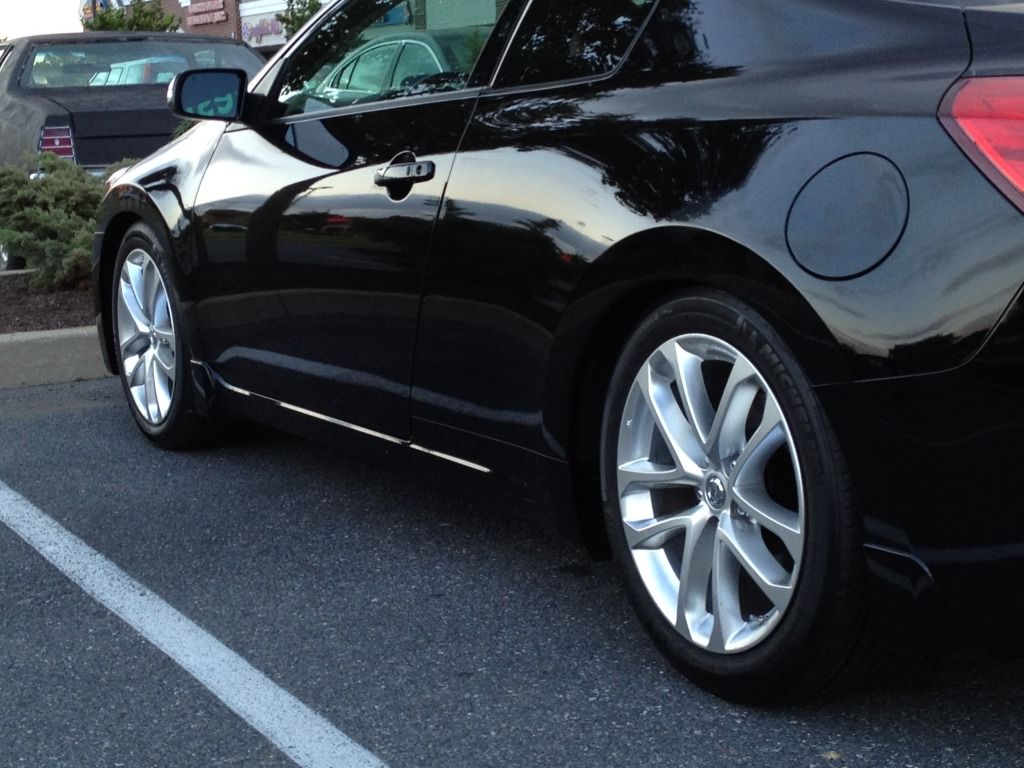
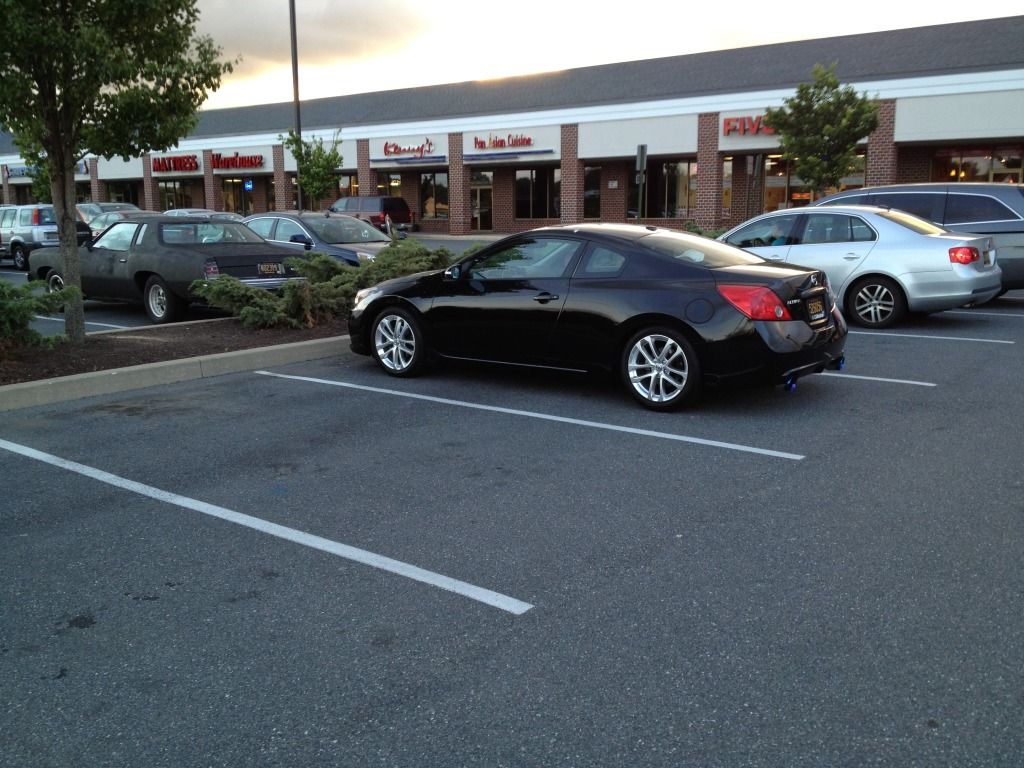 . I have been super busy with work and trying to keep my dog exercised and stop from bouncing off the walls lol. So will update new photos with my good camera soon!!
[/img]. I have been super busy with work and trying to keep my dog exercised and stop from bouncing off the walls lol. So will update new photos with my good camera soon!!-
AlexN09
- Posts: 1051
- Joined: Sat Jun 11, 2011 7:07 am
- Car: 2011 Nissan Altima Coupe S 2.5
- Location: Nashville, TN
Re: Best way to lower for bad roads
Dang is that a five guys?! I had some of that in Athens, GA once and it was tasty!!
Re: Best way to lower for bad roads
Thanks. And I already do sort of regret not going with the teins, I keep reading about how nice they ride! However, I'm in wilkes-barre and the roads are amazingly bad. I grew up in the boston area and thought we had bad roads. There's no comparison.
Money wasn't a concern, but it also wasn't unlimited. With the money I didn't spend I bought a y-pipe and shift kit, and am more comfortable with the money I spent on wheels.
Thanks for the feedback tho, and I like how much your car is lowered. Looks not-slammed, but lower than springs... I want that!!
Money wasn't a concern, but it also wasn't unlimited. With the money I didn't spend I bought a y-pipe and shift kit, and am more comfortable with the money I spent on wheels.
Thanks for the feedback tho, and I like how much your car is lowered. Looks not-slammed, but lower than springs... I want that!!
-
Weimy812
- Posts: 80
- Joined: Thu Mar 15, 2012 4:11 pm
- Car: Alt coupe 2012 3.5sr, greddy spectrum elite, raceingline y pipe, Tein Street Advance coilovers
- Location: Delaware
Re: Best way to lower for bad roads
Yeah np I can go probably another 1in lower in the front the rears are tucked about a 1/2in will get better pics soon. Yeah I love my ypipe and exhaust sounds amazing! I'm waiting on wheels still haven't decided if I want change yet. But the comfort of the coils is like nothing else 
Re: Best way to lower for bad roads
Good to know about the coils. Ill def go that route when the time comes.
I have the y-pipe and stock exhaust, not a fan of the sound. I want it deeper, but dont want it any louder. Think the Borla is next on my list.
And my wheels came in today!!! Thanks to my work I have a lot of connections around town, so i was able to get a really good deal on 19x8.5 enkei RSM9s - I wanted 19s but didn't want to kill the ride, gas mileage, speed etc, so I was looking for something light and these supposedly weigh < 20lb, and I paid significantly less than any price I've seen for them listed online. Only downside was they aren't selling them in the US and I had to wait like 7wks for them to ship from japan (although guy at enkei said there's only 1 or 2 sets in the US so far, so i guess that's cool). Been waiting a long time, and spent a lot of money... so they better look good. I can not friggin wait to get them on!!!!!!!!!!
I have the y-pipe and stock exhaust, not a fan of the sound. I want it deeper, but dont want it any louder. Think the Borla is next on my list.
And my wheels came in today!!! Thanks to my work I have a lot of connections around town, so i was able to get a really good deal on 19x8.5 enkei RSM9s - I wanted 19s but didn't want to kill the ride, gas mileage, speed etc, so I was looking for something light and these supposedly weigh < 20lb, and I paid significantly less than any price I've seen for them listed online. Only downside was they aren't selling them in the US and I had to wait like 7wks for them to ship from japan (although guy at enkei said there's only 1 or 2 sets in the US so far, so i guess that's cool). Been waiting a long time, and spent a lot of money... so they better look good. I can not friggin wait to get them on!!!!!!!!!!