Hi,
It's been two weeks now since my swap, and so far I've been very pleased. The only problems so far are 1) leaky transmission (note to self, if I ever do this again, I will replace ALL the seals first as a matter of course) and 2) overheating.
As I said, though, my overheating problem is strange. It starts about 10-20 miles down the highway, but if I'm in town, no problems. It will go up to 220 and stay there, and once it gets hot, it won't come down.
I talked to someone who had a similar problem in his MGA with a V6 swap. He said it was airflow, as did someone else I spoke to. To today I took the car out in 98 degree heat and drove it with the hood off. It took a very long time to get up to temperature - about 15 minutes or so, but then it ran at about 210. It would sometimes go up to 220, but only briefly.
So I have an airflow problem, but why did it take so long to start overheating? Why did it overheat when I had the hood off. Here's my basic stats:
* CA18DET engine with no heat insulation on the turbo or exhaust. (I'm sure this is part of the problem.)* Good compression (120) in all cylinders. (For those of you who saw my other post, I got lucky and the engine is fine.)* stock Jaeger temp gauge. It's almost 50 years old but I had it rebuilt a year ago. * new '65 Mustang radiator (aluminum)* new water pump* new thermostat* recent chemical flush of the radiator* I'm using tap water. I plan on using distilled water and water wetter next time
Here's the strangest part, though; it works fine. If it weren't for the readings it's been giving (and the heat I've been feeling), I wouldn't think anything was wrong.
Any ideas? One idea I have is that the temp gauge is not measuring the water correctly because it is mounted near where the heater plumbing is, but I don't have a heater so the water doesn't move there.
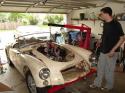
Anyway, here's few pictures:
Here's where the thermometer is mounted:
Any ideas would be welcome. Part of my says that I should just get a lot of heat insulation and ignore it, since it seems to work fine on it's own...
Thanks,
Darian

Another overheating question, but this one is a little weird.
-
ca18detgabby

- Posts: 3329
- Joined: Sat Feb 10, 2007 5:31 pm
- Car: 92 Nissan S13 ca18det SOLD
03 Infiniti G35 - Location: lake Mary FL
- Contact:
Re: Another overheating question, but this one is a little weird. (dhen)
You have got to be heat soaking the **** out of that filter.
where is the maf? maybe the coolant temp sensor is bad? got a wideband to measure a/f?
where is the maf? maybe the coolant temp sensor is bad? got a wideband to measure a/f?
Re: Another overheating question, but this one is a little weird. (ca18detgabby)
That's a very good point. That might be why the temperature rises slowly. I've been talking to some other people about this and I think it's a matter of trying to get some fresh air into the back half of the engine compartment.ca18detgabby wrote:You have got to be heat soaking the **** out of that filter.
-
themadscientist

- Posts: 26254
- Joined: Tue Nov 12, 2002 3:30 pm
- Car: R32 GTR, DR30 RS Turbo, BRZ, Lunchbox, NSR50 Sportster 883 Iron
- Location: Staring down at you with disdain from the spooky mountaintop castle.
Re: Another overheating question, but this one is a little weird. (dhen)
Good lord, did you load that motor in through the bottom? It's a tighter fit than midget p0rn.
Re: Another overheating question, but t ... (themadscientist)
Not much you can do about that one, I'm afraid. These cars are really hard to do engine swaps on. I think that might be my problem, though, since there's no where for the air to go.themadscientist wrote:Good lord, did you load that motor in through the bottom? It's a tighter fit than midget p0rn.
But what can I say, it's fun having a 2,000 lb. car with this engine...
-
ca18detgabby
- Posts: 3329
- Joined: Sat Feb 10, 2007 5:31 pm
- Car: 92 Nissan S13 ca18det SOLD
03 Infiniti G35 - Location: lake Mary FL
- Contact:
Re: Another overheating question, but this one is a little weird. (dhen)
could always do a blow through MAF and attach the filter right to the turbo