The engine is a big air pump that needs to inhale and exhale without obstruction to function properly. If it can't properly remove exhaust gasses, correct incoming fuel/air mix and proper detonation will surely suffer. A plugged up cat reminds me of the prank some people would play years ago by putting a potato in an exhaust pipe of a gasoline engine car to temporarily keep it from running.
Matt - Let me post some pictures tonight of the broken pintle caps to see if they look familiar. A buddy of mine recently found a couple of broken pintle caps (on Phase Ii injectors) that were causing uncontrolled fuel flow on his I30. He said it was running bad and getting random misfires. In my case, I found random misfire codes (via OBDII) on cylinders 2 and 5. Wes made a good suggestion about the cats. Does FL still run emission tests as part of the annual licensing process? When I lived in the Tampa area I remember driving the car to some state run emissions testing center to get a certificate to be able to get license plates. I'm not familiar with current FL emission testing requirements. I bought a new Warpspeed Y-pipe and highflow cat for the Maxima that will remedy my cat problems. However, there are no state vehicle inspection requirements here in sparsely populated AR. I ordered an injector refurb kit with new pintle caps, screens, and o-rings to use with some better injectors that came with the replacement engine. My buddy with the I30 sent his injectors to DW in OKC for a refurb and spray testing. He also found a bad fuel pressure regulator. My fuel pressure regulator is new which I think kept the pressure up on leaking injectors that helped the aggravate flooding problem -- go figure.
Wes - What do you think about Matt removing the O2 sensors, so the engine can breathe, for a test drive to see if it makes a difference? Matt - It will be loud and you will need to keep your window rolled down so you don't get sleepy from any exhaust fumes that get into the cabin. This was the temporary testing approach I used to find the plugged up cats.
NOTE: When I ran the test to find the plugged up cats, I took zip ties and secured the O2 sensors to the body to keep them from dangling underneath the car and breaking while I made the test drives. I wanted the sensors to be hooked up to the ECU and not throwing codes while I ran the test. Heated O2 sensors tips do get hot -- so handle carefully. Wes can verify if Stage 3 should be used during a test in the event the ECU ignores signals from O2 sensors.

1990 Q with pre-detination at around 6000 RPMs.
-
elwesso

- Posts: 30810
- Joined: Sun Feb 23, 2003 4:52 pm
- Car: 94 Infiniti Q45t 5 spd
2007 BMW M Coupe
2007 Infiniti G35 S 6MT - Location: Indiana
- Contact:
Re: 1990 Q with pre-detination at around 6000 RPMs.
The ECU ignores the o2 sensors only at high load, so for normal driving and cruising it still uses the o2 sensors. Why you can still get good fuel economy on stage III.
I'd agree with removing the o2 sensors just to see... It's easy enough to do, and would eliminate one thing. I would try that before messing around with the ECU talk and whatnot. Normally fuel pumps are either good or bad, and I've never heard of a FPR failing... Anything fuel related would seem very unlikely IMO.
I'd agree with removing the o2 sensors just to see... It's easy enough to do, and would eliminate one thing. I would try that before messing around with the ECU talk and whatnot. Normally fuel pumps are either good or bad, and I've never heard of a FPR failing... Anything fuel related would seem very unlikely IMO.
-
mattd1979
- Posts: 710
- Joined: Fri Oct 29, 2004 6:08 am
- Car: 1990 Pearl White Q45 plain Jane with 266,000 miles. 2015 moonlight white metallic Q70L with 20” wheels, sport brakes and a 5.6L at 58,000 miles.
- Location: Jacksonville
Re: 1990 Q with pre-detination at around 6000 RPMs.
I have an exhaust back pressure gauge that I can screw into the o2 sensor port. I bought it long ago for this purpose but never got around to it. What RPM should I be at when testing?
I wonder if the VTC could be bad on one or both sides and not fully traveling one way or another and hanging up. I'm referring to the actual sprocket assembly, not the solenoid. That could explain why the car sometimes feels responsive pulling away from one traffic light and sluggish when pulling away from the next light. It is strange.
I said in an earlier post that the power seems to fade out when approaching 1500 RPM. It is actually around 2000 RPM that I notice the dead spot as the RPM is climbing and then it starts to pick up again as it approaches 4000 RPM and then it feels like it kicks in further when approaching 5000 RPM. This is all happening while still in 1st gear or 2nd. At WOT the power feels less until I begin lifting my foot and then the power comes on further. Like it is running to lean at WOT and when releasing the throttle some, it allows the fuel mixture to richen.
According to the service manual, the o2 sensors are ignored during acceleration or at WOT.
I wonder if the VTC could be bad on one or both sides and not fully traveling one way or another and hanging up. I'm referring to the actual sprocket assembly, not the solenoid. That could explain why the car sometimes feels responsive pulling away from one traffic light and sluggish when pulling away from the next light. It is strange.
I said in an earlier post that the power seems to fade out when approaching 1500 RPM. It is actually around 2000 RPM that I notice the dead spot as the RPM is climbing and then it starts to pick up again as it approaches 4000 RPM and then it feels like it kicks in further when approaching 5000 RPM. This is all happening while still in 1st gear or 2nd. At WOT the power feels less until I begin lifting my foot and then the power comes on further. Like it is running to lean at WOT and when releasing the throttle some, it allows the fuel mixture to richen.
According to the service manual, the o2 sensors are ignored during acceleration or at WOT.
Re: 1990 Q with pre-detination at around 6000 RPMs.
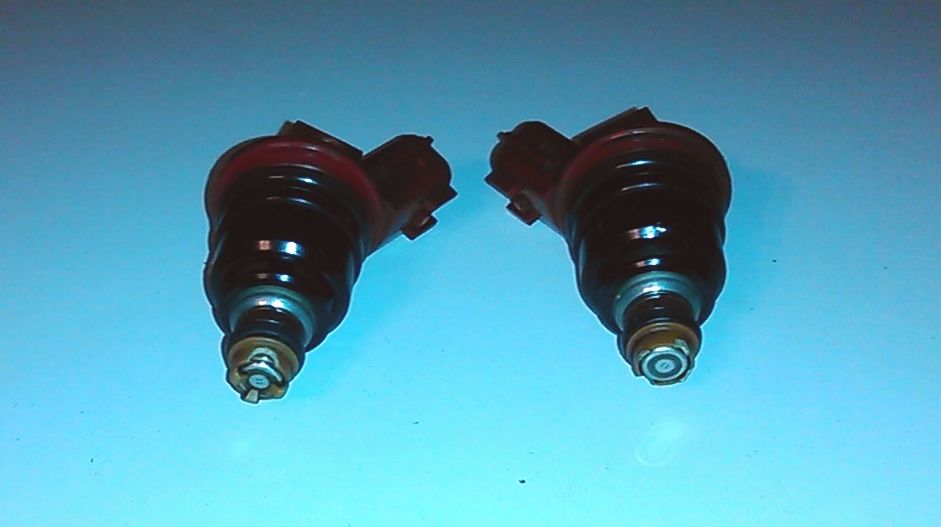
Matt - Here's a picture of the broken pintle caps. The injector on the right was on Cyl #5 where the most uncontrollable flooding was occurring. The dealer performed a power balance test and determined Cyl#5 was not functioning -- but could not find the cause. The dealer stated the injectors tested good. I guess they only performed an injector Ohm test. Cyl #2 and Cyl#5 were both experiencing random misfires as picked up by OBDII on the 99 model. I think the caps may have broken when the rails were moved from the old to the newer engine.
The dealer declared the ~73,000 mile replacement engine to be bad and in need of replacement. The estimate to replace was $8,400.
The dealer declared the ~73,000 mile replacement engine to be bad and in need of replacement. The estimate to replace was $8,400.
-
mattd1979
- Posts: 710
- Joined: Fri Oct 29, 2004 6:08 am
- Car: 1990 Pearl White Q45 plain Jane with 266,000 miles. 2015 moonlight white metallic Q70L with 20” wheels, sport brakes and a 5.6L at 58,000 miles.
- Location: Jacksonville
Re: 1990 Q with pre-detination at around 6000 RPMs.
That is the same style of injector that is in my car. Some of the caps are partially broken but the power balance test was good and so was the compression. I did a fuel pressure leak down test by pinching off the return line and then pinching off the feed line after the pump cycled off. The pressure held steady. I could understand the flooding part if the cap tip was missing because then there would be nothing there holding the o-ring in position. I examined a bad phase II injector to see if the tip of the nozzle would come loose with the cap removed and couldn't remove the tip. That is when the only thing I could figure was those tips were to help keep the lower o-ring in place when removing the injector.
Re: 1990 Q with pre-detination at around 6000 RPMs.
Matt - Take a look at the o-rings above the caps. The o-rings are still in place. No fuel pressure leak down was occurring. It was holding fuel pressure during my tests. I think that was tripping up the dealer mechanic. However, it looks like metal part that makes contact with the caps has a "wear ring" around the sprayer from the tip spinning inside the cap. Maybe someone who knows more about injectors than me can explain the wear rings on the tips and pintle cap funtion.
This may not be your exact situation. Though I do believe having too much fuel passing through the injectors due to the broken caps caused the cats to be destroyed. In this example, I truly believe the "root cause" for the cat failure was from an over rich mixture delivered by the injectors in the picture.
As Wes noted, I would start with looking for clogged cats by removing the O2 sensors and running a test. That's a fairly easy test to run and rules out a clogged cat problem.
Side note, I picked up an injector refurb kit for the VQ30DE from eBay with new screens, caps, and o-rings for $34.
This may not be your exact situation. Though I do believe having too much fuel passing through the injectors due to the broken caps caused the cats to be destroyed. In this example, I truly believe the "root cause" for the cat failure was from an over rich mixture delivered by the injectors in the picture.
As Wes noted, I would start with looking for clogged cats by removing the O2 sensors and running a test. That's a fairly easy test to run and rules out a clogged cat problem.
Side note, I picked up an injector refurb kit for the VQ30DE from eBay with new screens, caps, and o-rings for $34.
-
mattd1979
- Posts: 710
- Joined: Fri Oct 29, 2004 6:08 am
- Car: 1990 Pearl White Q45 plain Jane with 266,000 miles. 2015 moonlight white metallic Q70L with 20” wheels, sport brakes and a 5.6L at 58,000 miles.
- Location: Jacksonville
Re: 1990 Q with pre-detination at around 6000 RPMs.
I took a few videos of the fuel pressure gauge on the windshield as I drove. The first video is of me idling the car and then holding the rpm at 1000 then 2000 rpm showing the oil pressure and fuel pressure. The 2nd and 3rd video is of me driving it accelerating onto the interstate two different times. You will notice that during accelerating that the needle drops off a second or two before the ECU reacts and kicks the pump into full speed. This was done on the 7th I believe. I haven't had a chance yet to do the back pressure test but today was one of those days where the car was more responsive. I just can't figure out why it changes like that. The weather is the same. It will be great one minute and almost struggling the next. Just like I said in a previous post about acting different from one light to the next. Is there a way to determine if the VTC is fully functioning besides knowing that the solenoids are activating. There may be a problem deeper in the assembly rather then the solenoids.
The videos are a actually better then how they are played through photobucket.


The videos are a actually better then how they are played through photobucket.
-
mattd1979
- Posts: 710
- Joined: Fri Oct 29, 2004 6:08 am
- Car: 1990 Pearl White Q45 plain Jane with 266,000 miles. 2015 moonlight white metallic Q70L with 20” wheels, sport brakes and a 5.6L at 58,000 miles.
- Location: Jacksonville
Re: 1990 Q with pre-detination at around 6000 RPMs.
Anybody know what the back pressure normally is for the exhaust system? I tried looking through the FSM but couldn't find it. I need something to compare too.
-
mattd1979
- Posts: 710
- Joined: Fri Oct 29, 2004 6:08 am
- Car: 1990 Pearl White Q45 plain Jane with 266,000 miles. 2015 moonlight white metallic Q70L with 20” wheels, sport brakes and a 5.6L at 58,000 miles.
- Location: Jacksonville
Re: 1990 Q with pre-detination at around 6000 RPMs.
Each one of the pictures will play a video if you click on them.