Nissan Forums | Infiniti Forums NICOclub staff, History and Advertising eMail NICOclub Webmaster Advertising on NICOclub Nissan forums


Active Topics

Quick Reply  Print  Email  Subscribe RSS  Help
 CA18DET Secondary Butterflies Control SystemFirst  1 2 >  Last
Author Post
biosehnsucht


Offline

1711 posts

Dallas TX
2-27-2004

  CA18DET Secondary Butterflies Control System


Updated 04/04/2008 - See Method 3

Basic Theory of Operation
The amount of fuel and air sucked/forced into a cylinder is dictated by several factors, one of which is charge velocity. Higher velocity means more gets in. At low RPMs, you usually aren't generating much boost, and since you don't have much displacement, you're not sucking much either. A larger opening lets the charge in slower, a smaller one faster. Think of a garden hose: just holding the hose out, the water comes out at a decent rate, but it's in no real hurry. Press your thumb over the opening to restrict the exit area, and flow velocity must increase, for flow to be maintained. At some point, you are restricting total theoretical flow, but at lower flow levels, this will cause a higher exit velocity. The same is true with the CA18DET's secondary butterfly system. At lower airflow points (i.e. RPM), the butterflies are closed, forcing nearly all intake charge to go through half the space, increasing its velocity into the cylinder and therefore the rate at which the cylinder fills. More charge = more power, all else being equal.

CA18DET Secondary Butterflies Control System
The secondary butterflies are controlled via a vacuum operated actuator, that sits on the back end of the intake manifold. When there is a vacuum, the butterflies are closed, and when there is no vacuum, are allowed to open. When correctly hooked up, this is controlled via the ECU for (presumably) optimal operation. The stock system uses a fairly complicated arrangement of gizmos, which I will cover towards the end. There are many ways to hook up this system. I'll start with the simplest.

Method 0: Do Nothing (WRONG way)
This is the worst method, i.e. not hooking it up at all. You get no benefits at all, and potentially some losses vs. not having the butterflies at all.

Method 1: The Simple way
This is the bare minimum anyone should do, and is very straightforward. Basically, you connect it to the intake manifold such that it sees vacuum and boost directly. As described above, when there's vacuum it'll pull the butterflies closed, and when there's no vacuum or boost, it'll let them open. This is not necessarily optimal, and from multiple accounts, is nowhere near as good as the correct way of hooking it up. You can either dedicate one of the vacuum ports to this, or T it in with something else (i.e. the FPR).

Method 2: The Stock ("Correct") Way
This is how it should be done, if you're running a stock ECU. By stock I mean OEM type engine control, retuned ECUs inclusive. This is quite complicated. The ECU controls the butterflies by turning a solenoid on and off. When on, they close, and when off, they open. This is achieved by connecting (when on) the butterflies to a vacuum source, and then when off, connecting them to a vent to ambient air pressure.

In detail, the vacuum source comes off the intake manifold, goes through a vacuum delay valve (possibly check valve), into a vacuum tank, then to the solenoid, then another vacuum delay valve (they’re to smooth the on/off transition) and finally into the actuator. The solenoid also has a connection running around to the intake side of the engine, behind the MAF, before the turbo, where it "dumps" the vacuum when the butterflies are switched off. The first valve may be a check valve (makes more sense), but the parts catalog in all regions has it listed "delay", whilst the FSM says "check" - and "check" also for the other valve, which can't be right or it would never release the actuator! Use the OEM parts and you won't have to care.

What happens is that due to the vacuum check valve built into the vacuum tank, the engine is always pulling a vacuum, or at least, not "venting" the vacuum, from the vacuum tank. This keeps it ready to go, all the time, in theory. After the tank, we have the solenoid. This is the one the ECU controls. When the solenoid is on, the butterflies are continuously held in vacuum by the vacuum tank. When off, the solenoid shunts the vacuum in the actuator and it's vacuum hose to the ambient air pressure by the intake, which releases the vacuum and opens the butterflies. Between the manifold and the vacuum tank, and also between the actuator and the solenoid, are vacuum delay valves. You could live without the valves, they’re just there to smooth things out. They merely restrict airflow to make the pressure changes in the system less sudden..

Like I said, it's complicated. It also takes up a lot of space in the engine bay...

Here are some images showing the layout/connections, and how the solenoid operates. You can find the entire section 223 image in original form here, however it is not nicely colorized and quite hard to read. I have also blanked out all the unrelated bits in the section for the purposes of this discussion.

Diagram of the stock layout and connections (if your browser (ex. Firefox) squishes it to fit the forum, right click and 'View Image' to make it legible):
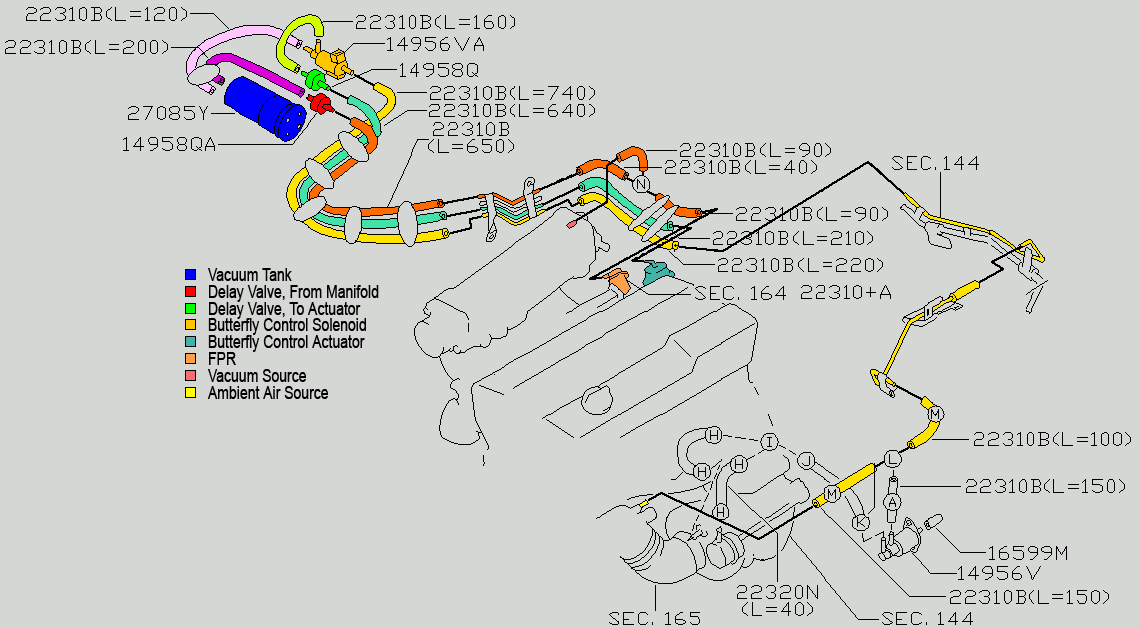

A note on above image: The uncolorized stuff in the bottom right with another solenoid and a few hoses I left in as it is connected to the same ambient source, but not highlighted as it is unrelated. This is the stock boost control system, when ECU sees more airflow than it thinks is ok it switches the solenoid to allow wastegate to see real boost, otherwise it sees the ambient pressure in that little cap.


Solenoid energized (on), secondary butterflies closed:
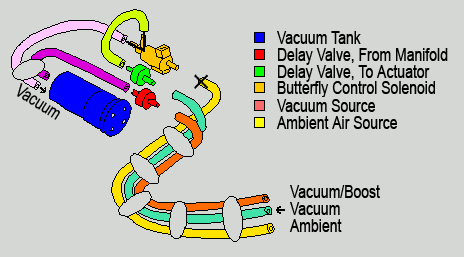

As you can see, it is connecting the butterfly system to the vacuum tank, which provides a vacuum source to pull them closed.

Solenoid de-energized (off), secondary butterflies open:
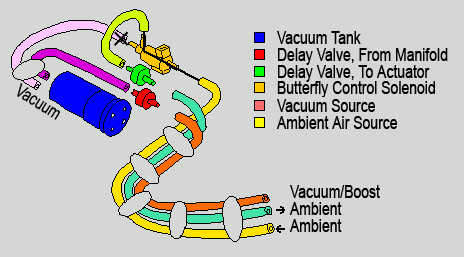
And here they are instead connected to the ambient air source, allowing them to open as they are no longer pulled closed.

Technical Details:
- Part number for solenoid is 14956-35F10 (JDM CA18DET) or 14956-27M00 (USDM CA18DE); partcodes of 14956VA and 14956U respectively
- Part number for vacuum tank is 22372-V6700; in the diagrams partcode is 27085Y (both JDM CA18DET and USDM CA18DE)
- Part number for delay valve, to manifold, is 14958-H9910; in the diagrams partcode is 14958QA (JDM CA18DET) or 14958M (USDM CA18DE)
- Part number for delay valve, to actuator, is 14958-V6700; in the diagrams partcode is 14958Q (both JDM CA18DET and USDM CA18DE)
- Solenoid is ground switched by ECU, pin 8 on the ECU. This means one wire to pin 8 on ECU and one to power (12V).
- Vacuum tank and both delay valves can be had from CA18DE equipped Pulsars.
- Both the above listed JDM CA18DET and US CA18DE solenoids are functionally identical, but are slightly different due to dimensions and mounting, hence different part numbers. Any solenoid will work as long as you connect it properly and it has 3 ports, A, B, Common, in a configuration such that when de-energized ports A and Common are connected, and when energized B and Common are connected. physical positioning of ports does not matter.

*NEW* 04/04/2008
Method 3: Cutting out the middle men

Quite a few Volvo, Volkswagon, etc cars from the mid to early '90's had a vacuum operated cruise control system. With this system, they had a vacuum pump with built in release solenoid. I have just slapped one of these in, and it awesomely simplifies things without sacrificing anything.

They look like this:
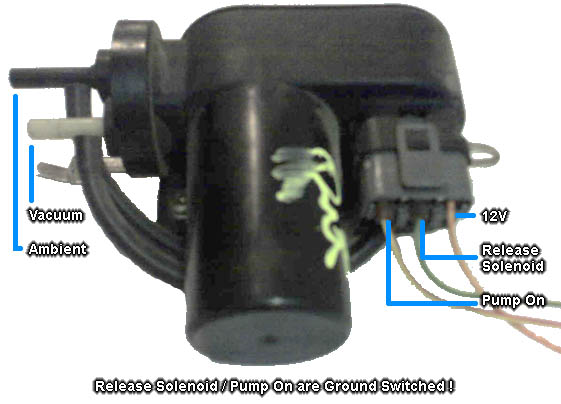
I pulled this one off a Volvo wagon of some sort, didn't think to check what model. If you see that it has cruise control, follow the second throttle cable to the diaphragm, and from there follow the vacuum tube and you'll find this puppy.

As I have noted in the image above, there's three wires on their harness connection, which are for 12V, ground switched release solenoid, and ground switched pump engagement.

Connecting this in lieu of the standard junk isn't too difficult. You'll need to slap a SPDT relay inbetween the ECU and the pump as follows:
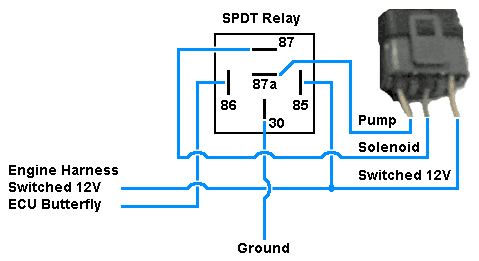
SPDT Relay:
Terminal 85 (or 86) - Switched 12V from engine harness
Terminal 86 (or 85) - ECU butterfly control switched ground
Terminal 30 - Ground
Terminal 87 - Release Solenoid
Terminal 87a - Pump On

Vacuum Pump:
12V input - Switched 12V from engine harness
Release Solenoid

Note that for relay terminals 85 & 86, the orientation 12V vs ECU doesn't matter unless your relay wiring includes a protection diode, which you don't really need anyways since the ECU is built to drive a solenoid with that wire anyways. If you do have a diode (for example, bought a relay boss with it built in) then make sure whichever side of the coil / diode that has the line on it marking the cathode is connected to the switched 12V, and the other side is connected to the ECU.

Finally, run your vacuum line from your pump (white connection, black is the atmospheric vent) to your butterfly actuator (via delay valve if you wish to keep the OEM smoothness). Now cap off or remove all the vestigial bits from however you had it setup before.

I'd have to say now method 3 is the way to go, it is both very simple to setup and very functional.

Alternative Methods
If using some form of standalone or other gizmo letting you use MAP instead of MAF sensing, you could modify the "correct" method where it would normally dump the vacuum through the solenoid to the intake post-MAF, pre-turbo piping. You could just let this vent out (might want to put a small filter on it) instead, since the MAP will cover for any variances due to the "leak" effect. This will at least remove one run of vacuum connections.

Another possibility (one which I've toyed with "on paper" but haven't had the time/energy to pursue) is replacing the actuator with a servo or stepper motor, which is then controlled via a microcontroller of some kind. Many variations on this theme could be done, such as merely full open/close in response to an on/off switch a la stock ECU, or precise degree open/close controlled via a standalone. One would presumably install limit switches and something that rotates with the rod driving the butterflies to trigger them, so that you can shut down the motor when you hit full open/close, rather than keep sinking current into it for no purpose at all.

Keywords: butterflies butterfly secondary secondaries vacuum check delay boost valve actuator

Modified by biosehnsucht at 6:30 PM 4/4/2008


89 240SX Red Fastback beater Car Status
ks13

Offline

883 posts
89 Silvia K's
Southern NH
9-3-2006

 « Re: CA18DET Secondary Butterflies Control System (biosehnsucht)


awsome write up man, and it couldnt have come at a better time!


LongGrain

Offline

52 posts
a piece of junk
Omro WI
10-27-2006

 « Re: CA18DET Secondary Butterflies Control System (ks13)


great writeup, i was thinking about not hooking mine up at all, so they were just always open, but now i know not to do that, thanks :D
float_6969
Moderator


Offline

11425 posts
1995 Nissan 240sx
Topeka Kansas
8-26-2002

 « Re: CA18DET Secondary Butterflies Control System (LongGrain)


Thanks Soooo much for the writeup! I'll get this linked in the stickies and see if we can't get you a little compensation for your troubles. Keep an eye out for an email from one of the administrators/super moderators/article guys.


After a long break, Project CA S14 is revived! Check it out NOW!
niscort

Offline

112 posts

1-3-2004

 « 


- Part number for delay valve, to manifold, is 14958-H9910; in the diagrams partcode is 14958QA (JDM CA18DET) or 14958M (USDM CA18DE)

this is actually a one way valve.. not a delay valve


"so everyone says they are going to make cnc machine plug covers. blah blah. never happens.."
irony much?
Bwana
Super Moderator


Offline

5672 posts
'89 240 coupe RB25DET '77 MGB CA18DET
Fort Collins CO
9-16-2004

 « Re: (niscort)


Writeup has been articlized! There's a missing link in the middle of it, if you can get that to me I'll add it into the article, if not I'll just remove it. Let me know what you want for a custom title and I'll get one of the admins on it. Great job btw!


My cars are for sale! Do the right thing and Buy them!!!
MGB Roadster!
240sx Coupe!

biosehnsucht


Offline

1711 posts

Dallas TX
2-27-2004

 « Re: (niscort)


Quote, originally posted by niscort »
- Part number for delay valve, to manifold, is 14958-H9910; in the diagrams partcode is 14958QA (JDM CA18DET) or 14958M (USDM CA18DE)

this is actually a one way valve.. not a delay valve

Well, thats the funny thing. FAST in all regions says its a delay valve .. and the US Pulsar FSM says check valve for both valves, which if that was the case you'd never release the vacuum on the actuator and you'd be up a creek as you'd always run with 4 runners only. And the parts between the two (USDM Pulsar and JDM S13) are the same, so obviously one or both (most likely) are wrong. I have seen items listed as 'check valves' in FAST however, so its not like they call all 'check valves' 'delay valves'.

it would make more sense than dueling delay valves.. however I'm pretty sure my vacuum tank holds a vacuum without it, so.. it may be redundant. At first I had two of the same delay valves as the one after the solenoid, and replacing it with a "correct" part didn't make any discernable difference.

The point of the correct way was using the OEM parts, which if you obtained from a junked Pulsar or bought from Nissan would work fine regardless. I am going to go ahead and put a comment in there that it may in fact be a check valve..

biosehnsucht


Offline

1711 posts

Dallas TX
2-27-2004

 « Re: (Bwana)


Quote, originally posted by Bwana »
Writeup has been articlized! There's a missing link in the middle of it, if you can get that to me I'll add it into the article, if not I'll just remove it. Let me know what you want for a custom title and I'll get one of the admins on it. Great job btw!

wups.. fixing that now.

-edit- fixed.

You can delete our two posts about the link if you want, since they're not technical posts?

iliketocrash


Offline

1066 posts

Medina, OH
5-31-2003

 « 


probably a delay valve and a check valve. cause i've tried blowing through them and you can definitely only blow one way through them but it is definitely harder to blow through than the actual vaccum lines that they connect to. so it does seem that they restrict some flow


"Try to keep the paper from sliding on your hand too much or you'll end up slowly sanding through your skin and bleeding all over the car. Should this happen get the blood off ASAP as it can cause staining and problems with the paint." - BaliLover
My Nico Gallery
Useful ca18det site
niscort

Offline

112 posts

1-3-2004

 « Re: (biosehnsucht)


Quote, originally posted by biosehnsucht »

Well, thats the funny thing. FAST in all regions says its a delay valve .. and the US Pulsar FSM says check valve for both valves, which if that was the case you'd never release the vacuum on the actuator and you'd be up a creek as you'd always run with 4 runners only. And the parts between the two (USDM Pulsar and JDM S13) are the same, so obviously one or both (most likely) are wrong. I have seen items listed as 'check valves' in FAST however, so its not like they call all 'check valves' 'delay valves'.

it would make more sense than dueling delay valves.. however I'm pretty sure my vacuum tank holds a vacuum without it, so.. it may be redundant. At first I had two of the same delay valves as the one after the solenoid, and replacing it with a "correct" part didn't make any discernable difference.

It may be that both are delay valves just for the DE version. The DET definately has a one way valve, at a guess so that the vacuum tank only ever recieves vacuum. Anyhow, this is the image from the JDM FSM which labels it as a one way. Hope it helps


biosehnsucht


Offline

1711 posts

Dallas TX
2-27-2004

 « 


That would make more sense. tho that still means the JDM parts catalog is mislabeling it (not the first time). I had a scan of the JDM FSM tho that said the same thing, but maybe that was just a misprint that was corrected.
themadscientist
RB/Skyline Moderator


Offline

18225 posts
staring down at you with disdain from the
spooky mountaintop castle
11-12-2002

 « Re: (biosehnsucht)


Nice writeup!


bow down or get the nekopunch!

float_6969
Moderator


Offline

11425 posts
1995 Nissan 240sx
Topeka Kansas
8-26-2002

 « Re: (themadscientist)


I tried the part number listed and it's definitely a check valve, not a delay valve.

And as stated, it allows the valves to close, but not open.

The way that I have mine setup is that on the outlet of the solenoid, I have a vac cap with a VERY small hole in it. It took me quite some time to get the opening size right.

The valves still shut quickly, but they open slowly now. It makes the transition from closed to open at the 3750rpm changeover much smoother.

ks13

Offline

883 posts
89 Silvia K's
Southern NH
9-3-2006

 « Re:


wasnt this going in the stickies?

the colored portions of the diagram make reading and understanding much, much easier.

float_6969
Moderator


Offline

11425 posts
1995 Nissan 240sx
Topeka Kansas
8-26-2002

 « Re: Re: (ks13)


It is in the stickies. He wrote this because I asked him to so that I could put it in the stickies.

http://forums.nicoclub.com/zerothread/136061

biosehnsucht


Offline

1711 posts

Dallas TX
2-27-2004

 « 


I rewrote it from scratch, my original even I almost couldn't understand, and I wrote it
Slidejenkins

Offline

5 posts
90 Silvia
Edmonton AB
11-16-2006

 « 


I've been reading thorough this thing at work , pretty brain dead at this point , so please forgive this retarded question... but I dont understand what the set-up offers us ?! getting rid off the valves ?!

or do we want solenoid energized (on), secondary butterflies closed ?!

or (off . butterflies open?)


float_6969
Moderator


Offline

11425 posts
1995 Nissan 240sx
Topeka Kansas
8-26-2002

 « Re: (Slidejenkins)


The point of the valves is to increase low end torque.

solenoid on, valves open.

Darius2250


Offline

91 posts

Auburn,Wa
6-21-2003

 « Re: (float_6969)


Is there a way we can get a actual picture of this set-up I have had 2 CA's and nether one had this set-up hooked up. I can assume that there was some japanese looting of parts on both my clips.. well I can think that at least.
superJoy


Offline

153 posts
1989 240SX
Belton, TX
6-20-2006

 « Re: (Darius2250)


I don't know how much help this actually is, but here's a look at all the components brand new from Nissan:

It mounts on the bracket under the windshield washer motor between the firewall and the passenger side strut tower.

Darius2250


Offline

91 posts

Auburn,Wa
6-21-2003

 « Re: (superJoy)


non of that came on my clip, thanks
nocwage

Offline

280 posts

Milton, Ontario
8-10-2004

 « Re: (superJoy)


Super Joy,
How much did all of that cost? Do you have a price breakdown on those parts??

missionsix43

Offline

166 posts
1989 240sx hatch ca18det
fullerton ca
12-3-2006

 « Re: (nocwage)


The holes in the manifold for the butterfly shaft are small enough to be drilled out with a 1/8" NPT tap drill bit, and tapped to 1/8" npt and use 1/8" npt plugs.


superJoy


Offline

153 posts
1989 240SX
Belton, TX
6-20-2006

 « Re: (nocwage)


Quote, originally posted by nocwage »
Super Joy,
How much did all of that cost? Do you have a price breakdown on those parts??

If I recall correctly... solenoid = $65, valves = $10 each, tank = $20. Well worth it IMO.
The_Chosen_One
NICO Powder Coater


Offline

1193 posts
1990 240sx
Boca Raton FL
10-17-2006

 « 


where did you get it? Are you still able to get more? If I gave you the cash could you get it for me?


Click Image for More Details.


superJoy


Offline

153 posts
1989 240SX
Belton, TX
6-20-2006

 « Re: (The_Chosen_One)


http://www.onlyfactoryparts.com

Just enter the part numbers in there and you're golden. They even have the JDM solenoid listed so you don't have to use the Pulsar one.

dattodude

Offline

385 posts
CA18DET Datsun 1200 B110 Sedan
Sydney OZ
6-29-2005

 « Re: CA18DET Secondary Butterflies Control System (biosehnsucht)


FYI, after some more dyno testing today. I'm using 270/9.25mm cams for both intake and exhaust. I'm running the cams at 7deg in, 2deg ex at the camshaft (14/4 at the crank).

I did a power run with the butterflies 'closed always', and one with them 'open always'. And then figured where they stopped being a benefit. The point was 4800rpm for my configuration. So I set my Autronic SMC to open them at 4800rpm instead of the factory 4000rpm.

My CA18 is pulling 188kW (250hp) at the wheels now at 16psi, I'm running a big turbo, and should be running 20-25psi boost. But the engine is still young.

Hope this adds to the body of knowledge in regards to these much maligned CA18 accessories.

nismoplsr

Offline

344 posts

connecticut
10-19-2003

 « Re: CA18DET Secondary Butterflies Control System (dattodude)


Sweet dude!

Do you have some dyno graphs of each test so we can see the difference? That would be amazing.


CA18DET, HKS, Haltech, TurboXS, K&N, Unorthodox, Spearco, NISMO, Greddy, Cusco
float_6969
Moderator


Offline

11425 posts
1995 Nissan 240sx
Topeka Kansas
8-26-2002

 « 


IIRC somebody claimed a 20% increase in torque down low. They were using big cams and a big turbo as well.

I think the more "race" the setup becomes, the more noticeable the effect of the butterflies.

nocwage

Offline

280 posts

Milton, Ontario
8-10-2004

 « Re: (float_6969)


Quote, originally posted by float_6969 »
IIRC somebody claimed a 20% increase in torque down low. They were using big cams and a big turbo as well.

I think the more "race" the setup becomes, the more noticeable the effect of the butterflies.

I've got proof..
Stock engine, but T3 super-60 turbo

I had the problem where the solenoid was never opening them and discovered it when i dyno'd my car and found the power curve was like an american OHV engine

CLOSED butteflies..

OPEN butterflies..


I lost 20lb-ft of torque pretty much from 2500 all the way to 4000rpm..

That's a BIG loss, and I'm not running anything fancy in the engine itself. If I lost 20lb-ft of torque than anyone with the stock cams lost it too no matter what boost or turbo..

mbmbmb23

Offline

531 posts

Charlotte NC
8-19-2004

 « Re: (superJoy)


Quote, originally posted by superJoy »
I don't know how much help this actually is, but here's a look at all the components brand new from Nissan:

It mounts on the bracket under the windshield washer motor between the firewall and the passenger side strut tower.

Do all pieces mount there or just the tank? Do you have a pic installed?...or a pic of the OEM bracket?

thanks,


-m

dattodude

Offline

385 posts
CA18DET Datsun 1200 B110 Sedan
Sydney OZ
6-29-2005

 « Re: (nocwage)


Good one Nocwage. That's a 'hole in one' for why we should be using these butterflies on engines that operate below 5000 revs :-)

Yeah it was me who touted the 20%. Yours looks closer to 10% but this alone would contribute more to 'feelable' power under 4000rpm than do pod intakes or expensive spark plugs.

Cheers,
Chris

superJoy


Offline

153 posts
1989 240SX
Belton, TX
6-20-2006

 « Re: (mbmbmb23)


Quote, originally posted by mbmbmb23 »

Do all pieces mount there or just the tank? Do you have a pic installed?...or a pic of the OEM bracket?

thanks,


-m

Don't have a picture, but I have this drawing from impactblue.org:

You can see how it sits on the bracket there... It's the same spot the cruise control actuator sits I believe—same bracket. I don't have anything but the bracket (my car had cruise originally) so I'm going to ziptie it all down and call it a day.

slidecrave


Offline

127 posts
AE86, S13 CA coupe
Orlando/Tampa Fl
9-24-2006

 « 


is there anyone who actually has this hooked up the correct way and can possibly provide some pictures of it.. would make it alot easier for me to really see whats going on since i guess i will need to pick one of these up as well since mine is totally missing the system too..


davidricardo86


Offline

503 posts
1992 Nissan 240SX SE
Cicero IL
9-14-2005

 « Re: (slidecrave)


Quote, originally posted by slidecrave »
is there anyone who actually has this hooked up the correct way and can possibly provide some pictures of it.. would make it alot easier for me to really see whats going on since i guess i will need to pick one of these up as well since mine is totally missing the system too..

Dude the pictures are there! Nissan printed the pictures above and thats how theyre suppose to be. Get the parts and install it however is most convienient for you! As if the Nissan Fast and FSM pictures werent enough.... jeez.... got me all worked up...

But wow its great to see the results were seeing from the Nissan Induction Control System (NICS) and this awesome sticky. Keep the info coming!


My CA build-up thread:
http://forums.nicoclub.com/zerothread?id=185406

E-mail:
davidricardo86@yahoo.com

slidecrave


Offline

127 posts
AE86, S13 CA coupe
Orlando/Tampa Fl
9-24-2006

 « 


I'm sorry I must of not made it clear I can see the diagrams and I know thats how its suppose to be.. I was simply curious to to see pics of the actually unit in the car.. Just a request cause in my book actual pic>diagrams sorry if that bugs you but then dont read what I post next time there's no need to get all work up life is too short for that.. Good Day Sir
sip

Offline

966 posts
1989 Nissan 180SX
Halifax Nova Scotia
8-24-2006

 « Re: CA18DET Secondary Butterflies Control System (biosehnsucht)


Man, i'm glad mine csme with a CA18DET stock so i don't have to understand that color diagram.

I assume mine are working. Is there really any way too tell for sure?

How would a piggyback ECU or a standalone effect this?


Quote, originally posted by My Wife »
What did you do to the car

Quote, originally posted by Me »
Put the coilovers on

Quote, originally posted by My Wife »
It hurts my boobs

Quote, originally posted by Me »
I'll get you a SPORTS BRA!

niscort

Offline

112 posts

1-3-2004

 « 


davidricardo86


Offline

503 posts
1992 Nissan 240SX SE
Cicero IL
9-14-2005

 « Re: (slidecrave)


Nah dude its cool. I was just saying that with the diagrams you should pretty much be able to figure it out.

Well look at that, an actual live picture!

mbmbmb23

Offline

531 posts

Charlotte NC
8-19-2004

 « 


I pulled a bunch of stuff from a pulsar today, both check valves, surge tank, and 4 solenoids. The solenoids are different than the new peice posted above (14956VA), they are like the 14956V units that connect to the yellow diagram hose near the turbo. Anyhow, 4 of these can be sourced under/around the stock airbox. I grabbed these and will go back for the pinch bracket thing that held the tank (it was rivetted to the bracket that holds the charcoal canister to the firewall and I didnt have a drill to drill them out). Once I get this part I'll put it onto a fabbed peice that will bolt to the strut tower.

Anyhow, anyone know which plug on the harness connects to this solenoid? Is it on the upper or lower harness?

thanks,


-Matt

 First  1 2 >  Last

» Return to CA18DE / CA18DET Forum
Forum Jump