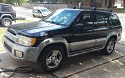
I can't get these damn things off. I tried hooking a ratchet strap to my breaker bar, but it won't budge and I've started stripping the nut. Does anyone have any tips?
I don't want to cut it and spend a ton of money on new bolts, but it looks like I might have to.

'01 QX4 Upper Control Arm Bolts?
-
mdmellott
- Posts: 1269
- Joined: Mon Sep 02, 2019 3:32 pm
- Car: '13 Kia Soul+ 2.0L AT
'02 Pathfinder SE 3.5L AT P/4WD - Location: SF Bay Area, CA
Re: '01 QX4 Upper Control Arm Bolts?
Using a six-point socket will prevent stripping the nut. Twelve-point sockets give you more rotational angle approaches for engaging a breaker bar put they tend to strip nuts when the nuts are badly seized and rusted onto the bolts. An 18" breaker bar is barely long enough to get the torque you need to break these rusted nuts free. A 24" breaker bar would be work better. Using PB Blaster on these nuts, and letting them soak long enough for this penetrant to dissolve the rust, will help free the nuts easier. Once the nut is removed, the nightmare may not be over if the bolt is seized and rusted into the bushing sleeve. More PB Blaster may help but it's difficult for it to get into the sleeve to do its job. Pounding the bolt out with a hammer, and the nut placed on the end of the bolt to protect the threads, will hopefully prove successful in removing the bolt. If you turn the bolt with a wrench and the bushing sleeve remains locked onto the bolt, breaking free from the rubber and turning with the bolt, your nightmare has just begun and you may end up having to cut through the bushing sleeve and bolt to remove the control arm after all.
-
VStar650CL

- Technical Expert
- Posts: 11928
- Joined: Thu Nov 12, 2020 1:25 pm
- Car: 2013 Nissan Altima 2.5 SL
2004 Nissan Altima 2.5 S
Re: '01 QX4 Upper Control Arm Bolts?
Md is right, 6-point is de rigueur. A combination of torque and impact will often bust fasteners that won't break with torque alone. Put about a 3-foot plumbing pipe over the end of your 18" breaker and have an assistant put moderate force on it while you rap the pipe with a hand sledge. Some impact will also help assure that the sleeve breaks free from the bolt without spinning out. Heat on the nut may also help, but don't directly heat the bolt, that will make the rubber more likely to give up.mdmellott wrote: ↑Sun Sep 19, 2021 9:06 amUsing a six-point socket will prevent stripping the nut. Twelve-point sockets give you more rotational angle approaches for engaging a breaker bar put they tend to strip nuts when the nuts are badly seized and rusted onto the bolts. An 18" breaker bar is barely long enough to get the torque you need to break these rusted nuts free. A 24" breaker bar would be work better.
Re: '01 QX4 Upper Control Arm Bolts?
Yeah I think I need to get some proper penetrating fluid because regular WD-40 doesn't cut it.
I'm looking at Seafoam Deep Creep at the moment because it seems to fare pretty well in test videos I've seen.
I'll probably have to jack the car up higher because there ain't much room for a cheater bar over the breaker bar.
So far 80% of my car maintenance is taking stuff apart only to find I need more tools haha.
Also if I do have to cut it and replace the bolts, do you guys know where I can find some good replacements? I saw a genuine Nissan set (for the upper and lower arms) for $50 on 4x4parts but that just seems crazy. I've heard some people say they just got some nuts and bolts from the hardware store.
I'm looking at Seafoam Deep Creep at the moment because it seems to fare pretty well in test videos I've seen.
I'll probably have to jack the car up higher because there ain't much room for a cheater bar over the breaker bar.
So far 80% of my car maintenance is taking stuff apart only to find I need more tools haha.
Also if I do have to cut it and replace the bolts, do you guys know where I can find some good replacements? I saw a genuine Nissan set (for the upper and lower arms) for $50 on 4x4parts but that just seems crazy. I've heard some people say they just got some nuts and bolts from the hardware store.
-
VStar650CL
- Technical Expert
- Posts: 11928
- Joined: Thu Nov 12, 2020 1:25 pm
- Car: 2013 Nissan Altima 2.5 SL
2004 Nissan Altima 2.5 S
Re: '01 QX4 Upper Control Arm Bolts?
There's always Grainger, Fastenal, or Zoro if you have one of those nearby. They can all pretty much order anything they don't stock. Or on the net, McMaster-Carr stocks every damn thing.
-
mdmellott
- Posts: 1269
- Joined: Mon Sep 02, 2019 3:32 pm
- Car: '13 Kia Soul+ 2.0L AT
'02 Pathfinder SE 3.5L AT P/4WD - Location: SF Bay Area, CA
Re: '01 QX4 Upper Control Arm Bolts?
PB Blaster Penetrating Catalyst works best on rusted bolts. It's not a lubricant. It has one job and that is to penetrate deep into rusted fastener joints and dissolve the rust to free up the connection. I used it once on a seemingly hopeless corroded door lock on my old '91 Pathfinder. Road salt and years of not being able to use the lock with my key, the tumblers and every other piece of the lock became one rusted fossil-like waste case. I removed the lock and soaked it in PB Blaster for at least 4 hours before I was able to get a slight amount of movement in the lock mechanism. Soaking overnight, I was able to completely free up every tiny piece in that lock, take it all apart, clean it up, and it worked for many years afterwards, applying a lubricant when it was all back together to keep it that way.
Re: '01 QX4 Upper Control Arm Bolts?
Yes,Yes,Yes....PB + soak +hit sideways if possible with 5lb sledge and drift punch - repeat every 15 min with a thorough SOAKING and a Rappattapparapp - tatap-tap , loosen up that "Rust belt Crud "
PB BLASTER.......PB BLASTER...................PB BLASTER conjunction with "BLOWS" shocks the rust/whatever and vastly enhances PB's ability to like soften the crud , the hits create like micro-cracks , and then re-soak with the Blaster keeps penetrating more & more & more - so you GOTTA HIT IT TOO to get Optimum results .
Getting a good Airgun impacting 400+ ft/lbs I would give a "Ten" . If you got room!
I get better results being patiently working it & working it - spend a little TIME - let SOAK.
When I've been impatient & overanxious is when I've F 'ed it all up !!!!!!!!!!!!!!
mdmellott correct on the PB.........anything else? TRIX ARE FOR KIDS
PB BLASTER.......PB BLASTER...................PB BLASTER conjunction with "BLOWS" shocks the rust/whatever and vastly enhances PB's ability to like soften the crud , the hits create like micro-cracks , and then re-soak with the Blaster keeps penetrating more & more & more - so you GOTTA HIT IT TOO to get Optimum results .
Getting a good Airgun impacting 400+ ft/lbs I would give a "Ten" . If you got room!
I get better results being patiently working it & working it - spend a little TIME - let SOAK.
When I've been impatient & overanxious is when I've F 'ed it all up !!!!!!!!!!!!!!
mdmellott correct on the PB.........anything else? TRIX ARE FOR KIDS
Re: '01 QX4 Upper Control Arm Bolts?
I digress , go see on youtube " Crank - Trix Are For Kids "
https://www.youtube.com/watch?v=sPh6L058GYc
https://www.youtube.com/watch?v=sPh6L058GYc

Re: '01 QX4 Upper Control Arm Bolts?
Have a drink - on me !
Re: '01 QX4 Upper Control Arm Bolts?
Fosty check out these bolts - they thread themselves ......... @ 11:10
https://www.youtube.com/watch?v=v96LTfmtDPU
Will that do on your re-assemlbly ??
https://www.youtube.com/watch?v=v96LTfmtDPU
Will that do on your re-assemlbly ??
Re: '01 QX4 Upper Control Arm Bolts?
How strong of an impact wrench am I going to need to get these SOBs off?
I just can't get the right angles with a breaker bar.
EDIT: Also any tips on getting this nut off now that I've warped it? It's not rounded, but the top half of it has just twisted because when I was trying the breaker bar, the socket must have shifted off a bit. I'm looking at some nut extractors and this thing here but I'm not too confident in it's abilities.
I just can't get the right angles with a breaker bar.
EDIT: Also any tips on getting this nut off now that I've warped it? It's not rounded, but the top half of it has just twisted because when I was trying the breaker bar, the socket must have shifted off a bit. I'm looking at some nut extractors and this thing here but I'm not too confident in it's abilities.
-
mdmellott
- Posts: 1269
- Joined: Mon Sep 02, 2019 3:32 pm
- Car: '13 Kia Soul+ 2.0L AT
'02 Pathfinder SE 3.5L AT P/4WD - Location: SF Bay Area, CA
Re: '01 QX4 Upper Control Arm Bolts?
400 or 500ft-lb of torque with an impact wrench works on a good day but you're not having a good day. A heavy duty impact wrench with 1000 ft-lb of nut busting torque may be needed if it's not too late due to the damaged nut. I'm not even sure an impact wrench will fit up in the limited space of the forward upper control arm bushings. Driving the rear end up onto automotive ramps gives you more of an angle to work with a breaker bar but those particular forward upper bolts will still be awkward to get the leverage you need.
Don't waste your time and money on that Amazon nut extractor. If the nut is too far gone for a 6-point socket to seat well enough on the nut, a heavy duty nut splitter may be needed or you're back at looking to an angle grinder with a cut wheel to hack through the bushing sleeve and bolt.
Don't waste your time and money on that Amazon nut extractor. If the nut is too far gone for a 6-point socket to seat well enough on the nut, a heavy duty nut splitter may be needed or you're back at looking to an angle grinder with a cut wheel to hack through the bushing sleeve and bolt.
Re: '01 QX4 Upper Control Arm Bolts?
Ah, good idea with the ramps. I'm borrowing a pair right now.
I'm going to attempt to file the nut a bit so the socket can fit back on it, then try hitting it with a torch too.
I will be victorious.
I'm going to attempt to file the nut a bit so the socket can fit back on it, then try hitting it with a torch too.
I will be victorious.
-
The Grand Pooh-Bah

- Posts: 49
- Joined: Fri Nov 22, 2019 6:41 pm
- Car: 2001.5 Infiniti QX4
- Location: Idaho
- Contact:
Re: '01 QX4 Upper Control Arm Bolts?
I had the same problem. I purchased a better air impact 1190 ft. lbs of torque from Harbor Freight. Item 62891. It made short work of all the control arm nuts.
Re: '01 QX4 Upper Control Arm Bolts?
Thanks.The Grand Pooh-Bah wrote: ↑Tue Sep 28, 2021 6:08 pmI had the same problem. I purchased a better air impact 1190 ft. lbs of torque from Harbor Freight. Item 62891. It made short work of all the control arm nuts.
I'm putting the project on hold until I get some more money, but I'll check that out later.