This post is intended to give an overview of how the TPMS works and some general tips on maintenence.
Why TPMS?The US government mandated the use of TPMS on vehicles as part of the TREAD act. The act was created in repsonse to the Firestone tire tread seperation issue of the late 90's which partly blames underinflated tires as the cause of blowouts. All passenger vehicles under 10,000lbs gross weight produced after Sept 2007 are required to have the system.
Canada: Although the TREAD act does not apply to Canadians, many of our vehicles have TPMS systems just the same.
What does it do?Each wheel has a pressure sensor and transmitter located inside which is connected to the valve stem. The system monitors the pressure of the tires (some cars monitor the spare tire as well... the Rogue does not have this) and provides the driver a warning if any tire is underinflated. In the Rogue, the alarm threshold is 26psi and the vehicle must be travelling more than 16mph (25 km/h) before the pressure is checked.
Special Precautions:- DO NOT use tire puncture sealant as it could damage the sensor.- Removal of the OEM tires can damage the sensor. The sensor must be removed prior to dismounting the tire from the rim. There is a specific procedure for doing this and the dealer and tire shops familiar with TPMS systems should be able to do it properly.
The low tire pressure warning light in ON:- Check the tire pressure using an accurate tire gauge and ensure they are inflated as per the sticker on the drivers side door jamb. The warning light should clear after driving for 5 min above 16mph (25km/h).
- If the outdoor air temperature drops suddenly, the tire pressure will drop and may trigger the TPMS. Re-adjust the tire pressures.
The low tire pressure warning light blinks for one minute then stays ON:
- If you substitite the OEM tires for aftermarket wheels or sometimes even the spare tire, you will get the low tire pressure warning light. The vehicle performance should not be affected while the light is ON, assuming you don't have a flat tire. The light will go off once the OEM tires are installed and after driving for 5 min above 16mph (25km/h).
- It is possible there is a malfunction in the system. Time to book a service appt with the dealer to check things out.
Can I install sensors on my new wheels?
Yes. New sensors can be purchased from Nissan and some aftermarket tire/wheel dealers. Cost is approx $80-100 USD each. You can also swap the sensors from the OEM wheels. Read special precautions above about sensor removal. Not all wheels will accept the sensors. Some aftermarket wheels may be labelled 'TPMS ready', but you will have to verify the sensor will properly fit. New sensors will have to be registered with the vehicle's computer to clear the TPMS light. This can only be done by a Nissan dealer.
What about tire rotation?Tire rotation should not affect the sensors. Worst case, you will get the blinking TPMS and may have to make a trip to the dealer to clear the code.
Reading TPMS codes and clearing themThere is a simple procedure to perform a self diagnostic and clear the codes.
1) Turn IGN switch to ON.2) Locate the TPMS warning check connector. It is a single loose wire with a connector located under the dash next to the steering column. It may be bundled with the OBDII diagnostic connector. 3) Using a suitable piece of bare wire inserted into the connector (a paperclip will do), momentarily ground the wire to the chassis.
NOTE: If you are uncomfortable doing this, then don't. You could damage your vehicle if the wrong wire is grounded.
4) The TPMS low tire pressure warning light will blink error codes as follows:
5sec. ON - 5sec. OFFLong (1 sec) blink = First digit (2 blinks = 2)Short (0.2 sec) blink = Second digit (ie 3 short blinks = 3)
There is a 2 second pause between multiple codes.The cycle will keep repeating starting with 5sec. ON
Codes:
15 - Front LH tire pressure drops to 26 psi or less.16 - Front RH tire pressure drops to 26 psi or less.17 - Rear RH tire pressure drops to 26 psi or less.18 - Rear LH tire pressure drops to 26 psi or less.21 - Data from front LH transmitter can not be receive.22 - Data from front RH transmitter can not be receive.23 - Data from Rear RH transmitter can not be receive.24 - Data from Rear LH transmitter can not be receive.31 - Checksum data from front LH transmitter is malfunctioning.32 - Checksum data from front RH transmitter is malfunctioning.33 - Checksum data from rear RH transmitter is malfunctioning.34 - Checksum data from rear RH transmitter is malfunctioning.
5 short blinks - System is OK.
5) To clear the codes, turn the ignition OFF.
6) Drive 5 min above 16mph (25km/h) to see if the problem reoccurs.
This procedure does not guarantee you won't get the blinking TPMS warning again. If the problem reoccurs, the warning light will turn back ON.

FAQ - Tire Pressure Monitoring System (TPMS)
-
philipa_240sx
- Posts: 3808
- Joined: Thu Jun 21, 2007 7:30 am
- Location: Canada
Re: FAQ - Tire Pressure Monitoring System (philipa_240sx)
On the Subaru Forrester, if there is a 1/4 inch difference in diameter of any tire, the AWD transmission may be severely damaged by driving. That much difference could result from a tire being even slightly low and having a little more wear. In the Rogue's owner's manual, there is a warning about different diameters, but there is no specific amount of difference stated. Does anyone know how much difference would damage a Rogue's transmission? After hearing about this problem in the Subaru, I can't see myself ever considering a Subaru.
Thanks,
Bill
Thanks,
Bill
-
philipa_240sx
- Posts: 3808
- Joined: Thu Jun 21, 2007 7:30 am
- Location: Canada
Re: FAQ - Tire Pressure Monitoring System (wftright)
The tire diameter issue raises an interesting question. I will look into it.
-
roguester
- Posts: 97
- Joined: Tue May 20, 2008 12:52 pm
- Car: 08 Nissan Rogue SL AWD
06 Nissan Altima S 2.5 Special
Re: FAQ - Tire Pressure Monitoring System (philipa_240sx)
Excellent info!So is the sensor is on the rim or part of the valve?My plan is to remove the factory alloys and tires in the winter and intall steel rims and snow tires for the winter.Can this sensors be intalled on the steel rims? what would be the best option.
-
philipa_240sx
- Posts: 3808
- Joined: Thu Jun 21, 2007 7:30 am
- Location: Canada
Re: FAQ - Tire Pressure Monitoring System (roguester)
It's part of the valve.roguester wrote:Excellent info!So is the sensor is on the rim or part of the valve?
Alloy rims seem to present the biggest problem as sometime the TPMS sensor will not fit. Steel rims should have fewer issues if at all.roguester wrote:My plan is to remove the factory alloys and tires in the winter and intall steel rims and snow tires for the winter.Can this sensors be intalled on the steel rims? what would be the best option.
Personally I would just live with the TPMS warning light and run your winter tires & rims without the sensors. It will not cause any harm or damage to the vehicle. The sensors themselves are quite pricey... over $100 each. Then you will have to get a Nissan dealer to re-register them with the TPMS computer every time you change your tires. Not very convenient or cheap.
Re: FAQ - Tire Pressure Monitoring System (philipa_240sx)
I got a flat this weekend. The light never came on. I guess I pulled over and turn off the car before it hit 33 PSI. I changed out the flat and put in the spare. I assume the light would come on then but didn't. When the garage guy was patching the flat, i saw a yellow thing inside the wheel. Is that the TPMS?
-
philipa_240sx
- Posts: 3808
- Joined: Thu Jun 21, 2007 7:30 am
- Location: Canada
Re: FAQ - Tire Pressure Monitoring System (AznJohn22)
This is what a typical TPMS sensor looks like. Color and size may vary:
Image courtesy Schrader Bridgeport
Image courtesy Schrader Bridgeport
Re: FAQ - Tire Pressure Monitoring System (philipa_240sx)
It was yellow instead of brown. how is the system connect with the car?philipa_240sx wrote:This is what a typical TPMS sensor looks like. Color and size may vary:
Image courtesy Schrader Bridgeport
-
philipa_240sx
- Posts: 3808
- Joined: Thu Jun 21, 2007 7:30 am
- Location: Canada
Re: FAQ - Tire Pressure Monitoring System (AznJohn22)
No TPMS light? There might be a few reasons for this:
- You did not travel far enough (>5min on the flat) or were going too slowly (<16 mph).
- The TPMS sensor signal can be picked up anywhere in and around the car... including the hatch area. This means a flat tire that's partially inflated to above above the 26psi threshold can be put in the hatch area and the spare tire swapped on and you would not get the TPMS warning light.
- You did not travel far enough (>5min on the flat) or were going too slowly (<16 mph).
- The TPMS sensor signal can be picked up anywhere in and around the car... including the hatch area. This means a flat tire that's partially inflated to above above the 26psi threshold can be put in the hatch area and the spare tire swapped on and you would not get the TPMS warning light.
-
roguester
- Posts: 97
- Joined: Tue May 20, 2008 12:52 pm
- Car: 08 Nissan Rogue SL AWD
06 Nissan Altima S 2.5 Special
Re: FAQ - Tire Pressure Monitoring System (AznJohn22)
Are tire specialty shops able to reset the tpms sensors?
-
philipa_240sx
- Posts: 3808
- Joined: Thu Jun 21, 2007 7:30 am
- Location: Canada
Re: FAQ - Tire Pressure Monitoring System (AznJohn22)
It's a wireless system using radio frequencies (433 MHz) to transmit tire pressure reading to the TPMS monitoring system in the car. The TPMS sensors are digitally coded (a serial number of sorts) so 2 cars driving next to each other do not pick up the wrong TPMS sensor reading. The TPMS sensor contains a battery and should be good for as long as 7 to 10 years depending on mileage. Why? The TPMS sensor has a battery saving mode that only activates once the wheel in spinning. If you drive alot, the batteries will die sooner.AznJohn22 wrote:
It was yellow instead of brown. how is the system connect with the car?
Quote »Are tire specialty shops able to reset the tpms sensors?[/quote]
Read my first post. The self diagnoses mode can be activated by simply jumpering a connector. Once the diagnoses is complete and the ignition switch is turned OFF, it will clear any TPMS error codes. Any shop familiar with this procedure should be able to do it... no special tools required.
Replacement (damaged sensor replacement, etc) of the sensors can only be done by the dealer using the CONSULT diagnostic tool. There is no other other method.
-
jk47
- Posts: 40
- Joined: Sat Jul 26, 2008 11:35 am
- Car: 2010 Nissan Rogue SL AWD
Previous: 2008 Nissan Rogue S AWD
I had my first experience with TPMS, one day afrer I got the car.
When I was driving to work the next day the TPMS warning light came on. I checked the tires and the rear-right tire had 16psi! After checking the tire I saw the screw head in between the treads.
The car didn't seem to be driving differently, if not for the warning light I might not have noticed until it was too late...
When I was driving to work the next day the TPMS warning light came on. I checked the tires and the rear-right tire had 16psi! After checking the tire I saw the screw head in between the treads.
The car didn't seem to be driving differently, if not for the warning light I might not have noticed until it was too late...
-
EddNog
- Posts: 349
- Joined: Sat Oct 27, 2007 10:54 am
- Car: 2008 Nissan Rogue SL AWD
- Location: Cherry Hill, NJ
Re: FAQ - Tire Pressure Monitoring System (philipa_240sx)
If your air pressure is too different across two corners, the VDC and slip warning lights will light up together and stay lit after a few minutes of driving the car. The only way to fix this is to even the pressure across all four corners. I know this from experience while experimenting with different pressure across corners. As soon as I shut the car off, equalized all four tires to 38PSI and restarted, the warning lamps never did this again. I believe the VDC will disable itself grip is not close to equal across the four corners.philipa_240sx wrote:The tire diameter issue raises an interesting question. I will look into it.
-Ed

Re: FAQ - Tire Pressure Monitoring System (philipa_240sx)
Hey Phillipa I have question for you. Is there any way maybe to ground this system or bypass so it won't check the pressure in tires? I'm planning to get aftermarket wheels and I know I wont have any sensors plus for the winter I like to lower the pressure in tires and I don't want to see a light on a dashboard that gonna bother me.
-
philipa_240sx
- Posts: 3808
- Joined: Thu Jun 21, 2007 7:30 am
- Location: Canada
Re: FAQ - Tire Pressure Monitoring System (Leo2005)
Unfortunately no. There is no way to byass the system by grounding a wire, pulling a fuse, etc.Leo2005 wrote:Hey Phillipa I have question for you. Is there any way maybe to ground this system or bypass so it won't check the pressure in tires?
Either live with the light or cover it up with a piece of black electrical tape.
Re: FAQ - Tire Pressure Monitoring System (philipa_240sx)
thats funny. reminded me Simpsons with check engine light. I guess ill just take out the bulb.

Re: FAQ - Tire Pressure Monitoring System (philipa_240sx)
Nice info..
Now the big question..
Part numbers for Rogue TPMS and which Nissan units are cross compatible?
Now the big question..
Part numbers for Rogue TPMS and which Nissan units are cross compatible?
-
philipa_240sx
- Posts: 3808
- Joined: Thu Jun 21, 2007 7:30 am
- Location: Canada
Re: FAQ - Tire Pressure Monitoring System (mstrmstr)
Most of Infiniti/Nissan TPMS sensors should be compatible. Each sensor is uniquely coded and the Rogue's TPMS system can only 'remember' 4 sensors at a time. The TPMS system can only be reprogrammed by the dealer so you will have to schedule a service visit every time you swap wheels/tires. Figure on a $100 service charge. Unfortunately there is no DIY method of reprogramming.
By the time you buy 4 TPMS sensors at over $100 per wheel plus the $100 reprogramming twice per year, is it really worth it? I don't have that kind of money to burn... thus I am sticking with $0.99 roll of electrical tape!
By the time you buy 4 TPMS sensors at over $100 per wheel plus the $100 reprogramming twice per year, is it really worth it? I don't have that kind of money to burn... thus I am sticking with $0.99 roll of electrical tape!
Re: FAQ - Tire Pressure Monitoring System (philipa_240sx)
Shouldn't be 5 sensors at one time? Since the spare tire has a sensor and the seller told me that I was monitored too.
That really a bad engineering from Nissan not to leave some space in the memory to be able to add a winter tires set a some lines of software to say that as long as 5 of these 10 tire sensors listed in the memory are received and in range, everything is ok.
That really a bad engineering from Nissan not to leave some space in the memory to be able to add a winter tires set a some lines of software to say that as long as 5 of these 10 tire sensors listed in the memory are received and in range, everything is ok.
-
philipa_240sx
- Posts: 3808
- Joined: Thu Jun 21, 2007 7:30 am
- Location: Canada
Re: FAQ - Tire Pressure Monitoring System (Pescakl1)
There is NO sensor on the spare tire. The seller is wrong.Pescakl1 wrote:Shouldn't be 5 sensors at one time? Since the spare tire has a sensor and the seller told me that I was monitored too.
It would be nice to have 8 or more sensors programmed into the system. But I suspect TPMS system operation is tightly regulated by the laws in the US it just may not be possible.
What Nissan could have done, is provide an easier method to reprogram the TPMS sensors that does not require Nissan's CONSULT diagnostic tool. A simple ignition key on/off sequence, or a jumper like I mention in my first post.
-
Venom_Rogue
- Posts: 53
- Joined: Sat May 31, 2008 12:08 pm
- Car: 2008 Nissan Rogue
Re: FAQ - Tire Pressure Monitoring System (philipa_240sx)
Ive got an issue with my TPMS sensor.
The light stays on even though all the pressures are okay in the tires.
Ive located the connector and grounded it to the steering column and the light just keeps blinking repeatedly with no pattern, no pauses or stops.
I proceeded to start the car and drive around and the light just continuously flashes in the same manner.
Once I turn off the engine and restart light stays solid again.
Am I doing something wrong?
The light stays on even though all the pressures are okay in the tires.
Ive located the connector and grounded it to the steering column and the light just keeps blinking repeatedly with no pattern, no pauses or stops.
I proceeded to start the car and drive around and the light just continuously flashes in the same manner.
Once I turn off the engine and restart light stays solid again.
Am I doing something wrong?
-
roguester
- Posts: 97
- Joined: Tue May 20, 2008 12:52 pm
- Car: 08 Nissan Rogue SL AWD
06 Nissan Altima S 2.5 Special
Re: FAQ - Tire Pressure Monitoring System (mstrmstr)
Has anyone figured how to remove the instrument cluster to access and remove the tpms bulbpls post if you know how tomstrmstr wrote:Nice info..
Now the big question..
Part numbers for Rogue TPMS and which Nissan units are cross compatible?
Re: FAQ - Tire Pressure Monitoring System (roguester)
lol. open fsb and find those 2 screws at the bottom. I'll stay with Phillipa's idea about electrical tape:)
-
Harveyeyes
- Posts: 22
- Joined: Mon Sep 24, 2007 11:23 am
- Car: 2008 Nissan Rogue SL AWD - Wicked Black/Grey Leather
Re: FAQ - Tire Pressure Monitoring System (philipa_240sx)
Here is something that I thought was interesting:
My TPM light came on one day, so I checked the pressure and measured ~29 in each tire after I had been driving for a few minutes, so I went and filled each to 33, but the light didnt go off. Due to temp changes lately, I thought I would remeasure the next morning, and had ~31 this time, so I went back and again filled to 33, but the light was still on after driving around town.
I called my dealer and told them the issue - they said it was happening a lot, and to inflate between 34-36 and see if that worked. So i inflated each to about 34.5, and it worked, the light went off.
So 33 on the door doesnt seem to be quite right for that monitoring system, and they never were down to 26 for the light to even come on. I think some adjustments need to be made to those numbers.
My TPM light came on one day, so I checked the pressure and measured ~29 in each tire after I had been driving for a few minutes, so I went and filled each to 33, but the light didnt go off. Due to temp changes lately, I thought I would remeasure the next morning, and had ~31 this time, so I went back and again filled to 33, but the light was still on after driving around town.
I called my dealer and told them the issue - they said it was happening a lot, and to inflate between 34-36 and see if that worked. So i inflated each to about 34.5, and it worked, the light went off.
So 33 on the door doesnt seem to be quite right for that monitoring system, and they never were down to 26 for the light to even come on. I think some adjustments need to be made to those numbers.
-
ChicagoRogue
- Posts: 1
- Joined: Tue Sep 30, 2008 5:06 pm
- Car: 2008 Nissan Rogue
My TPMS warning light came on tonight as I was backing out of my parking spot at work. I was a little confused, since I hadn't even come close to hitting the 16mph threshold. I pulled over and checked the pressure and I was running about 32-34 in each tire. So I turned the car on again and drove home, hoping it was a hiccup and would turn off. It didn't. Once I got home I let the car sit for a bit then went back out to check the pressure. Still about 32-34 in all four tires. I put a little more air into each one, just to see if that did anything... still stayed on even after driving it around for 5 minutes at about 30mph. So now I'm wondering what the problem is.
The temperature has dropped about 25 degrees Farenheit in the last couple of days, but I wouldn't think rapidly enough to make a different. We went from about lower 80s a couple days ago to upper 50s today. But could that be the problem?
I guess my biggest concern now is that I have to drive a decent amount for a work meeting tomorrow, should I get the tires inspected first? It's been about six hours since I first checked and the pressure hasn't gone down in any tire and a visual inspection didn't turn up anything obvious.
The temperature has dropped about 25 degrees Farenheit in the last couple of days, but I wouldn't think rapidly enough to make a different. We went from about lower 80s a couple days ago to upper 50s today. But could that be the problem?
I guess my biggest concern now is that I have to drive a decent amount for a work meeting tomorrow, should I get the tires inspected first? It's been about six hours since I first checked and the pressure hasn't gone down in any tire and a visual inspection didn't turn up anything obvious.
Re: (ChicagoRogue)
Regardless of the reason, your dealer needs to make a incident/repair ticket.
The single case of TPMS failure at my dealer was one bad sensor. You may get lucky and just need the sensors re paired (not repaired..like paired)
If you have no real pressure changes it should be safe enough to get where you need to go- just keep a eye on the tires. Before electronic TPMS you were the monitoring system..
The single case of TPMS failure at my dealer was one bad sensor. You may get lucky and just need the sensors re paired (not repaired..like paired)
If you have no real pressure changes it should be safe enough to get where you need to go- just keep a eye on the tires. Before electronic TPMS you were the monitoring system..
-
philipa_240sx
- Posts: 3808
- Joined: Thu Jun 21, 2007 7:30 am
- Location: Canada
Re: (mstrmstr)
Update Dec 8, 2008:
Nissan Technical Bulletin NTB08-033 regarding the TPMS system and it's operation:
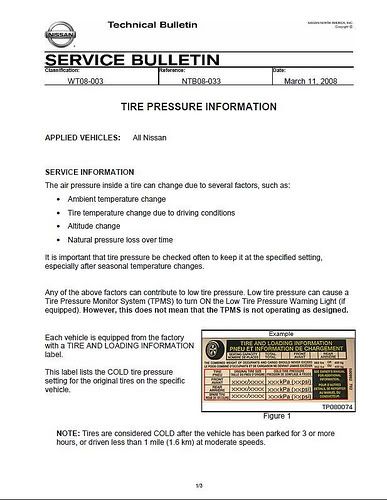
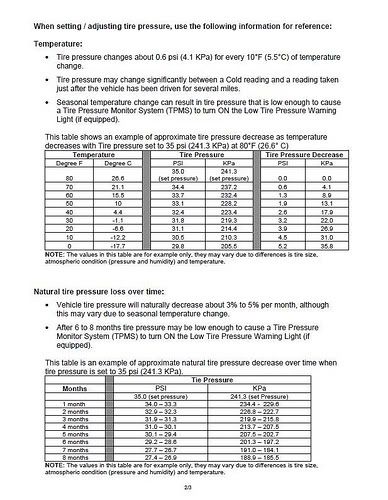
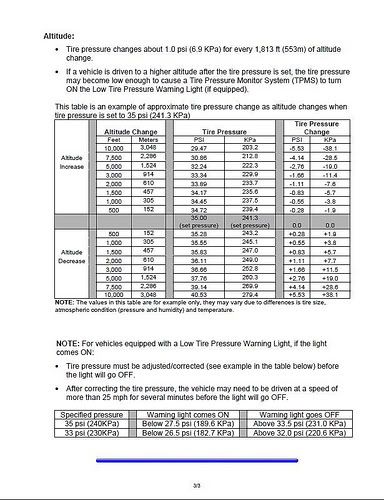
Nissan Technical Bulletin NTB08-033 regarding the TPMS system and it's operation:
-
philipa_240sx
- Posts: 3808
- Joined: Thu Jun 21, 2007 7:30 am
- Location: Canada
Re: (philipa_240sx)
The TPMS trigger point is 26.5psi. You need to raise the tire pressure above 32 psi and drive at speeds above 25mph for several minutes for it to turn off. This is different from the owners manual which indicates 16mph.
Notes about altitude:
The TPMS system measures pressure relative to sea level. Most tire pressure gauges measure relative to the ambient air pressure outside the tire. Ambient air pressure decreases 1psi for every 1,800ft above sea level so you may have to compensate your hand held tire pressure gauge to match the TPMS sensor.
ie. at 1800ft above sea level, you will need to inflate the tire 33 psi instead of 32 psi for the TPMS warning light to turn off.
Notes about altitude:
The TPMS system measures pressure relative to sea level. Most tire pressure gauges measure relative to the ambient air pressure outside the tire. Ambient air pressure decreases 1psi for every 1,800ft above sea level so you may have to compensate your hand held tire pressure gauge to match the TPMS sensor.
ie. at 1800ft above sea level, you will need to inflate the tire 33 psi instead of 32 psi for the TPMS warning light to turn off.
-
roguester
- Posts: 97
- Joined: Tue May 20, 2008 12:52 pm
- Car: 08 Nissan Rogue SL AWD
06 Nissan Altima S 2.5 Special
Re: FAQ - Tire Pressure Monitoring System (philipa_240sx)
Summer/all season tire switchover is upon us has anyone tried this re-setting procedurephilipa_240sx wrote:This post is intended to give an overview of how the TPMS works and some general tips on maintenence.
Why TPMS?The US government mandated the use of TPMS on vehicles as part of the TREAD act. The act was created in repsonse to the Firestone tire tread seperation issue of the late 90's which partly blames underinflated tires as the cause of blowouts. All passenger vehicles under 10,000lbs gross weight produced after Sept 2007 are required to have the system.
Canada: Although the TREAD act does not apply to Canadians, many of our vehicles have TPMS systems just the same.
What does it do?Each wheel has a pressure sensor and transmitter located inside which is connected to the valve stem. The system monitors the pressure of the tires (some cars monitor the spare tire as well... the Rogue does not have this) and provides the driver a warning if any tire is underinflated. In the Rogue, the alarm threshold is 26psi and the vehicle must be travelling more than 16mph (25 km/h) before the pressure is checked.
Special Precautions:- DO NOT use tire puncture sealant as it could damage the sensor.- Removal of the OEM tires can damage the sensor. The sensor must be removed prior to dismounting the tire from the rim. There is a specific procedure for doing this and the dealer and tire shops familiar with TPMS systems should be able to do it properly.
The low tire pressure warning light in ON:- Check the tire pressure using an accurate tire gauge and ensure they are inflated as per the sticker on the drivers side door jamb. The warning light should clear after driving for 5 min above 16mph (25km/h).
- If the outdoor air temperature drops suddenly, the tire pressure will drop and may trigger the TPMS. Re-adjust the tire pressures.
The low tire pressure warning light blinks for one minute then stays ON:
- If you substitite the OEM tires for aftermarket wheels or sometimes even the spare tire, you will get the low tire pressure warning light. The vehicle performance should not be affected while the light is ON, assuming you don't have a flat tire. The light will go off once the OEM tires are installed and after driving for 5 min above 16mph (25km/h).
- It is possible there is a malfunction in the system. Time to book a service appt with the dealer to check things out.
Can I install sensors on my new wheels?
Yes. New sensors can be purchased from Nissan and some aftermarket tire/wheel dealers. Cost is approx $80-100 USD each. You can also swap the sensors from the OEM wheels. Read special precautions above about sensor removal. Not all wheels will accept the sensors. Some aftermarket wheels may be labelled 'TPMS ready', but you will have to verify the sensor will properly fit. New sensors will have to be registered with the vehicle's computer to clear the TPMS light. This can only be done by a Nissan dealer.
What about tire rotation?Tire rotation should not affect the sensors. Worst case, you will get the blinking TPMS and may have to make a trip to the dealer to clear the code.
Reading TPMS codes and clearing themThere is a simple procedure to perform a self diagnostic and clear the codes.
1) Turn IGN switch to ON.2) Locate the TPMS warning check connector. It is a single loose wire with a connector located under the dash next to the steering column. It may be bundled with the OBDII diagnostic connector. 3) Using a suitable piece of bare wire inserted into the connector (a paperclip will do), momentarily ground the wire to the chassis.
NOTE: If you are uncomfortable doing this, then don't. You could damage your vehicle if the wrong wire is grounded.
4) The TPMS low tire pressure warning light will blink error codes as follows:
5sec. ON - 5sec. OFFLong (1 sec) blink = First digit (2 blinks = 2)Short (0.2 sec) blink = Second digit (ie 3 short blinks = 3)
There is a 2 second pause between multiple codes.The cycle will keep repeating starting with 5sec. ON
Codes:
15 - Front LH tire pressure drops to 26 psi or less.16 - Front RH tire pressure drops to 26 psi or less.17 - Rear RH tire pressure drops to 26 psi or less.18 - Rear LH tire pressure drops to 26 psi or less.21 - Data from front LH transmitter can not be receive.22 - Data from front RH transmitter can not be receive.23 - Data from Rear RH transmitter can not be receive.24 - Data from Rear LH transmitter can not be receive.31 - Checksum data from front LH transmitter is malfunctioning.32 - Checksum data from front RH transmitter is malfunctioning.33 - Checksum data from rear RH transmitter is malfunctioning.34 - Checksum data from rear RH transmitter is malfunctioning.
5 short blinks - System is OK.
5) To clear the codes, turn the ignition OFF.
6) Drive 5 min above 16mph (25km/h) to see if the problem reoccurs.
This procedure does not guarantee you won't get the blinking TPMS warning again. If the problem reoccurs, the warning light will turn back ON.